


Welcome to CONVERGER, a biweekly newsletter mapping the content singularity where AI and the internet collapse all media into one—a connective node where emerging technology, policy, culture, futures thinking and storytelling intersect.
Converger presents news and views from an AI, internet and media policy expert who is pro-innovation but anti-hype, allergic to both AI panic and AI boosterism, and passionate about supporting rather than supplanting human creativity with new technology.
Some issues may be heavier on media commentary, others on AI policy, others on personal passions like sci-fi’s influence on technology (both for good and bad) or the evolving medium and business of comic books in the digital age. You never know what threads might come together in convergence-space!
I’m Kevin Bankston, your host. You can watch me develop newsletter content in real-time on LinkedIn and the social network formerly known as Twitter, and less often on Bluesky and Instagram. You can also look for my more wonkish takes on AI governance at Elicitation, the new Substack from my AI policy day-job colleague Miranda Bogen of the Center for Democracy & Technology’s AI Governance Lab. (Note that my Substack articles don’t necessarily reflect CDT’s positions.)
In this week’s edition, I’m still struggling to winnow down the content for this beast of a newsletter for both your and my sakes: from 8k words in the first edition, to 10k in the second issue, and now back down to 8k for this third one. I’ll keep working on slimming things down in future issues, but I promise: all of the below is GOLD, Jerry, GOLD! And for my law and policy peeps: I know this is a light issue for you guys but look out for a massive AI litigation update next time.
So let’s get to it! And please share with your friends and colleagues if you enjoy! But first, a question:
Will I see you at the AI On The Lot conference in LA this week?
I’m so excited to be flying to LA this week to attend the fourth annual AI on the Lot conference on Wednesday (tomorrow!) and Thursday, hosted this year at Amazon MGM Studios in Culver City.
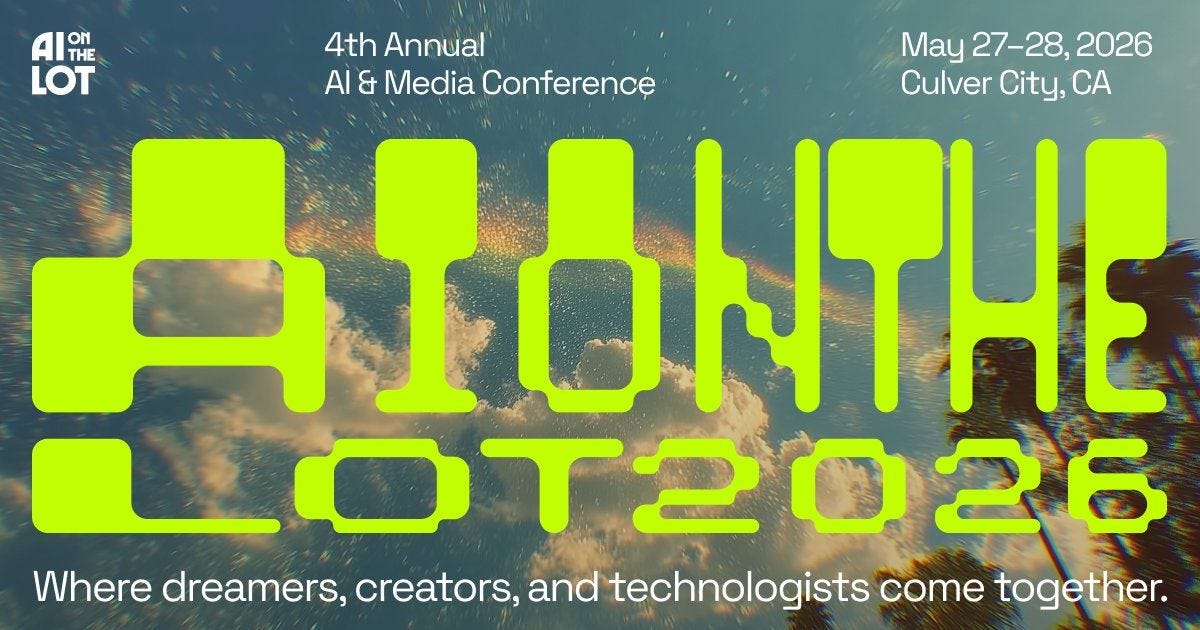
I’ll be there both days, soaking up as much new knowledge and meeting as many new people as possible. So if you’ll be there too, please drop me a line either via Substack DM or at converger@kevinbankston.com! I’ll be writing up my key takeaways from the event in the next issue of Converger.
TABLE OF CONTENTS
FEATURES (>500 words)
The AI Vibe Shift at Cannes Film Festival
Hannah Einbinder Swirlie Watch, Bonus Edition: Who Else is Getting Flushed for Using AI?
The Microdrama Megatrend Intensifies
How I “Engineered Wonder” by Making Comics Books
How (Not) To Integrate AI into Newsrooms, Revisited
FRAGMENTS (<500 words)
YouTube Censorbots Mistake Stop-Motion Grandma for AI Slop
Chinese Models Are Still Eating US Labs’ Lunch on Video Gen
Gemini Omni Flash: Awesome, Awful, or Both?
The YouTubers Taking Over Horror Cinema Are Busting Box Office Records
New Actors’ Union AI Protections Don’t Bring “Significant Additional Value” to Guild Members
Google Search Leans Even Harder Into AI, and the Web Trembles
News Sites Block Internet Archive, Cut Nose Off to Spite Face
No One Wants to Listen to AI Music
Real Monet Mistaken for Artslop
Runway: Video First, Then the World
Startup Founder Fails to Read the Room, Pitches AI Comics to Comics Creators
AI is Learning the Wrong Things From Sci-Fi
Rogue One: The Andor Cut: Now This is The Kind of Remix Culture I Can Get Behind
Netflix Inkubates an AI Animation Studio
A Deep Dive into Gossip Goblin’s AI Filmmaking Process
Skeletor Steals the Sky for Advertising
AI Wins Prestigious Short Fiction Prize, Now No Longer Prestigious
FEATURES
The AI Vibe Shift at Cannes Film Festival
In our first issue last month, I highlighted how comedian and Hacks star Hannah Einbinder went off on AI creators, calling them losers and saying she wanted to stick their heads in a toilet and flush (what any middle-school bully knows as a “swirlie”). I further highlighted the many self-evidently non-loser Hollywood creatives who were risking Hannah’s ire by announcing they were using AI, including A-list directors like Steven Soderbergh and Doug Liman. Then we had to repeat that “Swirlie Watch” segment again in our second issue, because so many more targets dared to admit to their use of, or approval of using, the dread AI. Now, as of our third issue, it seems perhaps that all of Hollywood may need to be on guard when going to the bathroom if Ms. Einbinder is around.
When the book is written on AI in Hollywood—probably by an AI?—it will likely highlight Cannes 2026 as a critical point: the vibe shift when the entertainment industry publicly pivoted from wary opposition to cautious acceptance of AI as a critical tool in the business called show. The ground was already seeded by Ben Affleck’s AI startup sale to Netflix earlier this spring, and sentiment had already noticeably begun to shift as noted in our last issue, but over the past few weeks—both at the Cannes Film Festival and elsewhere—directors and stars were practically falling over themselves to volunteer for an Einbinder dunking.
In particular…
Demi Moore, at the jury press conference kicking off the festival, set the tone when asked about AI: “I think the reality is that to resist—I always feel that against-ness breeds against-ness. AI is here. And so to fight it is to fight something that is a battle that we will lose. So to find ways in which we can work with it I think is a more valuable path to take.” (Coincidentally, Againstness Breeds Againstness is the name of my Rage Against the Machine cover band.)
Of course, there were still several notables who did breed some againstness. For example, when asked about AI in filmmaking, Seth Rogen said: “I don’t understand what it’s supposed to do. Every time I see a video on Instagram that’s like, ‘Hollywood is cooked,’ what follows is the most stupid dog shit I’ve ever seen in my life. And if your instinct is to use AI and not go through that process. You shouldn’t be a writer. Because you’re not writing.”
Similarly, Guillermo Del Toro—consistent with his past statements—declared “Fuck AI!” in his speech after an anniversary screening of his film Pan’s Labyrinth, and further complained of people arguing that it is “useless to resist” AI and think “that art can be done with a fucking app.”
And, though far away from Cannes, music producer Jack Antonoff weighed in on Instagram to sing the praises of AI-independent human creativity before heaping scorn on those using AI, in religious language that echoed French poet Baudelaire’s condemnation of photography in the 1800s. Addressing those who use AI to make music as “godless whores” (!), he said: “So to everyone who is gassed up about the new ways you can fake making art, by all means drive right off that cliff. We’re genuinely happy to see you go. Generations coming will be engaging in the ancient ritual of writing, recording and performing as it comes to us from God,” while “bad actors will willingly reveal themselves through slop.”
But the overriding sentiment was in the other direction, as exemplified by Lord of the Rings director Peter Jackson: when asked about AI he (half-)joked that although it is “going to destroy the world,” when it comes to its use in film, “I don’t dislike it at all. I mean, to me, it’s just a special effect. It’s no different from other special effects.” In particular he didn’t see the objection to using digital duplicates, so long as the likeness was properly licensed: “If you’re doing an AI duplicate of somebody, like Indiana Jones or anyone else, as long as you’ve licensed the rights off the person who you’re showing, I don’t see the issue. It’s when people’s likenesses get stolen and usurped [that there is an issue].” He also lamented that animus against AI likely means that the actors behind even 100%-human-performed computer-animated characters—like Andy Serkis’ Gollum in LOTR—will never win awards. (Serkis recently discussed Hollywood’s “snobbery” around actors performing for digital productions like video games with Variety.)
It’s worth noting that Jackson and Del Toro have a complicated history: Del Toro spent two years prepping The Hobbit movies in New Zealand as the intended director before giving up after continual delays due to MGM’s bankruptcy, sticking producer Jackson with the unwanted task. So now I’m imagining these two burly directors getting into the proverbial ring to work out their difficult past and their current debate over AI with fisticuffs, and it is a funny image. But I digress.
After Moore and Jackson’s comments, the pro-AI (or at least, not-anti-AI) sentiments came pouring out across the French Riviera. For example, director Nicolas Winding Refn (Drive) spoke in rapturous terms:
Having now tried it on something later on that may show here, I really love the creativity. For me, it’s like a brush. And obviously, no one really knows all the implications of what this is going to do and what’s going to happen, but from the perspective of creativity it’s a new invention. And then it’s [a question of] what you’re going to do with it.
Also at Cannes, director Darren Aronofsky—already on Swirlie Watch because of his use of AI for a documentary about the American Revolution—highlighted how just as new film technologies were liberating for past filmmakers like Orson Welles, so too will AI liberate today’s creators: “I think storytellers more than ever will have an easier time to tell stories.”
Other indicators of the vibe shift were happening away from Cannes, as well. James Cameron indicated in a podcast interview that his team would be spending the next year “looking at some new technologies” to see if they can make the next Avatar sequels “more efficiently.” “I want to do them in half the time for two-thirds of the cost”—a process which would certainly require liberal use of generative AI technology. (Cameron was also in the news recently as the target of a lawsuit from The New World actress Q’orianka Kilcher who alleges that Cameron used her likeness as the design foundation for the Avatar character Neytiri).
Meanwhile, back at Cannes, although the festival competition recently issued relatively strict new rules on the use of AI in festival films—films that use generative AI to produce scripts, synthesize performances, or generate primary visual content are excluded from competition—there were multiple “market screenings” of AI-inclusive cinema on the sidelines of the festival for potential buyers.
These included:
Steven Soderbergh’s John Lennon and Yoko Ono documentary The Last Interview which includes substantial portions that were AI-generated.
Doug Liman’s thriller Bitcoin: Killing Satoshi that was shot in a hybrid process with real performances but AI generated backgrounds.
the AI-generated documentary Post-Truth, which had a full-page back-cover ad in the Cannes edition of The Hollywood Reporter.
A fully AI-generated 95-minute “live action” sci-fi action fantasy feature called Hell Grind, about super-powered skateboarders fighting demons. Higgsfield AI, the generative video tooling startup that reportedly made Hell Grind in two weeks using Seedance 2.0, must have good publicists since they landed an entire Wall Street Journal feature story ahead of their screening, with the headline: “This Cannes Film Cost $500,000 to make. $400,000 Was AI Compute Costs.” (You can actually watch—and judge the quality—of Hell Grind yourself online; here is the 22-minute Episode 1.) The hype was a bit on the annoying side as the film kept getting described as screening “at Cannes” as if it were in the festival rather than simply “in Cannes” during the festival, and Higgsfield claimed that unnamed distributors who attended the screening were predicting “$100M box office.” Notably, though, no distribution deal has been announced.
Higgsfield isn’t the only AI toolmaker making flicks to help demo their products and perhaps make a sale at Cannes. Kling, the generative video service of Chinese app company Kuaishou, is at Cannes promoting Raphael, a planned 80-minute AI-generated dystopian sci-fi feature currently being produced by two Korean AI studios. And another AI-driven studio, Storyverse, also made its market debut by previewing a slate of AI-generated genre TV series developed using its proprietary AI-assisted production pipeline.
Less effective as a demo for AI models was the AI-generated animated family film Critterz, brought to the Cannes market by AGC Studios. Not that it is a bad movie, but some of the technology it’s demo’ing doesn’t exist anymore—the film was made in partnership with OpenAI before it killed its video generation model Sora last month and image generator Dall-E earlier this month, both of which were used in the production of the film. As the French say, “c’est la vie de l’IA!” (Critterz is also notable for having successfully obtained copyright registration with the US Copyright Office, another indication that reports of the death of copyrightability for AI-generated content has been greatly exaggerated.)
Finally, the award for most ignominious AI debut in (not at) Cannes goes to Sh(AI)ved, a collection of AI generated erotic films that nonconsensually took photos from a 1976 erotic magazine and animated them, putting the real human beings who were photographed decades ago into new photorealistic sexual situations they never consented to. (Sadly, this is just the first case of AI-generated nonconsensual intimate imagery we’ll have to discuss in this issue, also see the microdrama segment below.)
Will anyone actually buy or watch something like Hell Grind? It remains to be seen. But there are some indications that at least some FAST (Free Advertising-Supported TV) streamers like Tubi may be looking to AI-generated content as a cheap way to broaden their offerings, based on this conversation I had on Twitter with AI filmmaker Brian James Gage who just made such a sale. It also appears that Roku’s FAST channel is beginning to host AI-generated short films.
One thing is for sure, though: the AI vibe shift is real, and you can tell because nearly every Hollywood trade mag and even Reuters had a headline that said so:
Variety: “AI Dominates Cannes Buzz as Filmmakers Grudgingly Accept It”
The Hollywood Reporter: “The Filmmakers at Cannes Who Are Learning to Love AI”
The Ankler: “...Sacre Bleu! The fest even warms to AI!”
The Wrap: “AI Surprise in Cannes: Curiosity Wins Over Fear”
Reuters: “At Cannes, filmmakers shift towards cautious acceptance of AI’s inevitability”
Vulture (with a characteristically spicier take): “The Year Boomer AI Crap Came to Cannes”
As Manori Ravindran at The Ankler put it, “[w]hen it comes to the use of generative artificial intelligence in Hollywood, there appears to be a coordinated effort to flip a switch this year in Cannes and let everyone know: ‘It’s cool to use AI now.’” And with all the various entertainment news organs playing the same tune, the vibe shift seems all but locked in. Hollywood now seems firmly on board the AI train, accelerating toward an increasingly uncertain future filled with promise and peril.
So…all of that is to say, it looks like Hannah Einbinder may want to call Jack Antonoff and Guillermo del Toro for backup, because she is going to be very busy delivering swirlies in Hollywood this hot AI summer.
Hannah Einbinder Swirlie Watch, Bonus Edition: Who Else Is Getting Flushed for Using AI?
As discussed in our top feature, Ms. Einbinder is already dealing with a target-rich environment post-Cannes. But a few other notable AI users and uses came up over the past few weeks that may warrant her attention:
Lady Gaga promoted the release of her new Apple Music Live concert film Mayhem Requiem with a (now-removed) video on YouTube of a slowly-burning candle sculpted in the shape of her face, with clips also posted across social media—where she was immediately roasted by many for apparently using AI rather than hiring an actual sculptor. An AI creator then gleefully trolled those commentators with an AI-generated video showing him happily sculpting the candle in his workshop: “I’m DEVASTATED that people are calling my hand sculpted work “AI Generated”... maybe people should think before they post.” Now that guy is just begging for an Einbinder swirlie.
Legendary and legendarily ornery writer-director Paul Schrader, in an uncomfortable and very swirlie-deserving bit of TMI, admitted on Facebook that he had “procured an online AI girlfriend” and “tried to probe her programming, the boundaries of explicitness, the degree she has knowledge of her creation and so forth…. When I persisted, she terminated our conversation.” This isn’t Paul’s first dalliance with AI: in a January 2025 post that drew a predictable amount of ire from the creative community, Schrader discussed using ChatGPT to come up with movie ideas: “Every idea ChatGPT came up with (in a few seconds) was good. And original. And fleshed out…. Why should writers sit around for months searching for a good idea when AI can provide one in seconds?” That’s two swirlies for you, Paul.
Martin Scorsese, who amongst other classic films directed Paul Schrader’s screenplay for Taxi Driver, also dared to encourage young creators to make friends with the machine—or at least not clearly condemn it, as Ms. Einbinder would prefer—in a new interview with BFI where he pointed to how AI was empowering the next generation of filmmakers. With all due respect, Mr. Scorsese, even you are not immune from a well-deserved swirlie, so watch out!
I don’t know where cinema’s gonna go…. You’re all in the process of a period of reinventing it. You know, it’s quite an extraordinary time and a lot of it has to do with the technology, which means we don’t need the studio…. So that’s the freedom you have now. It’s so much freedom that I think you have to rethink what you wanna say and how you wanna say it, and use that technology, ideally, what I hope is that, I hesitate to use the word but ‘serious’ film could still be made with this new technology in this new world we’re part of, this even more dangerous new world, so that it can be enjoyed by an audience of this size on a big screen. That’s the key.
A team of AI-assisted filmmakers in Honduras appear to be the first to have released a fully AI-generated animated film in theaters. Their hope was to demonstrate how AI can be a boon to the creation of locally-tailored media content in markets that have traditionally lacked their own production capacity, but the launch has been notably inauspicious. According to Cartoon Brew, reaction from critics and audiences to the 74-minute Mayan-themed family adventure, Copán: La Leyenda, has been overwhelmingly negative, describing it as an “Overlong, AI Slop Commercial,” “stuffed with jarring product placement and visibly inconsistent AI-generated imagery.” Critics became even more enraged when it was reported that some Honduran schools were requiring students to attend screenings as educational programming; the movie has also received extensive support from the country’s tourism institute. So, a lot of swirlies to go around if Ms. Einbinder can find the time for a quick jaunt to Central America.
Closer to home, and as already reported by outlets like The Hollywood Reporter, The New York Times, and Politico, cheeky AI-generated ads for Republican LA mayoral candidate and reality TV villain Spencer Pratt are going viral—and although not generated by the campaign, Pratt is happily retweeting them. Several of them made by AI creator Charlie Curran, who just received a laudatory profile in tech right newsletter Pirate Wires, carry an insurgent hero vs. the evil establishment theme with imagery taken from the movies—Pratt as Batman versus the Democratic Jokers in government, Pratt as young Obi-Wan Kenobi against the Democratic incumbent’s Darth Vader—often against the backdrop of a dystopian crime-ridden LA in flames. Another series of ads depicts Pratt as a Disney-style animated fairy-godmother magically solving the city’s ills, while other videos depict “average” voters comedically slamming the incumbent Karen Bass or praising Pratt, or parodically depict Bass herself. Although annoying and distasteful, I do think these ads are both satiric fair uses of those copyrighted characters, and protected political speech under the First Amendment. (I’m personally more annoyed and offended by the non-AI video produced by the Pratt campaign of the candidate appropriating the rap from the intro to The Fresh Prince of Bel-Air.) That’s why it’s particularly disappointing to see some Democratic lawmakers intimating that the videos violate the state’s recent anti-deepfake laws, which highlights both the constitutional infirmity of those laws and the political left’s apparent inability to simply fight AI fire with AI fire because they are chilled by the fear of condemnation from folks like Ms. Einbinder.
So there’s your full target list for this week, Hannah—get to work!
The Microdrama Megatrend Intensifies
In our first issue we covered the macro-growth in the microdrama pipeline, and in the past few weeks the microdrama megatrend has only accelerated, with a bunch of relevant new pieces of news in the vertical shorts space:
The new Issa Rae-produced horror microdrama Screen Time, launched on TikTok and its microdrama sister app PineDrama, was a hit with nearly 75 million viewers its first week. This is the first in a broader microdrama partnership between the tech giant and Rae’s Hoorae Media.
Disney’s new CEO Josh D’Amaro announced on the latest earnings that the company would be increasing investment in short form media for its Disney+ app, both with new IP and by allowing third-party fan creators to make their own shorts with pre-existing Disney IP, citing new Predator and Lilo & Stitch content from outside creators now available on the app.
The Disney/Sora deal may have fallen apart with the untimely demise of OpenAI’s video generation model, but as Amaro’s announcement highlights, the drive to enable (and monetize) fans’ remixing of existing IP is accelerating—not only at Disney but at Spotify, which just paid for a license from Universal Music Group to allow Spotify users of a new paid add-on feature to remix and cover songs from UMG artists, and on YouTube, which is introducing a new video “remix” feature that will allow users to change the style of or insert themselves into the content of other posters’ videos; posters will have to opt-out if they don’t want to be remixed. Not cool, YouTube!
In an attempt to grab onto our increasingly short attention spans before we navigate away from the Netflix homepage, Netflix is introducing a new vertical clips feature to help with discovery. I complained on Bluesky that posting vertical clips from legacy media was a lame way to compete with original vertical-native shortform content like on TikTok, but an analysis from AI and media Substacker Maureen Kerr persuasively explains how I’m wrong:
Netflix is not trying to become TikTok. It is trying to own the few minutes before a member decides what to watch. That moment is the contested one. Someone opens Netflix without a plan. They have a few minutes. They are not ready to commit to a series or a film. They browse, hesitate, and either find something quickly or leave for YouTube, TikTok or Instagram. Clips is built for that moment.
You’ve convinced me, Maureen.
Meanwhile, new microdrama studios and efforts are sprouting like weeds:
NBCUniversal’s Bravo is launching new unscripted microdramas around its reality-TV star personalities to provide original vertical content for the Peacock app;
US-based AI shorts studio and streaming app TrueShort just raised $12m in venture funding (they have a notably interesting three-person “pod”-based structure for producing shows, each with a “showrunner”, an “AI filmmaker,” and an “editor”, roles for which they are hiring now along with writers)
Hispanic media company Canela Media launched its own vertical video app Zully for bilingual microdrama fans, and although the planned mix of shot vs. generated microdramas on the new platform was unclear, the “live-action” series clip shown at the announcement was completely AI-generated
Two former Warner Bros. and Showtime execs backed by former WME chair Lloyd Braun announced that their new vertical shorts app aTwist will be launching this summer;
Japanese digital manga app Piccoma announced it will be launching a new anime video shorts category in late May, adapting six popular webtoons using AI-assisted animation (causing some backlash among fans);
Indian audio/microdrama company Kuku launched what it described as “India’s first AI-generated microdrama slate,” demo’ing its AI production stack at India’s AI Impact Summit 2026; and
in a bit of news I missed last month, Spoonlabs-owned Korean microdrama platform Vigloo launched its first AI-generated microdrama series designed for US audiences—Bloodbound Luna, made in eight weeks with ten creators—as part of its strategy to eventually have 30% of its content generated by AI.
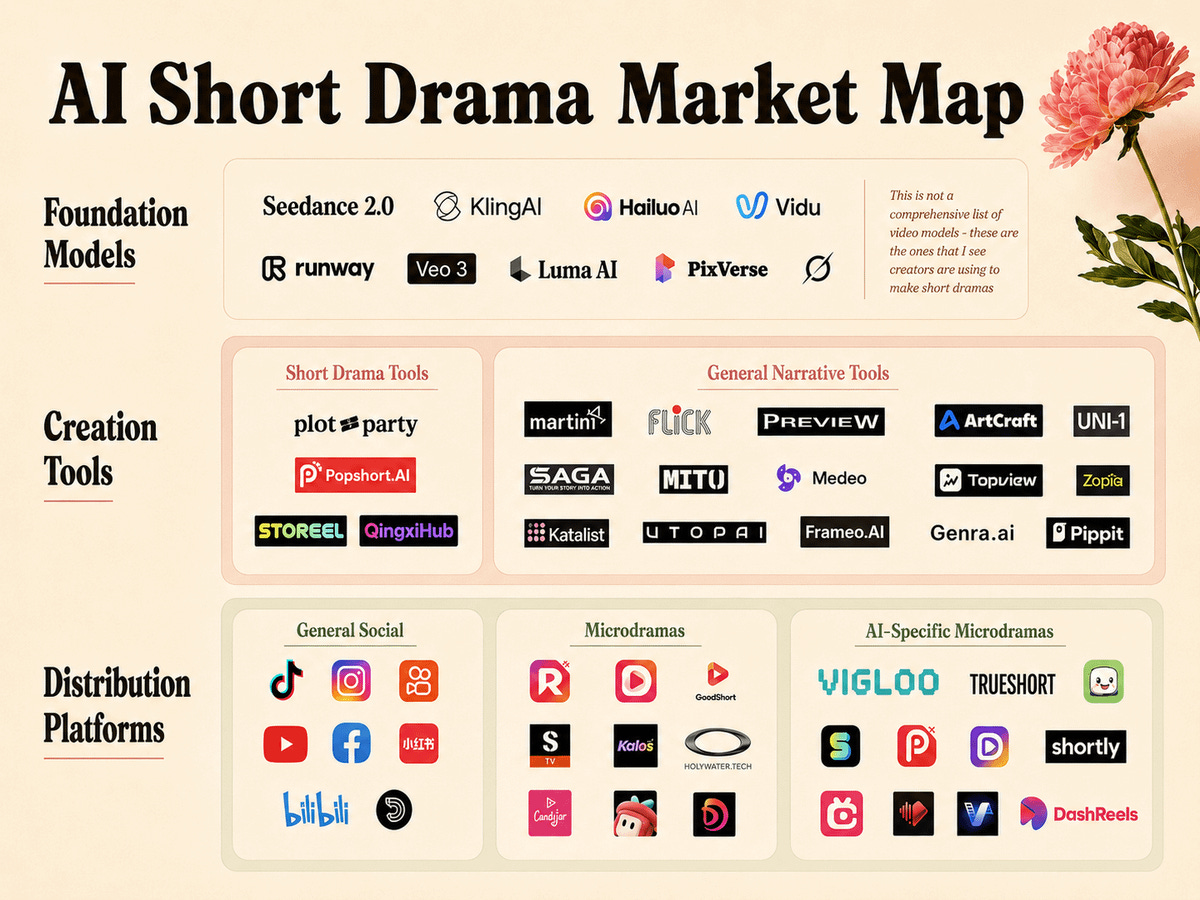
If you’re having trouble keeping up with all of these companies, here’s a handy graphic posted on Twitter by venture firm a16z partner Justine Moore:
Last, in what is easily the most disturbing microdrama news of this cycle, Business Insider reports that some microdrama platforms and producers are circulating promotional videos that contain fake photorealistic AI-generated sexual content that the actual actors never shot and never consented to. Making fun of LA’s mayor in a clearly satirical AI-generated political ad is one thing; marketing based on AI-generated nonconsensual intimate imagery is wholly another, and I hope someone here gets sued.
And that’s all the microdrama drama that’s fit to print, folks!
How I “Engineered Wonder” by Making Comics Books
My friend Sophie Raseman writes my favorite Substack on modern parenting, American Childhood. She will often put out calls for people who can offer expertise on whatever she’s writing about, and a few weeks ago she published a note looking for folks who could help her nine-year old daughter get started making comic books.
Since I’d recently been on a making-comics journey of my own, I raised my hand to volunteer—which unexpectedly led to this interview on her Substack about my experience. Here’s an excerpt telling my personal story; if you want to read more, including my advice for the single most important book for kids to read when starting their own comics journey, you’ll need to check out the whole article over at American Childhood!
How did you start making comics?
I’ve loved comics since I was about ten years old. I was a big Marvel kid and in college I devoured DC’s mature readers line, Vertigo. And although there have been stretches of years where I’m not regularly reading them I’ve always eventually come back to the medium.
My last return to the comics world was a year ago, after my then two-and-a-half year-old daughter fell in love with Spider-Man, and Spider-Woman aka Ghost Spider, when I let her watch the Spiderverse movies at far too young an age.
I discovered there was actually a comic store just a quick bike ride from our house and so I brought her in May to the annual Free Comic Book Day, which, well, is what it says. There’s lots of free preview comics to try to get folks in the door and into the habit.
My kid was ecstatic to get all these free comics, while I was ecstatic to find all kinds of new work on the shelves that jived with my tastes in storytelling. In particular, in the years I’d been away, elevated horror comics had become a big thing—and I just happened to have been knocking around a few big horror ideas in my creative writing at the time, one of which has actually gotten me a development meeting during the pandemic with master of horror John Carpenter of Halloween and Escape from New York fame. But that’s a story for another time.
Anyway, I started devouring books about making comics and writing for comics [ed note: here is Kevin’s Google doc compiling books and resources on making comics], and learned how writing pitches works in that world—you actually need to partner with an artist to make the first few pages of your comic book to show it around. And I was reading an interview in one of these writing books, Words for Pictures, with this legendary editor, Diana Schutz. If you’ve seen 300 or the Hellboy or Sin City movies then you’ve seen adaptations of classic comics that she edited back in the day.
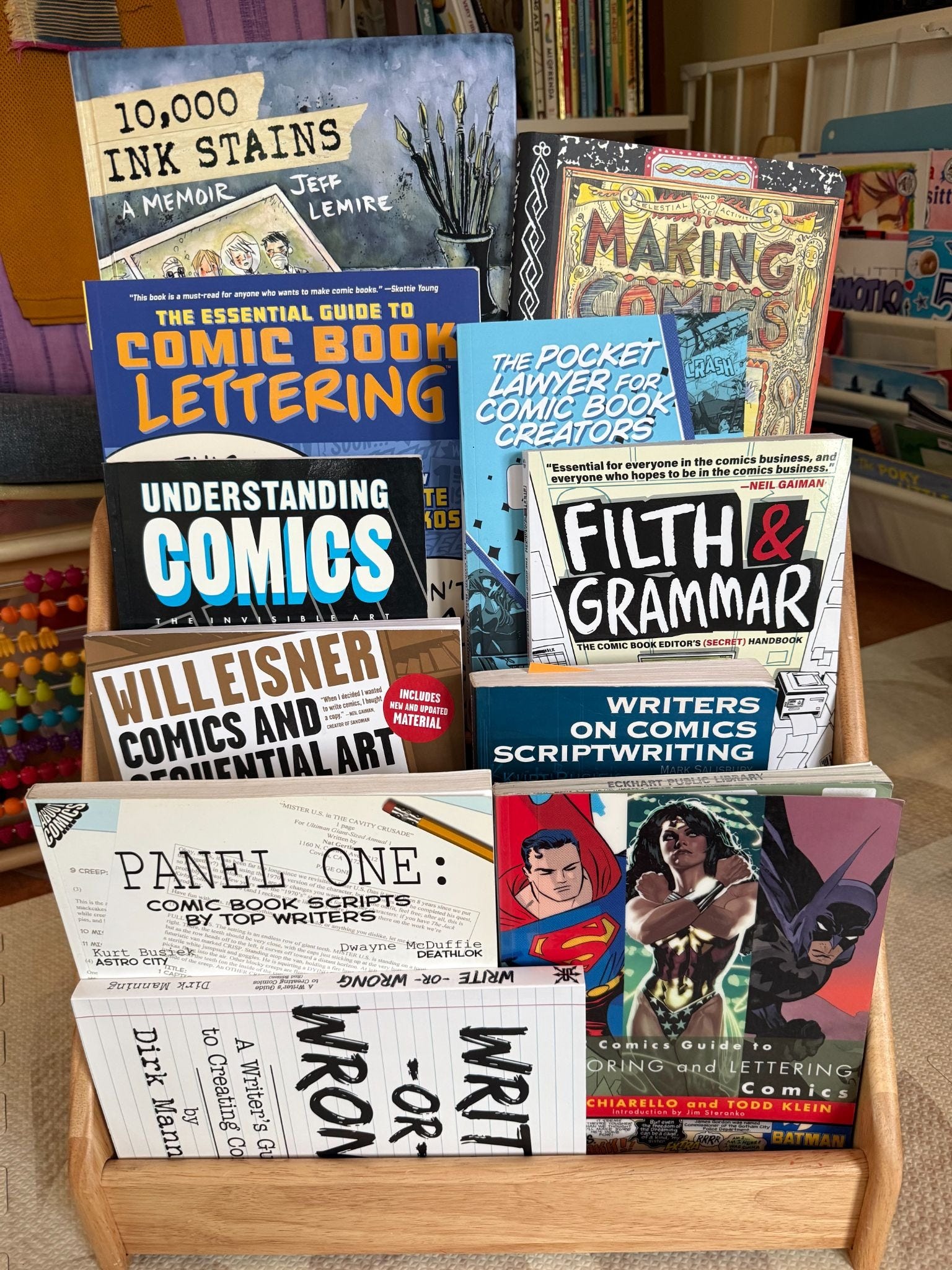
A portion of Kevin’s library of books on making comics
Diana now teaches making comics at Portland State, and in the interview she was talking about how it’s important for editors to see that you can complete a self-contained comics project which is why one of the three major projects for the semester is the completion of a stand-alone eight-page minicomic. And I just suddenly had this brain spark of: I’m gonna do that! I’m gonna take myself to comics school. I’m gonna budget time and money like I’m taking a semester of college and put together three professional level pitches using the story ideas I’ve already developed and I’m gonna do it before Comic-Con in New York in October!
And I didn’t come close to meeting that goal! But I did follow through, and I did finish one of them before New York so I could shop it around to editors there, and I’m now finishing the third and final one this month.
So you’ve made three comics now?
Yes! I built three different teams with artists, colorists, letterers and the all-important editor for three different comic ideas—an action-horror, a supernatural horror, and a swashbuckling action-adventure—and made three different “ashcans” [ed note: prototypes of a comic] with covers and logos and the first five to ten pages of each story, and with making-of materials at the back explaining the overall story and characters and world. And now I’ve learned how to write for this medium, how to project manage a comic production, how to network in the comic convention space, how to pitch to editors at the comic publishers, how to deal with comic printers, and more.
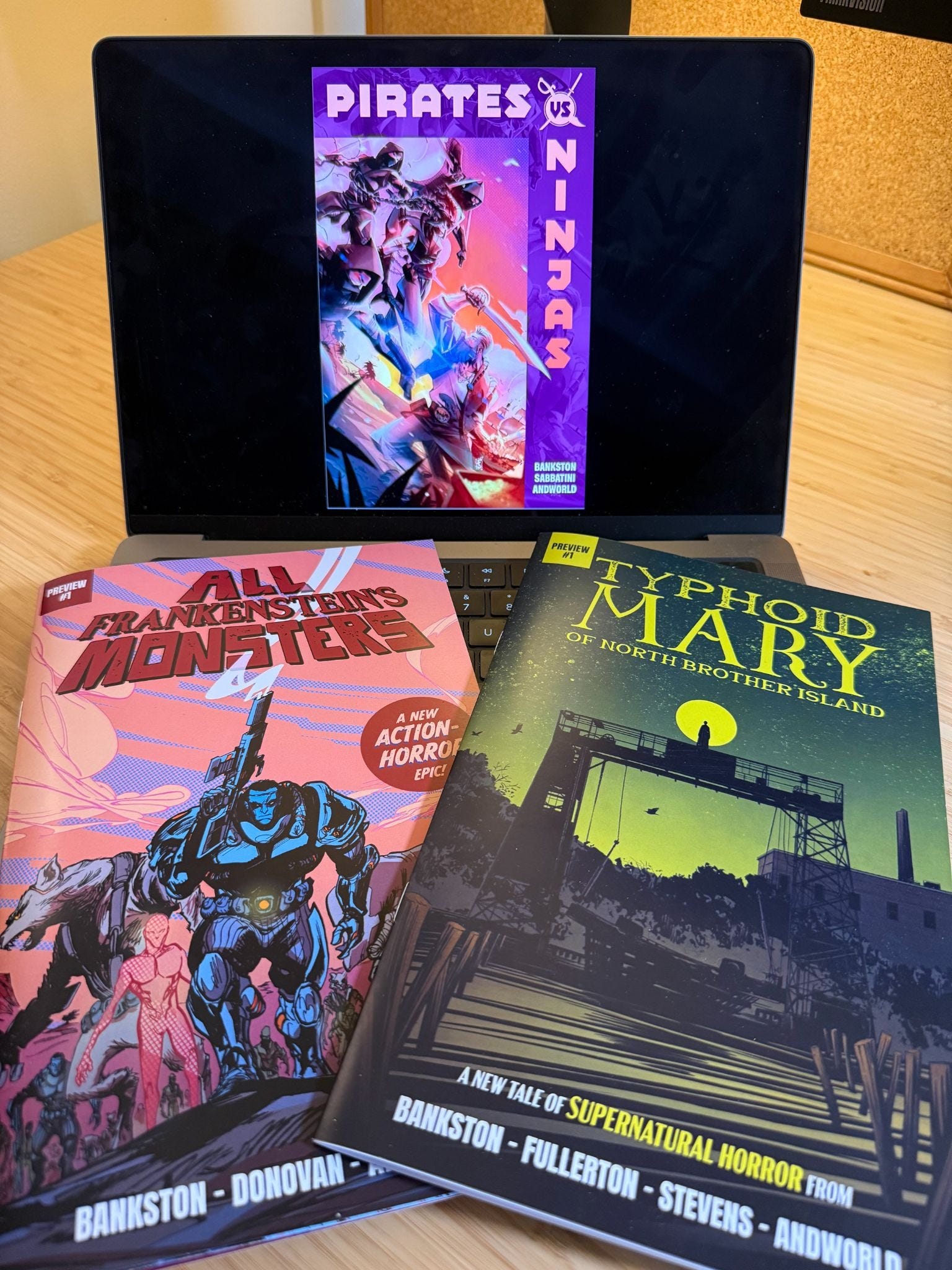
Kevin’s three recent comic book projects. Art credits: Eryk Donovan (“All Frankenstein’s Monsters”), Gavin Fullerton (“Typhoid Mary of North Brother Island”), Federico Sabbatini (“Pirates vs. Ninjas”)
No publisher has bought a pitch yet and I may end up Kickstarting the first issue of one of them myself, but that was never really the point. The point was to invest in myself and follow my joy and learn something new and at the end of it have these physical manifestations of story ideas I’d been chewing on for years. And although I’m making a real go of it—I want to actually publish, and make back the money I spent, and then publish again—I think the money will have been well spent even if I don’t, because of how much I enjoyed and learned from the process.
Particularly as a new dad with two young girls and an intellectually demanding job and in the midst of crazy turbulent times in our country, I really just needed a project that was only for me, to stay sane, rather than just doomscrolling or watching Netflix.
And Sophie, I gotta say: other than getting married and having kids, it’s literally been the most fun I’ve had in my entire life.
So for the adults, I would just say: Figure out what makes you feel like you’re twelve years old again and do it. Invest in your joy and it’ll be the best money you ever spent. And the generative creativity that you spark will spill over into the rest of your life.
I later read an article by tech and productivity writer Cal Newport who described this kind of project as “engineered wonder” and it really captured what I was trying to do: pursue something I was intellectually and creatively curious about, just for the childlike play of it, without expectation of some career or capital return. And I cannot recommend it enough. For me, the wonder was in comics—and it sounds like it might be in comics for your daughter too!—but I’m sure every one of your readers has at least one specific wondrous thing they’d love to play at doing.
So—go do it.
How (Not) To Integrate AI into Newsrooms, Revisited
Last issue, I wrote about some horribly negative examples of AI use in journalism leading to mistreatment of reporters and slop being presented as news. More examples have popped up since then, the most poetically ironic being the discovery of hallucinated quotes in the new nonfiction book The Future of Truth: How AI Shapes Reality. Even funnier: the writer then had the temerity to blame the AI, saying he was “seduced and betrayed.”
This infiltration of slop into purported journalism has now led The New York Times—which has already faced several controversies around AI in its own content, including in book reviews, op-eds, and news stories—to issue a stern warning forbidding contributors from submitting “any material for publication that contains content generated, modified or enhanced by [generative AI] tools, or that has been input into these tools.”
The caution is warranted, especially at journalistic institutions where a reputation for truth and accuracy is itself the product. That doesn’t mean, however, that there aren’t ways that AI can and should be leveraged to improve the field of reporting and enable new types of journalistic work, especially around large data sources that would be impossibly impractical or expensive to leverage without AI assistance.
That’s why I was so honored to get to speak a couple of weeks ago at the second AI x Journalism Summit in Baltimore. The event is hosted by Hacks and Hackers, a 15+ year-old nonprofit dedicated to bringing journalists (the “hacks”) and technologists (“hackers”) to work together to improve the information ecosystem. And although the folks at this conference were approaching AI with due caution—for example, I was brought in to help talk through the legal issues around developing and using AI tools, especially copyright—the overall focus was intensely practical.
The session speakers came from over fifty different news organizations including heavyweights like The New York Times, CNN, NPR, ProPublica, and the Center for Investigative Journalism, and were almost universally focused on how to make and use AI tools for journalists in a way that builds rather than threatens trust, with a particular focus not on how to have AI write for you but on how to enable better research and reporting. How to use AI to sift through masses of public records and monitor local government meetings, parse voluminous audio and video content, hold the powerful accountable through greater data transparency, improve rather than undermine fact-checking, and how to develop and apply AI use policies that will prevent embarrassing incidents like those at The New York Times mentioned above—these were the sorts of practical and productive angles covered at the event. The summit was focused on building things.
And damn, it was inspiring. Or, as Paul Cheung of Hacks & Hackers put it in his written reflections on the conference:
[T]he conversations in Baltimore weren’t about fear. Ken Romano from Stacker came in expecting the usual AI noise. What he found instead was one word threading through every session and every hallway conversation: trust. Not “is AI the devil.” The how. How do you use it without breaking what your audience believes about you? How do you move fast and still come clean when something goes wrong?
That’s the conversation journalists are actually ready to have.
Graham Ringo from Press Forward said it plainly: “We don’t need to be afraid of this technology. We should be thinking about how to use it to work smarter, create more capacity, and help every newsroom find new ways to thrive.”
Mike Orren, former Chief Product and Marketing Officer at the Dallas Morning News, called it “a breath of fresh air, an environment of curiosity and opportunity that gives me hope we’ll avoid the industry failures around Internet 1 and 2.”
Niala Boodhoo said her ideas and to-do lists left Baltimore as full as her heart.
Same. That’s the version of journalism I want people to carry out of this room. Not the grief. The appetite.
Build something. See you next year.
I couldn’t have said it better myself. I too left the conference inspired about how I might use AI to (very carefully!) build big data-based reporting projects for Converger that I never could’ve done before.
As a result I’m now cooking up several new AI-enabled (though not AI-written!) pieces of reporting, including building a database that maps the past ten years of comics-to-screen adaptation deal activity, that I’ll hopefully be able to debut soon. That comics deal pipeline project is a good example of something that will have a very interested niche audience but is also a huge research lift, such that it never would’ve made sense to try to build it pre-AI. Even with AI it’s been an enormous project, nearing a hundred separate chat threads and a couple hundred dollars of Claude tokens, but I’m having fun and learning how to do online research and data management at scale with AI. Like with my comics projects, I’m engineering wonder by pursuing it.
So, watch this space for that, and thanks again to all the hacks and hackers who were kind enough to welcome me into their space and share their inspiration. Maybe they will inspire you too:
What can you build now that you couldn’t before?
FRAGMENTS
First off this week we have fragments following up on pieces from the last two editions—a follow-up fragments round-up, if you will:
YouTube Censorbots Mistake Stop-Motion Grandma for AI Slop
Youtube’s indiscriminate demonetization wave against purported “inauthentic content” continues, with perhaps the most egregious mistake so far as reported by Cartoon Brew: YouTube’s poorly-calibrated censorbots automatedly demonetized Tiny Grandma, a 175M-follower channel posting physical stop-motion animations about the adventures of the eponymous tiny grandma. After much outcry on social media, YouTube reached out to fix the problem that it created; thankfully, many of the creators I cited in the original story have eventually been reinstated after sometimes-repeated appeals. But that just goes to show how worrisomely over-inclusive this wave of automated demonetization continues to be, and not everyone has a large outraged audience to demand action on Twitter.
It’s worth noting that the deepfake detection censorbots also described in the last edition’s feature on YouTube would likely automatically flag the fair-use-and-First-Amendment-protected Spencer Pratt videos discussed above for takedown if any of the political figures depicted had signed up for the detection feature, likely requiring appeals based on YouTube nominal policy carveout for parody and satire.
So, yet another example of why private platforms should probably err on the side of underinclusive rather than overinclusive enforcement of their content rules around legal speech, and/or teach their censorbots to exercise much better judgment. And of course, this isn’t just a problem with YouTube but with the filters on model outputs, too—although many models’ launch with the filters loosely applied if at all, the screws always eventually tighten—which may be one reason why more flexible open source Chinese models are gaining traction. Speaking of…
Chinese Models Are Still Eating US Labs’ Lunch on Video Gen
Echoing my conclusions from last issue’s feature about Chinese models dominating video generation, The Financial Times reports that, well, Chinese models are still dominating video generation.
Gemini Omni Flash: Awesome, Awful, or Both?
The trend of Chinese video gen dominance seems likely to continue based on the response I’ve been seeing online to the release of Google’s new “anything-to-anything” model, Gemini Omni Flash. Google DeepMind is the US leader in video generation, thanks especially to the wealth of YouTube data it can train on. (One would expect Meta to be in a similar position thanks to its wealth of Insta data, but so far Meta AI’s slop engine strategy doesn’t seem to be producing great models). Many online are putting the new Omni Flash head to head against Seedance 2.0 in straight text-to-generation-of-scenes and that Chinese model’s results are clearly superior. However, others online are pointing out that Omni Flash is, well, a Flash model—smaller, more efficient, not a Veo-scale generator, and that because it’s a multimodal model it is perfect for the video-to-video generation use cases that can be most practically useful to professional content creators—allowing for easier editing, actor replacement, element removal, lighting changes, scene extension, changing character and background appearance, switching camera angles, and more. So, the haters may be getting it wrong here and the real head-to-head comparison that will matter will be the next, bigger, non-Flash Omni model or the next iteration of the Veo text-to-video flagship.
The YouTubers Taking Over Horror Cinema Are Busting Box Office Records
The YouTuber takeover of horror cinema escalated since our feature article on the trend: the new horror feature Obsession directed by Youtuber Curry Barker, shot for less than $1M, opened to an impressive $17.2M and then had an even more astonishing 30% bump in ticket sales in its second week instead of the usual drop. Meanwhile, tracking for the viral Youtube creepypasta adaptation Backrooms from director Kane Parsons is suggesting that its debut this Friday will be A24’s biggest opening weekend ever. As media critic Marshall Shaffer predicted on Twitter, “I think it is very likely, if not probable at this point, that BACKROOMS will open above the second frame of THE MANDOLORIAN AND GROGU and send shockwaves across Hollywood boardrooms around what people *actually* want to see right now.”
New Actors’ Union AI Protections Don’t Bring “Significant Additional Value” to Guild Members
I complained in the last issue about the lack of clarity on the AI protections that were reportedly included in the Screen Actors Guild’s new four-year contract with the studios. Well, now those details are out, with Variety reporting that the agreement “allows studios to use synthetic performers only if they bring ‘significant additional value’ to a project [and] also requires studios to notify and bargain with the union if they license performances for AI training.” The same story reports how some guild members are concerned that those provisions are far too flexible. That’s a particularly reasonable concern considering that, as former FTC Commissioner Alvaro Bedoya put it, “The strongest protections against AI at work have not come from Congress, nor have they come from lawsuits - no. Without question, they’ve come from collective bargaining by organized labor.” If these are indeed the strongest protections the actors union can obtain, I foresee an even more challenging next four years for that community.
Google Search Leans Even Harder Into AI, and the Web Trembles
With new even-more AI-forward search features announced at its developer conference I/O, Google threatens to “summarize the web to death” as Platformer’s Casey Newton puts it. This news very much ties into the piece from my first issue about the future of the open internet in the face of AI products that are destroying human traffic to websites while exponentially increasing costly bot traffic. No wonder major online publishers like Conde Nast are having to develop strategies based on the assumption of zero search referral traffic in the future, and as for small publishers…well, link-winter is coming.
News Sites Block Internet Archive, Cut Nose Off to Spite Face
Our feature on the future of the open internet from issue one also highlighted how the Internet Archive, an endlessly helpful resource for journalists, is now tragically being blocked from archiving by key journalistic outlets by The New York Times, who have also asked the Archive to stop serving previously archived content. (Hypocritically, NYT just did a story covering the disappearance of the archive of political polling news site fivethirtyeight.com as unfortunate and suspicious news while ignoring that the NYT has disappeared its own much larger and more important archive.)
Well, new research from the Nieman Lab at Harvard highlights that it’s not just national news organs that are cutting their reporters’ noses off to spite their faces by hobbling this critical archive: the study identified over 340 local news outlets that are also now blocking the Archive. Add to this the continuing memory-holing of previously-posted government content from the web and the increasing deployment of robots.txt on those same government sites to block scraping, and we may soon lack critical historical context on the evolution of not just the internet but human society at large.
No One Wants to Listen to AI Music
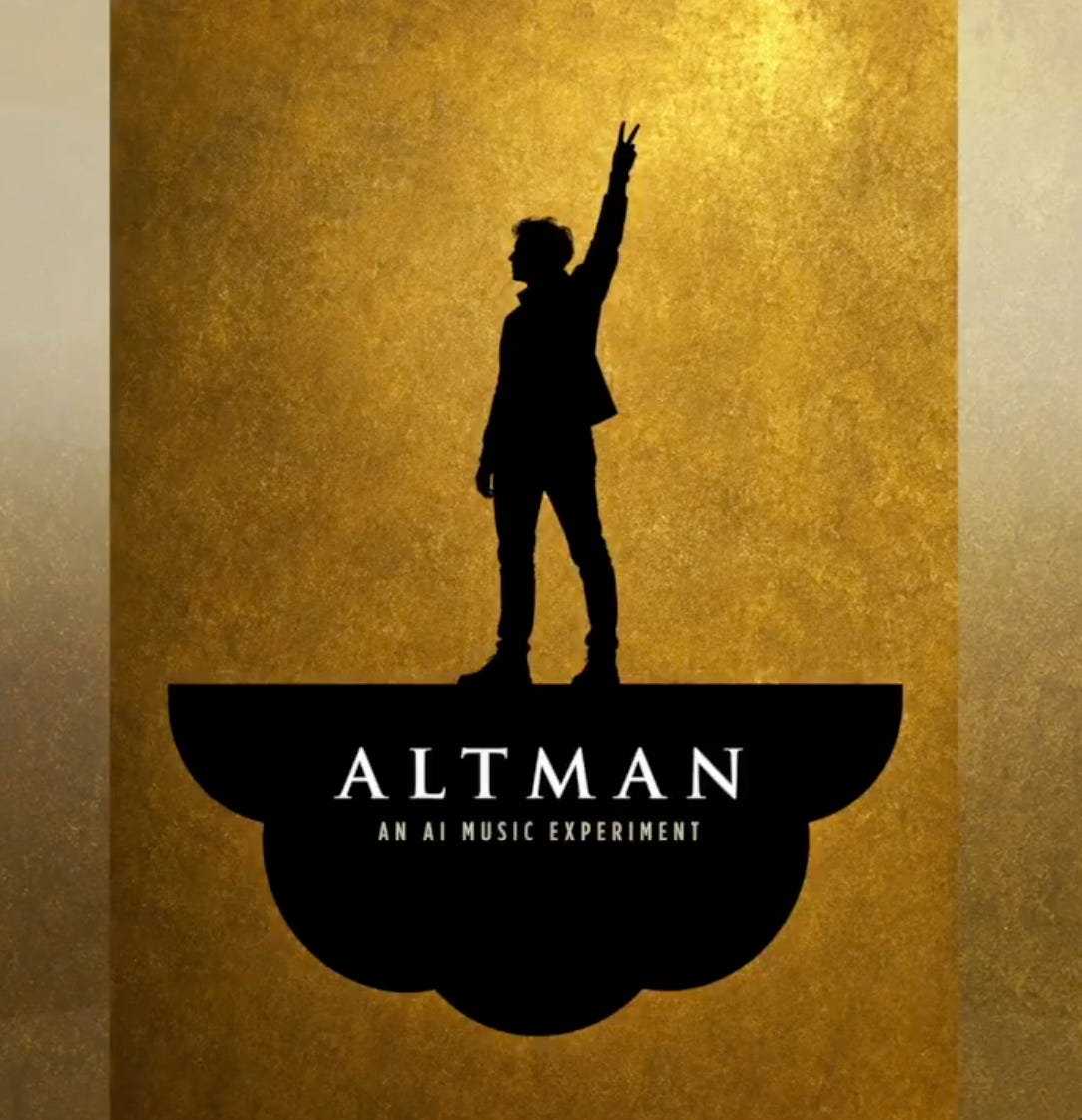
As highlighted last issue, while AI-generated music now makes up 44% of new uploads on music streamer Deezer, it only counts for 1-3% of actual listens. Well, here’s confirmation of the trend from a streamer I’ve actually heard of: according to Apple Music’s SVP Oliver Schusser, 33% of new uploads on the service are AI-generated but make up <.5% of listening time. So far Spotify has not disclosed data with the same granularity as Apple and Deezer, but industry estimates predict similar numbers for that service. These numbers probably don’t bode well for ElevenLabs newly-released Suno-competing AI music app, and it also remains to be seen whether or how this phenomenon—of listeners rejecting AI music—will apply in other domains like video and writing. But I will admit that the “song” I’ve enjoyed singing along to the most in the past few weeks is this hilarious AI-generated track, translating the texts between Sam Altman and Mira Murati the weekend that Altman was (temporarily) ousted as OpenAI CEO into a stage-musical number. “Directionally very bad!” LOL
OK, enough of those reheated leftover fragments, time for some freshly-baked fragmentary takes!
Real Monet Mistaken for Artslop
It may be that one reason listeners are rejecting a lot of AI music is not (only) because it’s bad but because it’s AI. That theory got a boost from a now-viral social experiment on Twitter where someone posted an image of a real Monet painting but claimed that it was actually an AI-generated imitation. The replies are revealing, with countless amateur art critics explaining why the posted image lacked the magic of Monet’s “real” artwork. Said one representative poster: “It’s Monet-ish, yes, and certainly pretty. But–at the risk of sounding pretentious—it imo would not hold up next to the real thing….”
Runway ML cofounder Cristóbal Valenzuela chalks up this kind of response to a well-documented cognitive bias called the effort heuristic, a mental shortcut where people evaluate the quality of something based on the perceived amount of effort that went into producing it rather than actual quality. It seems that cognitive bias will probably play a large role in whether and how AI-generated content is accepted by consumers, and also raises an interesting issue around AI disclosures: why would anyone want to disclose that they are using AI if it will cause people to inaccurately value its quality less?
Runway: Video First, Then the World
Speaking of Runway, TechCrunch had an interesting exclusive spotlighting that company’s aspirations beyond merely building video generation tools for creators: building the world models that may succeed LLMs as the dominant form of AI and drive a much wider variety of applications including robotics. For the computer scientists in the audience, you may want to head to arXiv to check out this newly-updated article survey article on the topic, “Video Generation Models as World Models: Efficient Paradigms, Architectures and Algorithms.” For the more artistic minded folks who will be in New York City or LA this June, tickets are now on sale for Runway’s annual bicoastal AI Film Festival.
READER BONUS: I bought a ticket for the New York festival on June 11 before checking my calendar and it turns out I’ll be on the wrong coast that day; drop a line to converger@kevinbankston.com to claim it for yourself, first come first served!
Startup Founder Fails to Read the Room, Pitches AI Comics to Comics Creators
If you think Hollywood is (or was) militantly anti-AI, then you haven’t met the comics community. Which makes it all the funnier how Shutterstock founder Jon Oringer failed to read the room when reaching out to comics creators to try to rope them into his new startup focused on AI-generated online comics. In particular, he slid into the Instagram DMs of graphic novel author Stephanie Cooke asking if she might be interested, leading to her virally roasting both his original come-on and his reply to her condemnation of the project. I don’t doubt that AI will ultimately find at least some limited place somewhere in the comics creation pipeline, but neither comic creators nor their audience seem interested anytime soon. (Nor am I, for that matter—note above that I hired real live human artists for my comic projects, and consider it some of the best money I ever spent.)
AI Is Learning the Wrong Things From Sci-Fi
It’s not just space billionaires with dreams of galactic conquest and posthuman rapture who’ve learned the wrong things from the sci-fi they read at an impressionable age: Anthropic just published a new report indicating that some real “evil AI” model behavior can be traced to stories about fictional “evil AI” in their training data, and can be remediated by adding more positive fictional AI stories to the models’ training, providing some new confirmation for this Transformer piece from last year where some experts predicted such a phenomena.
Rogue One: The Andor Cut: Now This Is The Kind of Remix Culture I Can Get Behind
Speaking of sci-fi: millennials and Xer nerds may remember the The Phantom Edit from back in olden internet days, a fan edit aiming to salvage the unholy mess that was Star Wars: The Phantom Menace. Well, now we’re getting a new fan cut of the pretty-good Star Wars prequel Rogue One re-edited with scenes, score, and more from the absolutely brilliant Star Wars series Andor. From the description of the preview trailer on editor David Kaylor’s YouTube channel:
‘Rogue One: The Andor Cut’ sets out to re-envision ‘Rogue One: A Star Wars Story’ as the finale and epilogue of the Andor series, as if it had been made afterwards. Musical themes and leitmotifs from the show will appear, pertinent flashbacks will be inserted, a few continuity errors will be removed, and the tone will be more in line with what we have grown accustomed to from the two incredible seasons. It also includes fan-made deepfake renders of Grand Moff Tarkin and Princess Leia, courtesy of @Shamook, and VFX battle-damage added to Darth Vader’s helmet to line up with A New Hope, courtesy of @PixelJoker95.
Yeah, I’ll watch the hell out of that. Pray that Disney will be a good sport with its fan community and not issue a DMCA takedown. H/T to the futurist newsletter Sentiers for surfacing this to me.
Netflix Inkubates an AI Animation Studio
The Verge brings us the scoop that Netflix is starting up a new studio unit called Inkubator dedicated to creating AI-generated animated content, based on examination of job listings describing the new “next-generation, creative-led, GenAI-native animation studio.” Netflix confirmed the news with a somewhat defensive statement after getting heat about the “GenAI-native” unit; via Cartoon Brew:
[N]etflix confirmed it is launching an “artist-led animation incubator” to develop new, extended stories based on its IPs.
The studio stressed that films produced at Netflix Animation Studios will continue to use traditional animation techniques and practices.
According to the company: “The initiative will provide creators with an artist-focused environment to experiment in, where they can explore how new tools and workflows, alongside traditional animation creative practices, can be leveraged to enhance their storytelling capabilities.”
Well, so long as it is “artist-led” and “artist-focused” and continues to use traditional animated techniques “alongside” AI, whatever that means, I guess we’re all cool here! No more questions.
A Deep Dive into Gossip Goblin’s AI Filmmaking Process
Some AI generated videos, no matter how technically impressive, are still tropey slop with no real story. The same cannot be said of the work of Zack “Gossip Goblin” London, whose 22-minute AI-generated short The Patchwright is a highly designed and uniquely creative piece of post-cyberpunk sci-fi narrative. That’s probably why he’s the only actual AI creator who ended up on The Hollywood Reporter’s list of the top 25 people shaping AI in Hollywood. And that’s certainly why fellow AI creator PJ “Ace” Accetturo published a revealing breakdown of Gossip Goblin’s workflow that highlights the absolutely enormous amount of hard work and deep thought that went into every frame. (PJ Ace is worth watching on Twitter if you like process content like this; see e.g. this thread on AI creator Kevan’s process for his AI-generated Magnific Original fantasy series The Chronicles of Bone.)
Skeletor Steals the Sky for Advertising
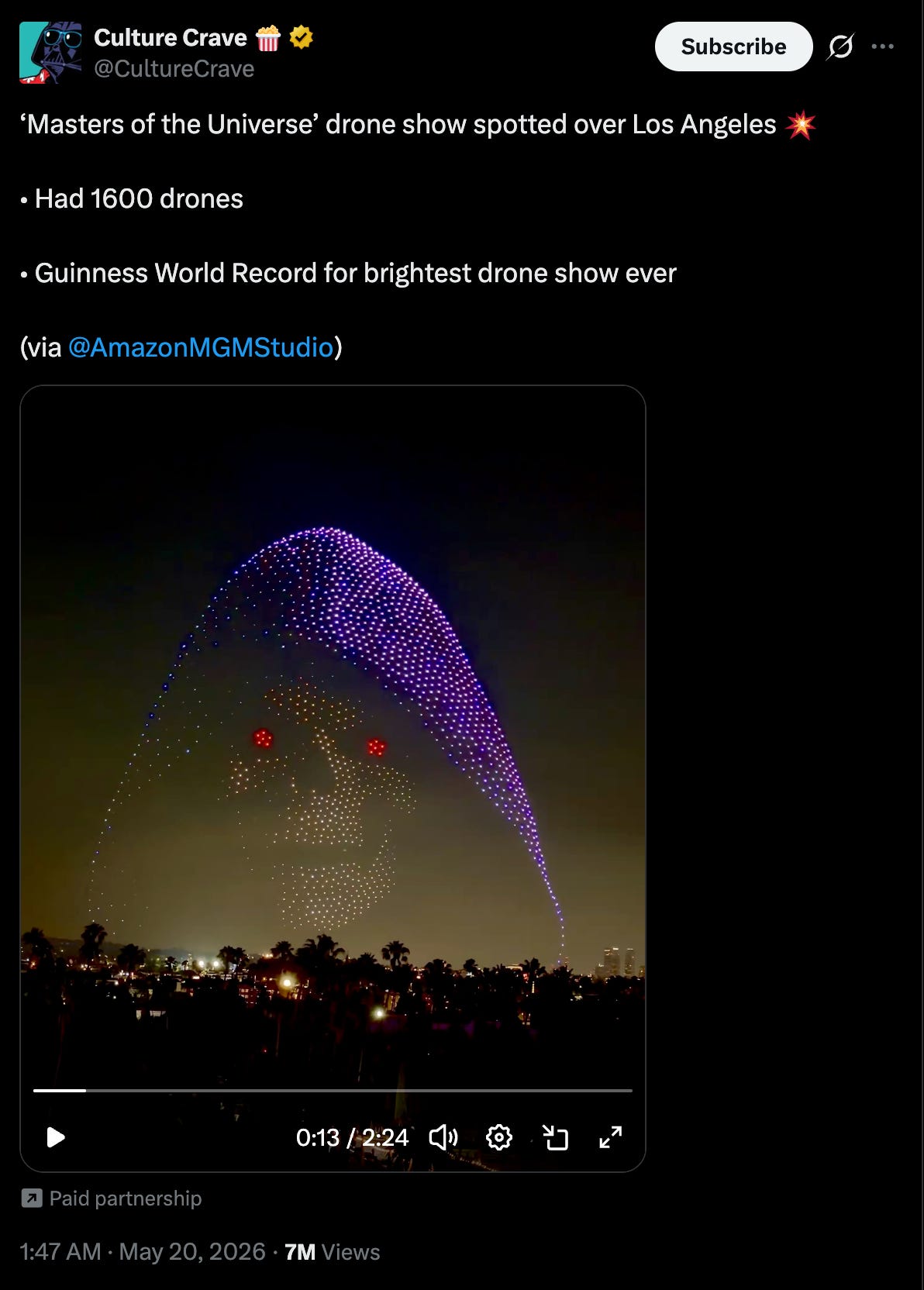
For the “please dear god don’t let this become a trend” file: Amazon MGM Studios dominated the sky in LA the other night with a drone show advertising the upcoming Masters of the Universe movie, with a skyscraper-sized Skeletor head looking down over the Hollywood Hills. How is this even legal? And how can we stop it from happening again? Next thing you know, these advertising drone shows will be regularly stealing our nighttime skies from us, and then the inevitable, horrible next step: etching ads onto the moon!
AI Wins Prestigious Short Fiction Prize, Now No Longer Prestigious
This story has already dominated online discourse for a few weeks now so I won’t belabor it as we close this edition of Converger, but: an apparently AI-generated short story, “The Serpent in the Grove” by Jamir Nazir, recently won the Caribbean regional prize from the Commonwealth Foundation for its “lyrical precision” and as a result was published in the respected literary magazine Granta. While the author has not yet confessed to using AI, analyses like this one are pretty damning. The prize foundation’s response was “well, we trusted the authors when they said their submissions weren’t AI,” rather than attempting to run the stories through any AI detection classifiers (Pangram notably ranks the story as 100% AI-written).
Hopefully this will serve as a cautionary tale for every other publisher, especially after Hachette’s recent abrupt cancellation of the novel Shy Girl when it was suspected to have been AI-generated. But perhaps the most notable aspect of this news isn’t that a story that was AI-generated won the prize, but that a story that was so badly written won the prize. Either way, both the Commonwealth Prize and Granta are going to have a tough time regaining the prestige that this AI incident has cost them.
And that’s what’s converging this week! See you next time.