


Welcome to CONVERGER, a biweekly newsletter mapping the content singularity where AI and the internet collapse all media into one—a connective node where emerging technology, policy, culture, futures thinking and storytelling intersect.
Converger presents news and views from an AI, internet and media policy expert who is pro-innovation but anti-hype, allergic to both AI panic and AI boosterism, and passionate about supporting rather than supplanting human creativity with new technology.
Some issues may be heavier on media commentary, others on AI policy, others on personal passions like sci-fi’s influence on technology (both for good and bad) or the evolving medium and business of comic books in the digital age. You never know what threads might come together in convergence-space!
I’m Kevin Bankston, your host. You can watch me develop newsletter content in real-time on LinkedIn and the social network formerly known as Twitter, and less often on Bluesky and Instagram. You can also look for my more wonkish takes on AI governance at Elicitation, the new Substack from my AI policy day-job colleague Miranda Bogen of the Center for Democracy & Technology’s AI Governance Lab. (Note that my Substack articles don’t necessarily reflect CDT’s positions.)
In this week’s edition, I’ve focused solely on takeaways from the ‘AI on the Lot’ conference. Only features this week, no fragments. I’ll catch up on those in our next issue, as well as sharing one more AI on the Lot followup, an interview with advice on how AI creators can protect the copyright in their AI-generated films. (Those who are waiting on the copyright litigation update that I promised will have to wait a week or two longer.)
Also this week, I just filed my first guest post over at the AI policy newsletter Elicitation. It’s all about AI data portability—why we need it, the current state of it (not good!), how to spot fake data portability, and how to demand the real thing. Here’s the first paragraph as a preview:
Last November, after over a year of regularly using ChatGPT, I was ready to give Google’s Gemini and Anthropic’s Claude a try instead. The latest versions of both models had just dropped, and everyone online was hyping them as better on a variety of benchmarks compared to OpenAI’s flagship. I’d played a bit with each of those other models before, but decided it was time to truly give them a shot, and compare their performance on my most important projects to what ChatGPT had been giving me. The problem was…I couldn’t.
Click on over to Elicitation to read the rest, after you read today’s Converger! And please share with your friends and colleagues if you enjoy!
TABLE OF CONTENTS
FEATURES (>500 words)
‘AI on the Lot’ Debrief I: How I Got an AI-Generated TV Series Cancelled (Accidentally)
‘AI on the Lot’ Debrief II: Conference Reflections Roundup
‘AI on the Lot’ Debrief III: Technology Brother vs. Hollywood Brother, with Matthew Bankston
Hannah Einbinder Swirlie Watch, the Final Edition: Who’s Getting Flushed for Using AI This Week?
FRAGMENTS (<500 words)—none this week!
FEATURES
‘AI on the Lot’ Debrief I: How I Got an AI-Generated TV Series Cancelled (Accidentally)
I helped murder Punky Duck.
Or maybe it was merely duckslaughter, since I didn’t mean to do it? Either way, the duck is definitely dead.
Two weeks ago, I tweeted a joke I heard from a creator at the AI on the Lot conference. Within 48 hours, that joke had helped get that creator’s just-announced new AI-generated cartoon show for Amazon Prime cancelled.
I feel bad about that, mostly. But it was probably going to happen anyway, and that’s on Amazon.
But I’m getting ahead of myself…
On Tuesday, May 26, as soon as I pressed publish on the last issue of Converger, I hopped on a cross-country flight to LAX to attend the fourth annual AI on the Lot conference.
With the explosive growth in the conference—from a half-day 600-person event the first year to now a two-day, nearly-2500-person event on a major studio’s lot—it seemed emblematic of the same AI vibe-shift that was evident at the Cannes Film Festival a couple weeks before. Not just small AI-native studios and online creators but traditional entertainment industry power players were there to talk about how they could leverage AI, with reps from Paramount, Fox, AMC, and MGM appearing on panels and reps from pretty much every other major studio attending to listen.
But it also became a reminder that the AI backlash in Hollywood was also alive and well, and I unwittingly became an instrument of that backlash.
“You’re trying to get me to make friends with the AI iceberg while I’m still on the Titanic.”
As usual it was a beautiful day, sunny and seventy with just a hint of spring chill in the air, as I first walked onto the Amazon MGM Studios lot in Culver City where the conference was held. I was accompanied by my younger brother Matt, who has been working in Hollywood as a creative executive for scripted television for over two decades now. He is understandably wary of how AI is going to impact his industry but as a meddling older brother I wanted to try to expose him to and help him adapt to the changes that are coming—or as he wryly put it, “you’re trying to get me to make friends with the AI iceberg while I’m still on the Titanic.”
Opening comments on Wednesday morning were on the main stage at Amazon-MGM’s Culver Studios: massive Stage 15 where they do shoots on the “volume.” the wraparound LED screen where CGI (and now generative AI) effects are projected behind actors. (If you’ve watched The Mandalorian, you’ve watched a show mostly made on a volume set.)
Albert Cheng, Amazon-MGM’s main representative at the conference throughout the two days who spoke on multiple panels, was recounting when he took the job as Head of AI Studios at MGM how many of his friends in the industry were aghast, surprised he would even associate his name with an AI title. But he made clear he was unafraid to represent this technology and the new creative and economic potential it brought to Hollywood.
In hindsight, maybe he should’ve been more afraid.
The next session was Amazon-MGM’s true spotlight moment: it announced for the first time that in partnership with Amazon Web Services, it was starting a GenAI Creators Fund. That fund would offer startup money and technical resources via AWS’ Project Nara video-gen production platform for creators to produce high-quality generative AI-driven entertainment. And although Cheng made clear that some of these upcoming shows would be hybrid productions like Amazon’s current House of David and Moses shows—human actors, shot on a volume stage or in a “gray box” stage using gen-AI backgrounds—the first three projects announced that morning were all animation:
Love, Diana Music Hunters, created by Albie Hecht, former President of Entertainment at Nickelodeon who greenlit and oversaw the development of countless Nicktoons including SpongeBob SquarePants, and featuring YouTube child star Diana of the popular pocket.watch internet series Love, Diana;
Cupcake & Friends, based on the BuzzFeed Studios animated web series and character Good Advice Cupcake created by cartoonist Loryn Brantz; and
Punky Duck, an original series about, well, a punky duck having madcap adventures in cartoon LA, from noted Mexican-American animator Jorge Gutierrez who is best known for his Guillermo del Toro-produced feature film The Book of Life (doing an animated take on a Mexican afterlife years before Pixar’s Coco), his classic Nicktoon El Tigre, and his more recent animated series Maya and the Three for Netflix, all heavy with Mesoamerican themes and imagery.
It seemed like a big legitimating moment for AI in Hollywood: a major studio (albeit one owned by a tech giant) had recruited big creative players from the Hollywood (and Hollywood-adjacent web series) establishment, to produce fully AI-generated animated series for its streaming channel.
But then it all went to hell.
They showed clips from the three shows, including the Punky Duck trailer, and it was clear from the jump it was a Jorge Gutierrez creation through and through—his design and color sense, his anarchic attitude, his style of action. And he seemed ecstatic about the whole thing. Particularly as an artist from an underrepresented community who (like most) has struggled to get greenlights in the past—he spent ten years trying to get The Book of Life made—he was delighted by how fast the AI-enabled process for his new show had moved. Celebrating how this series went from a pitch in March to a greenlight just two months later, he joked that “it’s like you have sex, and then someone hands you the baby!”
Oh, that’s a funny line, I thought—and tweeted it. I’d wanted to send a few updates from the conference to my social networks over the course of the two days, perhaps tie them back to Converger and pick up a few more subscribers for my new newsletter, and this was my first dispatch. I knew it was a borderline offensive take and expected that it would probably ruffle some anti-AI feathers online—perhaps even relished it a bit—but I had no idea what was coming.
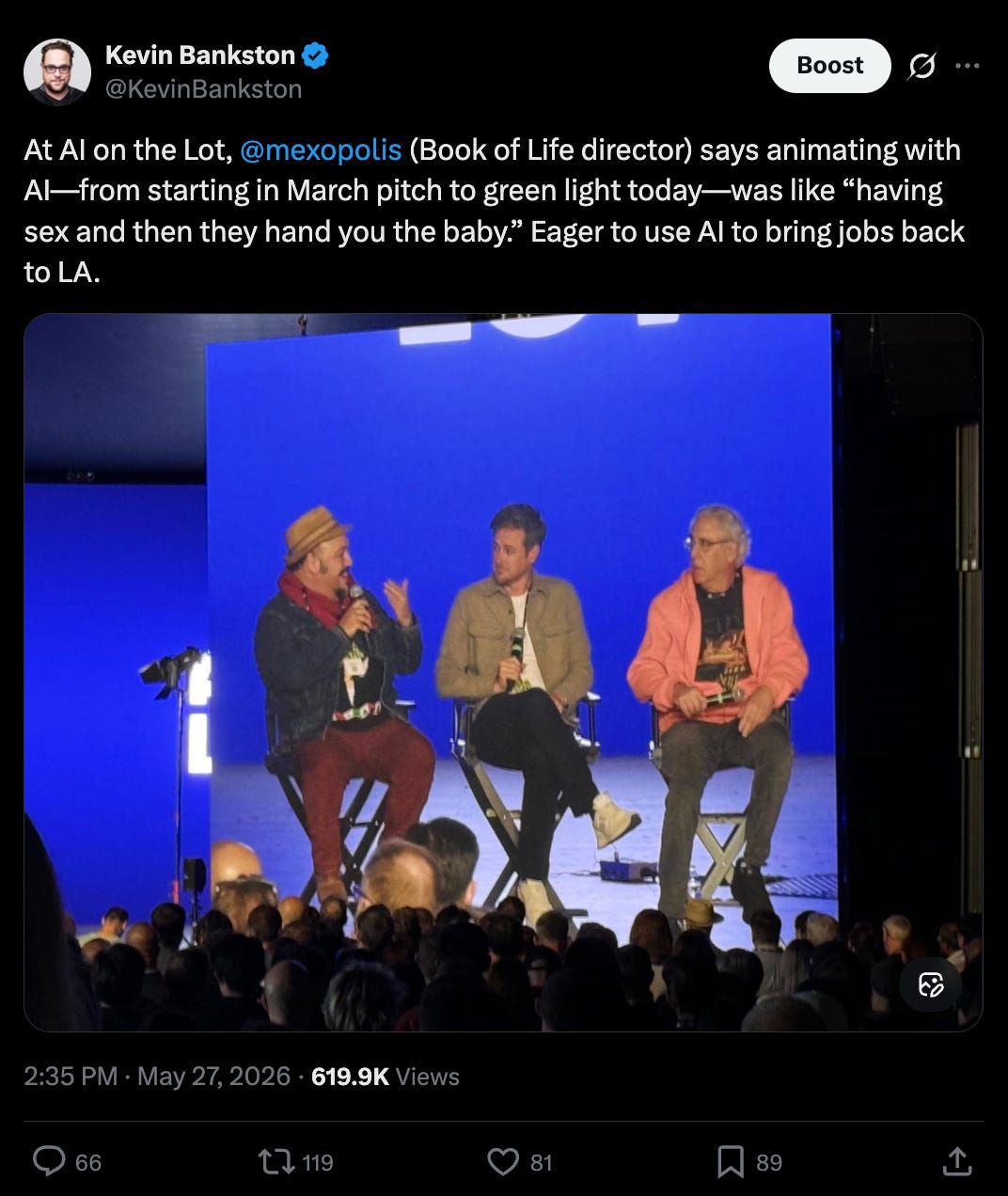
As I could have guessed, film concept artist and illustrator Reid Southen—perhaps the most vocal opponent of AI use by Hollywood on Twitter, and someone whose research on model memorization I actually teach in my AI and copyright class at Georgetown—almost immediately retweeted me with a scathing take. He highlighted Jorge Gutierrez’s apparent hypocrisy by sharing a 2024 tweet from the animator criticizing AI as theft that was putting the animation ecosystem in peril.
Over the hours of that day I’d continue to check in on Twitter and see that a snowball of anti-AI vitriol was rolling down the hill, accumulating around my tweet. Endless and endlessly hostile replies and retweets—I’d never been ratio’d so hard—attacked Gutierrez for making this show with AI and with Amazon, calling him a sellout and a traitor to all artists. There were a few voices that celebrated or defended him using these tools to deliver a personal creative vision that may not have been made otherwise—and certainly couldn’t have been greenlit so quickly—but they were in the distinct minority, especially after the tweet got picked up by pop culture news outlet CultureCrave and cartoon news site ToonHive. By the next day, my tweet would even be linked to by The LA Times (although they’ve since replaced that link with an independently sourced quote of Gutierrez’s “sex/baby” line.)
By the end of the first day Gutierrez was already on the defensive, issuing a statement to cartoon news site Cartoon Brew that spoke of the new project as “an experiment” for which he was “cautiously optimistic” and where he would be as “cautious as possible with AI” to ensure that it is “artists driving tech, and not the other way around.”
“The racist stuff and the attack on my kid were too much.”
He also took to Twitter, making clear he was listening to concerns and open to hearing them but noting that threats against his family would be reported, in a tweet that has since been deleted. When asked why he deleted it, in a later thread where he said he was “learning a lot from many of you…[and] absolutely understanding the concern,” he replied “the racist stuff and the attack on my kid were too much.” Elements of the mob, it appears, were taking this way too far.
As the conference continued into the second day, Thursday, I was mortified watching the online feeding frenzy attacking this man, and feeling responsible for it. Of course, there would have been a backlash without me, whenever this news was reported. Gutierrez was a major figure in a community with an enormous amount of hostility to AI, had previously been outspoken about protecting artists’ rights, and now he was suddenly doing an AI show for Amazon!
But I wondered if the reaction wouldn’t have been so immediate and so vitriolic without my tweet. Maybe it wouldn’t have been as bad, and he could have stayed the course, if I hadn’t tweeted. Maybe he wouldn’t have had to do what he did on Friday morning of that week, when—less than 48 hours after his enthusiastic announcement—he issued a diametrically-opposed announcement: he was dropping out of Amazon’s AI program.
Punky Duck was dead.
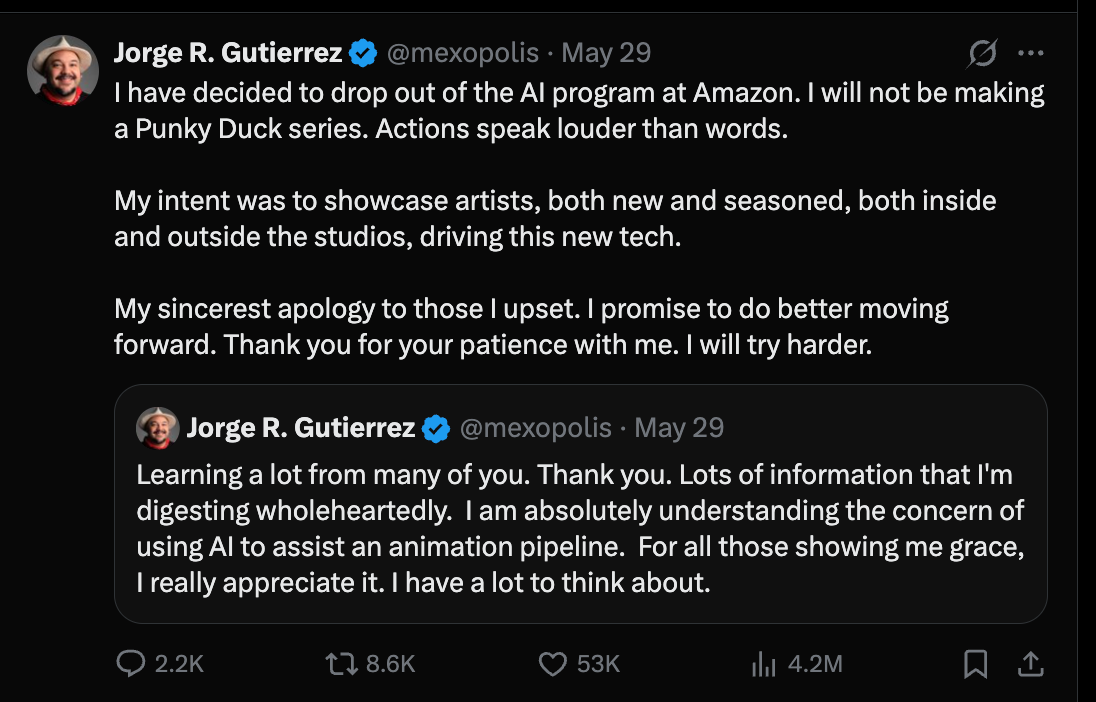
As I sat reading that tweet in the early morning Culver City sun on Friday, drinking my first coffee on a bench right outside Culver Studios before hopping in a car to LAX to fly home, it was a dark capstone to what in many ways had been an amazing trip of discovery. The vibe shift in Cannes—at least amongst Hollywood elites—had traveled back to California and was evident across the conference. But many others in the community were still far from getting onboard the AI train that the studios were so excited about, and instead were very angry. And then of course there were the pro-AI voices on Twitter that were now equally angry at Gutierrez, for surrendering to the anti-AI mob.
That online mob was given even more to get angry about as the conference went on, and as another of the Amazon projects became a center of controversy. Turns out that the creator of the BuzzFeed-owned character Cuppy the Good Advice Cupcake, Loryn Brantz, was staunchly opposed to using generative AI and had declined to participate in that character’s Amazon show because of that. Yet somehow, knowing this, Amazon-MGM and BuzzFeed had thought it was a good idea to move forward anyway. Predictably, Cuppy’s creator spoke out immediately after the launch announcement about how she was “disgusted” by the whole project.
Certainly, BuzzFeed had the legal right to proceed; the character was created as a work-for-hire that they owned the copyright in. But the idea that Amazon-MGM would have one of its three flagship AI projects be a show that was done over the objections of the actual creator, when the whole point of the exercise was to try and legitimize the technology in Hollywood, was just astonishing. What did they expect? Of course people were angry!
And I understood those people who were angry toward AI—and Amazon-MGM, and Gutierrez, and BuzzFeed for using it—not least because my brother was one of them.
“They keep talking about saving time and money as if that doesn’t mean cutting people’s jobs. I live in Burbank, man—that ‘time and money’ are all my neighbors.”
I was angry as well. Not because Gutierrez wanted to use AI. I, personally, was and am excited about the creative possibilities of AI, and hopeful for its potential to empower more creators than it disempowers, and sad that Gutierrez was bullied out of making a show he was passionate about.
No, I was angry at how he, and Amazon, and BuzzFeed, and frankly almost all of the presenters at AI on the Lot, brought this on themselves. Because throughout the conference, instead of actually grappling with people’s objections, they pretended those objections—and those people—didn’t exist.
I certainly didn’t attend every session at the conference since many were running in parallel, but I did attend a session in every slot across the two days. And there was an elephant sitting in every single room, that everyone was working very hard not to acknowledge: the prospect of significant job displacement in the very community within which the conference was being hosted.
There was a lot of talk about creator-centric and artist-centric and story-first AI creation, AI as a tool within the control of creators rather than controlling creators, AI as a way to save “time and money” in making new films and TV, and so on. But as my brother put it: ”They keep talking about saving time and money as if that doesn’t mean cutting people’s jobs. I live in Burbank, man—that ‘time and money’ are all my neighbors.”
Many speakers highlighted how AI wasn’t coming, it was here, and although there would be objectors, it would eventually be accepted. There were the usual analogies to the backlash against photography from portrait and landscape painters in the 19th century, the backlash against CGI artists from traditional animation and special effects creators in the 1990s, etc. There was lots of talk about past technology shifts in Hollywood and how each transition eventually moved from being met with “oh shit” to “oh cool” to just being normal.
But there was practically no direct talk from the stages about the threat or reality of Hollywood job displacement, even in the session that was framed as a “debate” that would address “the questions that actually matter.” Indeed, I saw only one person on stage—producer and The Ankler AI columnist Erik Barmack—directly bring up the prospect of job displacement, and the panelists talked around it.
As it was bluntly put by director Jon Erwin when asked by an audience member about AI taking away jobs: “What jobs?”
Elsewhere, the threat of lost jobs in the immediate community—even, lost jobs amongst the people attending—only ever came up from audience members during Q&A, a pattern I saw a couple of times, and rarely were those questions answered directly. At most, there was general talk about the idea that with shows being cheaper because of AI (particularly in the realm of hybrid productions which still employ actors and camera crews and production design staff as well as the gen-AI animators themselves), cheaper would mean more greenlights, and with more greenlights there would be more production in LA again, which would help bring jobs back to a community that had already lost so many.
Or, as it was bluntly put by Jon Erwin, the director of Amazon-MGM’s hybrid productions House of David and new miniseries The Old Stories: Moses, when asked by an audience member about AI taking away jobs: “What jobs?”
And he’s got a point. Hollywood production has been in freefall for over half a decade and long before any impact from AI: because of the pandemic, streaming’s economic implosion of 2022 when Netflix’s stock dropped and the freewheeling greenlights of the “Peak TV” era peaked and passed, the actor and writer strikes of 2023, reduced production from 20th Century Fox after its merger with Disney, and the continued flow of shoots over the past decade to other states and countries with cheaper labor and better tax rebates.
Erwin claimed his company Wonder Project’s AI-enabled productions had brought six hundred new jobs to the LA area. Reportedly one hundred people were directly employed as crew on the Moses miniseries in particular (although the same news story notes that the show was shot in just one week, so: short jobs!). Similar claims have been coming up around hybrid film productions: Doug Liman’s gray-box feature Bitcoin: Killing Satoshi reportedly employed 107 cast members, 100 shoot crew and 54 non-shoot crew, on par with a regular independent feature. And Jorge Gutierrez in his original onstage announcement had made the same point about animation: he hoped that gen-AI cartoons would help create more jobs for both new and established writers, designers, and animators in LA thanks to more shows being greenlit.
This is not a wholly implausible hope. But especially absent real data, or predictions from labor economists who aren’t self-interested producers of AI shows, it’s cold comfort to a community already struggling for jobs. I personally can’t judge how realistic all the “it’s not a zero-sum game, the pie is going to grow with all the new greenlights” rhetoric is; it might have some truth to it. But even so, many of the jobs will change, and people whose expertise was needed before won’t be needed in the new world, and many of the jobs that do materialize will be much shorter gigs for much less money. We’re already seeing this dynamic in the fast-growing sector of non-union microdrama shoots, shoots that start and finish in a matter of days and that pay very little.
So when the conference’s only answer to the concern was this unsupported “AI will raise all boats” assertion, it rang hollow and called the whole endeavor into question. It gave the impression that the community that was excited about AI was wearing blinders, was callous to the human cost that was literally in the room with them, and was out of touch with the community they were trying to recruit to their cause.
In other words, when it came to the angry reaction they faced from outside the studio gates: they deserved it.
It’s not hard to imagine an alternative scenario: a real opportunity for a teaching moment, shared between those who are excited about AI, those who are concerned, and those like me who are both.
And Amazon-MGM especially deserved it. They could have and should have anticipated the backlash that their creators were going to face, especially considering Gutierrez’s past comments and the Good Advice Cupcake creator’s unwillingness to participate. They could have approached the entire project differently, more openly, rather than proceeding in secret and then announcing the fund when the first projects were already a done deal, after quietly soliciting agents to find out which creators might be open to working with AI. And they could have empowered young new creators without resources, rather than funding work by industry veterans.
It’s not hard to imagine an alternative scenario, as AI creator BLVCKL!GHT pointed out in his post-conference wrap-up: Amazon-MGM announces the fund, then publicly solicits participants with a focus on new talent, then provides an ongoing behind-the-scenes look as those creators move through accepting pitches to developing those pitches for possible greenlights, educating us and the creators on the technology along the way, demonstrating how it can help express personal visions faster and more effectively than traditional tools, all while also talking openly about the concerns they and the broader community might have about AI, and then, finally, announcing the greenlights.
It could have been a real opportunity for a teaching moment, shared between those who are excited about AI, those who are concerned, and those like me who are both.
It’s also not hard to imagine a version of the conference that invited more dissenting voices in, and gave the elephant in the room its own microphone, and dealt honestly and with some modicum of understanding with the concerns of the very real people in the very real community the event was embedded in. Indeed, I privately spoke afterward with one of the organizers who admitted that including such voices needed to be a priority next year.
But this year, it was not to be. Instead, we got the absolute flaming dumpster fire of an Amazon-MGM launch event that we got, which I accidentally helped pour gasoline on. And everyone lost.
Punky Duck most of all.
‘AI on the Lot’ Debrief II: Conference Reflections Roundup
The Punky Duck controversy was just one of the interesting takeaways from my visit to the Culver Studios lot. The others are below. I’d also direct you to several other worthwhile wrap-up stories and posts in the traditional trades, and on Twitter and LinkedIn; my takeaways mostly jibe with theirs, although particularly considering my reservations as stated in the last feature, I don’t think I’d quite echo the booster-y tone of some of those write-ups. That said, it was truly an excellent conference experience: a great venue with a fascinating lineup and a wealth of interesting and creative speakers and attendees. I definitely plan to attend again next year.
The Money Came to Watch
The clearest signals that AI on the Lot was becoming serious business were the name tags on stage, representing real Hollywood money: not just host Amazon-MGM but execs from Paramount, Fox, and AMC all spoke, with more real money sitting in the audience. The number of traditional-studio reps on the lot made clear that the popular perception of AI video as a hobbyist sideshow is outdated; the incumbents and their dollars have decided that generative AI in entertainment is real enough to monitor up close.
What’s not clear is how much they’re buying yet. The actual buys right now seem to be coming from the AI side, not the Hollywood side, paying for the ability to use Hollywood’s IP. For example, the week’s marquee deal, reported by Variety and Deadline, had the AI voice company ElevenLabs licensing the late Stan Lee’s voice and likeness (the rollout drew immediate backlash), with another ElevenLabs deal for the voices of Hasbro toy/cartoon characters like Optimus Prime and Cobra Commander announced the following week. And as Erik Barmack pointed out in a The Ankler story shortly after the conference, the market for AI companies licensing Hollywood’s content libraries for training is also heating up.
From what I saw at the conference, the emerging market for finished AI video outputs still appears to be dominated by YouTube and social network monetization, advertising clients, and microdrama production, with premium pickups showing up as the exception. Three “iffy-looking” animated shows greenlit by Amazon (two of them hobbled by controversy as described above), one action-horror generative feature where everyone who’s seen it agrees it’s a bad movie even if technically impressive (Hell Grind, discussed last issue), and the still-upcoming but as-yet-unfinished family feature Critterz, don’t yet look like a trend; they look like exceptions.
The real money seemed most immediately interested in how to use these tools for post-production penny-pinching on traditional shows, and on the radical cost-savings promised by hybrid productions—shows with real performers but with AI-generated backgrounds that are projected on a volume stage’s wraparound LED screen or are used to replace a gray-box background. Amazon-MGM’s House of David and The Old Stories: Moses were more than proofs-of-concept; they were much-discussed success stories that I expect other studios will be emulating within months. Indeed, one of the most compelling images of the conference wasn’t on a screen but was conjured in my mind by a description of House of David director Jon Erwin, standing in the center of the Amazon-MGM volume stage during production, directing a dozen generative AI artists to orchestrate live changes to his backgrounds at the same time he was directing his actors. That’s the kind of artistic command and control paired with practical savings and production flexibility that gets both directors and studios excited.
“The Secret Sauce is Human,” Especially for Copyrightability
Across the conference I often heard about the importance of ensuring that AI remain a tool for human intention rather than deferring to its creative decisions—not only to maintain high quality and preserve human authorship of the work but also to maintain legal control. “The secret sauce is humans” said Jorge Gutierrez before he and Punky Duck were cancelled, and many commented on the need for independent human creativity to guide the AI and especially to reject its creative guidance when warranted. Amazon-MGM’s AI studio chief Albert Cheng highlighted how important it was to trust your own artistic intentions and not be steered of course by the AI. His interviewer, UCLA media prof Jay Tucker, made the steering metaphor literal, likening following your own artistic compass in the face of AI to when you are driving and know that the GPS advice is bad: “it’s 4:30, there’s no way I’m turning onto Overland Drive.”
As we’ll dive deep on in the next issue, the mandate to preserve original human authorship was also a legal one: first, to ensure that you don’t intentionally or unintentionally infringe on copyright with the wrong prompts (apparently all the clients of the AI studios want to approve every prompt for this reason, and want contractual indemnity); and second, to ensure the Copyright Office will actually recognize that you rather than the AI authored the resulting work (the importance of having a strong audit trail of all your human input was repeated panel after panel). As one attendee put it on Twitter, creators and clients were eager to avoid copyright concerns by exhaustively documenting their “ethical prompting.” Or as AI creator BLVCKL!GHT put it, “You know what’s dead in the water? Literally anything that has even a whiff of something that may be ripped from existing IP…. [E]ven a single scene or character that looks like existing media (something or someone from an existing show) won’t get a green light.” As it should be.
The Tools Work if You Work Them
The most concrete takeaway from the conference was simply this: the tools work and work well. Of course, they are unpredictable and don’t have good taste of their own: as The Hollywood Reporter quoted Gareth Edwards (Rogue One, Jurassic World Rebirth), generative AI is like “a second-unit director who is a billionaire on acid.” So, sure, the models will occasionally lose their minds and hand you senseless crap, but the question is no longer “is it technically possible for the model to generate whatever I want,” as even my skeptical brother would admit. The question is now “how do I coax the model to generate exactly what I want.”
So the interesting problem has moved up a level, from “can the model make this shot” to “how do I tightly orchestrate a dozen of them as one pipeline.” This year’s energy went to that orchestration layer, as at least half of the conference content was just one tool provider after another demonstrating their workflow, whether it was the popular open-source software ComfyUI, or Foundry’s recently-acquired Griptape, or startup fal which announced they were selecting Amazon Web Services as their cloud vendor of choice.
Notably, most of these “node-based” tools appear to be converging on the same basic functionality—a graphical pipeline UI that chains together prompting for story, character and set design, storyboarding, then generation and editing—which left more than one attendee wondering aloud what these products actually compete on, and predicting a wave of consolidation. But it’s unclear who the winner will be: as a16z partner Justine Moore noted coming out of the conference, “it feels like no one has figured out a repeatable process of using AI on all productions. It’s still relatively case-by-case and relies on knowledgeable AI practitioners being involved in each project.”
Slop is as Slop Does
Those knowledgeable AI practitioners were out in force on the lot, and I was constantly amazed at the level of precise, detail-oriented work that the AI creators demo’ing the tools had obviously put into their creations. Everyone agreed that there’s AI-generated content that is slop and AI-generated content that is not slop, and the not-slop was typically defined by the amount of authorial intention (and the related ability to plainly describe it in text). I saw massively detailed prompts, endless iteration, tweaking of camera angles and lens simulations and character designs and background details and on and on. Perhaps the most impressive demo was a five-minute photorealistic short film made in eight days by a creative director with Foundry’s Griptape to show off that pipeline tool, a dynamically directed and wholly convincing depiction of a European rally racer duo piloting their car through race after race, from scorching desert to snow-topped mountains.
Bring in the Writers, Please
The problem is that the very same short film that dazzled me technically was also boring as hell, because there was no story. I wouldn’t call it slop—it was far too well made for that—but I also wouldn’t call it a good film. Which is where the writer comes in, or rather doesn’t. For a gathering this fluent around digital design, lighting, editing, and camera moves, the writer was conspicuously off the program.
The closest to a marquee writing demo came from perennially cranky writer-director Paul Schrader (Taxi Driver, First Reformed), who described the result when he asked ChatGPT to help him come up with the story for a new Paul Schrader movie. As IndieWire recounted, he was impressed by the story it gave him—entitled The Collection Agent—with a very Schrader-esque scenario of a lone antihero, Elias Vane, with a moral wound from a bad decision in his past for which he was seeking redemption and a complicated relationship with his religion. “Not bad,” he said repeatedly as he walked through the story treatment, and he seemed pleased to see his style reflected back at him.
“AI doesn’t create, it combines,” said Schrader, and although he admitted that The Collection Agent was “second-rate Schrader, it’ll be first rate soon enough.” I’m sure it will, and recombination is a fine creative engine when you have fifty years of oeuvre to feed the AI. But it’s a worrying one when your actual problem is building a voice from scratch, so I worry for the writers of the future. Right now, though, I’m looking for the writers of the present to author some actual stories for these AI people, since they mostly seem to be iteratively generating hot demo reels and tropey nonsense like Hell Grind.
Nonlinear Production, Nonlinear Consumption
Iteration was indeed the watchword. The structural change that kept coming up was that from traditional linear production to non-linear AI production. “It’s iterative, not sequential,” said Jay Tucker, and that insight was evident everywhere you turned. For example, the studio Happy Monday talked about writing, generating, and editing a series’ episodes in parallel and tuning them on the fly based on audience reaction to the first posted episode. Foundry’s representative described this iterative process as a circle rather than a line, as story blends into previz blends into shooting blends into post blends into script blends into concept art, all constantly being adjusted in dialogue with each other until you finally call the thing done.

Sometimes, like with Happy Monday’s shows, that iteration happened in dialogue with the audience: as The Wrap‘s roundup recounted, a short from AI studio Pickford took live texts from the audience and regenerated scenes around them; the crowd spammed mentions of Taco Bell until the on-screen detective offered the suspect a Taco Bell subscription for a confession. (Apparently the AI knows something about Taco Bell’s business model that I don’t.)
Justine Moore anticipates this capability being pointed at fandoms, with IP owners newly interested in letting audiences generate inside their story-worlds, and fan fiction turning dynamic as anyone could produce (ideally for a fee) an image or a clip with their favorite characters. The optimistic read is a genuinely new participatory grammar. The pessimistic read is that iteration-on-audience-reaction and remixable IP is the assembly line for optimized slop. The truth is it will probably be a bit of both.
Half-Fake Productions vs. Fully-Fake People
The conference’s real and mostly unspoken fault line was between hybrid versus fully synthetic production. As Jon Erwin, whose hybrid Amazon-MGM series The Old Stories: Moses shot on the lot’s volume, put it: “collaborating with the actor is my line in the sand.” Amazon-MGM AI studio chief Albert Cheng tended to agree, in remarks reported by Deadline, that “humans must be an active participant and a decision maker,” both for copyright reasons and because audiences still recoil from the fully fake. Even after seeing Runway’s latest videos intended to demonstrate that the “uncanny valley” is a thing of the past, and especially after seeing many clips of Hell Grind, I too am skeptical that audiences will want to watch AI-created people instead of actually-emoting actors.
Schrader, though, was happy to describe the final destination that many boosters keep moving toward but tend not to name—the next Clint Eastwood being a fully synthetic protagonist—and called Cheng’s caution a flinch. “I think he’s just afraid,” Schrader said. “I think it is going to happen. I think we are going to have a non-hybrid protagonist in the arts… [and] us carbon-based fools [will] spend our money empathizing and caring about silicon-based creations.”
He’s probably right. And like everything related to AI, it will probably happen faster than we expect, whether we like it or not. Many seemed to leave AI on the Lot feeling a triumphal inevitability around the technology, but their inevitable future left me not just intrigued but troubled, while it filled my little brother with creeping dread.
So I interviewed him about it.
‘AI on the Lot’ Debrief III: Technology Brother vs. Hollywood Brother, with Matthew Bankston
Any Converger reader knows I’m excited by and interested in the creative possibilities made possible by AI; I wouldn’t have started this newsletter if I wasn’t. I also have strains of skepticism, both around creative quality and around economic impact on creative workers, but on balance I’d say I’m more intrigued than worried. But then again, AI isn’t putting my paycheck at risk (yet).
My younger brother Matt Bankston, on the other-hand, is a full-blown skeptic, a perspective based on his over twenty years of working in Hollywood. Matt’s front-line take on AI informed and was informed by our AI on the Lot experience together, and I wanted to share that perspective with you.
I say “vs.” in the title here, because we definitely have some differences of opinion, but this interview wasn’t really a debate. I just wanted to better understand how he saw the issue, and by extension better understand the views of the broader working Hollywood community he sits within, especially since I felt like that view was woefully underrepresented in the conference content itself.
Thankfully, and with characteristic Bankston frankness, Matt did not hold back.
Kevin: Who are you? Tell our readers what your deal is.
Matt: My name is Matthew Bankston. I’m currently head of scripted television for an Australian production company called Perpetual Entertainment. Before this I had a long career in international co-production television. I was with a domestic studio called AGC Studios, and before that with Luc Besson’s company, EuropaCorp, out of their LA office. The résumé goes on from there but I’ve been working in the development and production of television since 2005.
Kevin: Some recent shows you developed and got executive producer credits on include Those About to Die, the gladiator show on Peacock…
Matt: That was a show I developed and produced in Rome. A big broadcast one was an adaptation of the feature franchise Taken, which ran on NBC for two seasons. But it’s been a lot—TV movies, limited series, broadcast series, streaming series. Done a lot.
Kevin: And recently there was also Troppo, the outback crime thriller starring Thomas Jane on Amazon Prime and Freevee, if I recall.
Matt: Correct.
Kevin: So you’ve been around the block, over 20 years. And as you put it, I tried to get you to make friends with the iceberg while you’re still on the Titanic when I pushed you to come to the AI on the Lot conference with me. So let’s start there. What were your impressions? What surprised you?
“What I saw—what made me really scared and really saddened me—was the writing on the wall for below-the-line talent in film and television.”
Matt: What surprised me is how well [the AI tools] worked. The technology is far more evolved than a lot of people realize. We both noticed there was a lot to be said for the continued importance of performance—actual flesh-and-blood characters—but in terms of photoreal spectacle and motion physics done basically off of prompts, it’s really impressive. It’s a little thoughtless, in that everything you see is a parade of nifty frames without a real coherent thought process about why those shots go together. But to your casual viewer, it’s still pretty dazzling.
I didn’t see anything that impressed me in terms of pure AI-generated content [with AI-generated performances]. What I saw—what made me really scared and really saddened me—was the writing on the wall for below-the-line talent in film and television.
Kevin: For our readers, define “below the line.”
Matt: Below the line is everybody from your department heads—cinematographer, costume designer, production designer, editor—all the way down to your PAs, your gaffers, your stitchers, your dyers, whatever. In a budget, it’s usually your cast, your director, your writer, and your producers above the line, and everybody else who works on a film or TV show is below the line. And the dream of the people behind the technology seems to be that you can have a director and a cast in a room with maybe ten crew, and you’re prompting everything else. There’s a hand-waving away of “oh, well, that’s not really how it works now,” but it’s very clear that’s the goal.
Kevin: Contrary to the popular perspective that video AI users are just slop-prompters—”make Brad Pitt and Tom Cruise fight,” press enter—these were craftspeople. They were working hard, in a deliberate and detail-oriented way: sometimes page-long prompts, picking angles, tweaking backgrounds. Were you impressed by the amount of work that went into it?
Matt: Let me disagree with the thesis. I don’t think it takes a creative professional to go, “Hey, computer, what if Neil Peart drummed for Nirvana?” That’s not the same thing as learning how to play the drums. It’s not the same thing as starting a band. This isn’t apples to apples. It’s a different kind of creative professional—it’s just not the same.
And they could show you the prompts. In these demos a lot of the time it was just “close shot.” Okay—what does that mean? If you went to a director and a DP and said, “I want a close shot,” you’ve given them ten percent of the information they need. But if you’re spitting out bits of prompting and the computer’s spitting out a dazzling shot, and you go, “Look at what I made”—no, you didn’t make that. But, as Erik Barmack [producer and The Ankler AI columnist who moderated a panel] made the point: it’s all good enough. None of it’s great, but it’s good enough to put out in volume.
I think where you were going with your comment was: isn’t this just a different sort of creative pursuit? And I don’t think it is. I don’t think it’s that different from saying “make Brad Pitt and Tom Cruise fight” to say “do Hamlet in the style of Wes Anderson.” It has the illusion of creative work. That’s the sort of thing network and studio executives like me will say in a room: “Oh, what if we did Hamlet in the style of Wes Anderson?” And if you just leave me and an LLM to figure out what that is, it’s going to be terrible. The difference is the people who actually know how to write and create things. They’re operating from a different skillset.
“I don’t think it takes a creative professional to go, ‘Hey, computer, what if Neil Peart drummed for Nirvana?’ That’s not the same thing as learning how to play the drums. It’s not the same thing as starting a band.”
Kevin: One example that resonated with me was in Stage 15, the volume stage, where the executives talked about watching Jon Erwin, the director of House of David, standing in the center of the volume, orchestrating his AI artists—having them make changes to the backgrounds on the fly while he directed his cast. That felt like a kind of artistry, that it wasn’t actually that different from what any other director does.
Matt: I didn’t watch that panel, but having worked in a production volume [using CGI]—not an AI volume—my major point is this: wherever we are now is step one to those people just not being there. That’s what seemed painfully obvious and nobody was saying out loud. It was so obviously the goal of where this is being taken, and no one wanted to say it. It made me very angry.
Kevin: As you noted, they kept talking about saving time and money, but not about that implicating people.
Matt: They’re not reducing the unit cost of a roll of gaffer’s tape. They’re talking about eliminating jobs. So this guy’s on a volume, calling out changes to four or five artists—okay, but that same software two generations down, in nine months, and he’s just directly calling out prompts to the AI. And those people are gone.
Kevin: Let’s talk about the jobs, which obviously hits personally. “That time and money are my neighbors in Burbank.” Have you seen direct job impacts from AI yet?
Matt: It’s hard to say “Joe doesn’t have a job because so-and-so producer’s using software X.” But it’s hard not to notice that no one’s working. Granted, that’s part and parcel of a larger content-production slowdown. It feels like every ten years or so there’s some cratering in production, then it bounces back—it’s always white-knuckle it till it comes back. But this is the first time you’ve seen this concerted effort of, “What if we don’t have to bring any of these people back?” Not “let’s not make more shows”—everyone’s trying to get more content back in the pipeline—just under different economic realities.
Kevin: Jon Erwin, when he was asked whether he was worried about AI taking jobs, his answer was, “What jobs?” To some extent it does seem like the iceberg has already hit Hollywood—between the pandemic, the streaming contraction, the strikes, consumers watching short-form online, the mergers, and the flight from LA for cheaper climes. Wasn’t it already really bad?
Matt: It was already extremely bad, but basically survivable. A lot of the conversations I’ve had with producers, agents, and executives over the past year and a half were: “What does this look like? Where does it end? Is there a bottom?” And more often than not there was a loose consensus that it’ll come back, just nowhere near the scale of peak TV. Maybe something more like the late ‘90s, early aughts—where you had broadcast, some cable, no streaming yet, but still a robust economy of jobs here in LA.
And that’s going to suck, because there are a lot of people who built careers in the last 20 years of peak TV and there won’t be jobs waiting for them. Look at Marvel shutting down their studios in Atlanta. People bought condos in Atlanta thinking, “Hey, I’ll do my Hollywood career there.” Now they’re sitting in a condo in Atlanta with nothing shooting. That sucks—but it’s still just a difference in degree. AI is going to be a difference in kind: “no one anywhere will be doing your job at any scale.” That’s not being decimated. That’s being annihilated.
And it goes further than dollars and cents. Coming out of one of the first panels, all I could say to myself was, “Who wants to make things like this?” Paul Thomas Anderson’s Oscar acceptance speech was something like: the great thing about making movies is you get to make them with people. You get to join the circus for some chunk of time, where you and a bunch of other people work really hard and make this thing. I don’t see it as some great win that those people all go away. It’s not just that I want those people to have jobs—those people have ideas.
“AI is going to be a difference in kind: ‘no one anywhere will be doing your job at any scale.’ That’s not being decimated. That’s being annihilated.”
Kevin: But the life of making things in Hollywood has changed enormously over the decades. There’s romance about the old studio system—the backlot where you could recreate every time period and every place. That was a romantic, amazing thing, but it was dead by the ‘70s at the latest, right?
Matt: No. As late as 2001, George Lucas was apoplectic that Martin Scorsese was rebuilding the Five Points on a backlot [rather than using CGI]. They built those Hogwarts sets for Harry Potter—big things shot on stages.
Kevin: I’m not saying sets and stages weren’t still a thing. But the idea of old Hollywood’s central lot where all these things get made at the same time—that has been gone a long time.
Matt: Right. The production flight to tax havens like Louisiana, Georgia, Eastern Europe—that all started kicking in late ‘90s, early aughts. That was less a technological issue and more “hey, we can go shoot this somewhere else.” But a lot of your design work and post work was still being done in Los Angeles. It still came back here. You could see it in the early days of production in Louisiana: the above-the-line and the department heads all come in from LA. Maybe the costume department is local, but the costume designer is from somewhere else. And there is a sort of gimlet-eyed nostalgia, but —
Kevin: I have that nostalgia about the old Industrial Light & Magic [the effects house founded at Lucasfilm to do the Star Wars movies]—the model makers, the creature makers. All of that went away with CGI. I’m sad about it. Although a lot of those craftspeople adapted their skills to be useful in that new world, others didn’t. Like, that monster maker, the monster maker, the guy who did The Thing—Rob Bottin. He just disappeared; the rumor is he left to go sell real estate. And that’s an artistic tragedy. But in the meantime, the cost of effects got lower because of computers, so eventually every movie had effects. Instead of a romantic little cottage industry, you had a massive effects industry, much bigger than before, employing an order of magnitude more artists. So do you think that might happen here?
Matt: No. Absolutely not.
“What’s left won’t be great, but it’ll be just good enough. Everything will be kind of shittily edited, but it’ll be free, so who cares?”
Kevin: You don’t buy that there’s going to be an increase in green-lights and productions, and that it will counteract the job loss?
Matt: There could be a massive increase in productions and green-lights, and it will do nothing to stop job loss if they’re using this technology.
Kevin: But you’ll still need camera people, lights, costumes, actors.
Matt: Do you? We watched a demo where a guy just AI’d the costumes onto his digital actors with prompts. You put all your actors in dotted suits, like in the Avengers movies —
Kevin: I don’t think you even need the dots at this point.
Matt: You don’t even need the dots. That’s why I really bristle at “hey, it’s just a new technology—there were [physical] models, now there’s CGI.” A lot of those job replacements were literally the same people. People who modeled with clay learned to do it on computers. Those 500 people in this building became a different 500 people in the building over there. This technology is explicitly about not having those 500 people—of any skill, any qualification, any cost whatsoever. That’s the all-but-stated goal. And all the happy talk of “don’t be afraid of disruption, you Luddites” is so patently disingenuous. It makes my blood boil.
“This technology is explicitly about not having those 500 people—of any skill, any qualification, any cost whatsoever. That’s the all-but-stated goal. And all the happy talk of ‘don’t be afraid of disruption, you Luddites’ is so patently disingenuous. It makes my blood boil.”
Kevin: Where do you think adoption is going to be biggest? It seemed like the studio money was most interested in making post-production cheaper.
Matt: Animation. And post-production has long been a real target, because it’s a big black hole. People don’t understand it very well—even seasoned studio executives. Once it goes into the techy, acronym-laden world of post, where some nerd is explaining file transfers, they just look at it as, “Can someone make this cheaper and faster, because I don’t understand it?” If you asked those same people, “Why are we spending all this time designing these beautiful sets?”—well, they know what a beautiful set looks like, they understand the value. But if you ask them why the sound mix can’t take half as long, they don’t understand it. So post has always been the problem to solve, at least for the studio world.
It’s the same with visual effects—people don’t really understand how they work. I’ve always been shocked, even working with producers and executives who’ve made a lot of things, that once you get into the weeds of post and CGI, they remain baffled by the process. They just want it done. They know what development looks like, they know what shooting looks like, and post becomes this big chunk of their budget where they can’t explain what’s happening moment to moment. So as soon as the AI conversation started bubbling up, my friends were always like, “Oh, the bullseye is on the back of post more than anybody right now.”
Kevin: Where’s [using AI] an easy yes? Where are you skeptical?
Matt: You’ve already seen it in Marvel laying off their concept-art group. The previs and concept-art world—Marvel should be the gold standard, protected by 20 years of unparalleled success, a company built on this iconography. The fact that they just laid off the people who created that iconography tells you something.
Scripts are probably toward the end, because even with your wealthiest screenwriters, it’s not that much of a cost. The cost in writers comes from scripts that don’t get made. But even if you’re paying a million dollars for an A-list screenwriter’s script, over the course of a $20 million movie, that’s not outrageous. So I think that’ll be toward the back.
Kevin: That’s also the area where AI has the most room to improve.
Matt: Yeah, but today’s the worst it’s ever going to be. They were also talking [at the conference] about being able to shoot things with flat wash lighting, then let the AI come in and shade it however they want on the back end. Grips, gaffers, lighting crews, camera crews—they’re all targeted. I can’t justify the hourly cost of every body on a film set. But I just know [a set without those bodies] is not an environment I’m dying to be in. Me and 15 people on a gray set, waiting for Claude to spit out what we’re going to do next—it sounds terrible.
Kevin: But the gray-box thing—the positive view would be that it’s like a return to theater. Just you and the actors working it out. That’s what James Cameron says about the Avatar process: very creative, actor-centric, imagination-oriented. But I guess that’s cold comfort for everyone who won’t be on that set.
Matt: That’s great if you’re working on the James Cameron gray set—I’m sure it’ll be a blast. But for everyone else it’s going to be miserable. At least if you were doing some shitty straight-to-video Western directed by Dingbat McGee, you got to go to Arizona for a month. You met new people, you had an experience, you joined the circus for a little while. This is just a nightmare. That’s why I don’t know who wants to work in this environment.
Kevin: There were a lot of people at the conference very excited to do this kind of creative work —
Matt: I think there are a lot of people at the conference who are excited to sell their startups. I didn’t see a lot of excited working Hollywood professionals.
“At least if you were doing some shitty straight-to-video Western directed by Dingbat McGee, you got to go to Arizona for a month. You met new people, you had an experience, you joined the circus for a little while.”
Kevin: A lot of non-Hollywood people are excited to use this technology to enact their creative visions. Although another gap we both saw: these creative visions are not very creative. There was a real gap in writerly vision in anything we saw.
Matt: No—and this is where you get into the disingenuous happy talk. They kept going on about how this is so important because it’s going to democratize filmmaking, and there are so many stories that need to get told, so many storytellers who won’t tell those stories but for this technology. But go talk to any film festival programmer who’s been working in the last 20 years. There’s been nothing stopping anybody. If you have an iPhone, you can make a narrative feature film. Steven Soderbergh has put out five in theaters that he literally shot on his iPhone. There was no barrier. I don’t think anyone’s looking at the landscape of available content and going, “What we need is less curation.” It’s horseshit. We’re going to be flooded with shit.
Kevin: You saw that Tribeca took an AI film from some Iranian creators on the logic that it’s a film that wouldn’t have been made, certainly not as timely, but for AI. You think that’s an edge case?
Matt: I don’t even think it’s an edge case. I think that’s PR for Tribeca. Did you click on any other stories about the Tribeca Film Festival in the last ten years?
Kevin: Fair point. A lot of this turns on whether any of it is actually going to be good. I don’t think it’s impossible—I think we’ll see good things that are generated, and certainly good hybrid productions.
Matt: I don’t know. For as much as people shit on Hollywood’s output, there’s actually no shortage of good. There’s no shortage of great. There’s more than I have time in a year to consume. So “how do we get more good stuff?” was never a problem to solve. And it’s usually not the most expensive stuff. We’re not solving a problem of good, and we’re not solving a problem of democratization. The only problem this is solving is that right now you have to make film and TV with people.
Kevin: Let’s talk about you. We talked a little about you using these tools for pitch development. How do you feel about it?
Matt: The way I’m using it: as opposed to spending six hours in Photoshop to create a sales deck, it takes me an hour of iterating. It doesn’t give me as much of an icky feeling, because it’s not like there was someone I was going to pay to do that work anyway. It truly is just a time-saver. But honestly, we haven’t gone into production on anything at the point at which AI has become this effective—so I haven’t been faced with any “should we use it?” decision.
Kevin: But you did extensively use volume on Those About to Die with traditional CGI. One could anticipate your next volume-heavy show using generative instead.
Matt: It really depends on where the pressure comes from. I don’t know what would happen if a studio or network partner just wasn’t going to approve a budget where we weren’t using AI where we could. That’s my fear: producers and filmmakers saying, “We didn’t want to use it, but we submitted our budget and they said, ‘This is bullshit that you’re spending $4 million on sets. You’re going to burn X percent of your budget building sets we’ll tear down after a week—we don’t approve this.’” You’re trying not to use AI, but if the people you’re in business with corner you, I don’t know what move you’ve got besides not doing the thing.
Kevin: That’s got to be coming sooner rather than later.
“I don’t know what would happen if a studio or network partner just wasn’t going to approve a budget where we weren’t using AI where we could. That’s my fear: producers and filmmakers saying, ‘We didn’t want to use it, but we submitted our budget and they said, ‘This is bullshit that you’re spending $4 million on sets.’’”
Matt: Right now you’d find it very difficult—especially in the indie world. It’s like the transition from film to digital shooting. If you’re not Chris Nolan or Quentin Tarantino and you submitted a budget to a major studio to shoot on 70 millimeter film, that would be a real fight. It’s just regarded as an indefensible waste of money to shoot on film. But make that argument to Paul Thomas Anderson or Chris Nolan. The Master does not look like The Master shot on an ARRI [digital camera]. Oppenheimer doesn’t look like Oppenheimer shot on a Sony. It just doesn’t.
And it becomes a cure-all for everything the person approving your budget doesn’t understand or doesn’t value. There’s no hard horizon to its threat. “Why do you have 50 extras budgeted for this day? We’re not telling you to use AI —”
Kevin: “We’re just telling you to bring the budget down.”
Matt: Right. And again, it won’t be great, but it’ll be good enough. That’s why it just made me sad. All the happy talk of “we’re just trying to make things better”—no, you’re not. You’re trying to make money, which is fine. Just say it. It’s not about democratizing access. And it’s not even about saving time and money—there are always more efficient ways you can make things. How many movies are there where they went, “We flew to Iceland to stand on this beach for a week for three minutes in the movie, because we couldn’t conceive of it without a black sand beach”? You can figure it out [how to make things more efficiently] without AI.
Kevin: We come from a family of frustrated creatives. Our older brother wanted to be a writer and now teaches English. I wanted to be a writer and went to law school. You wanted to be a writer, or a director —
Matt: I wanted to be a director, and I became an executive.
Kevin: You wanted to be a director, and now you’re an executive. So haven’t you thought about trying to use these tools creatively for yourself—just to play?
Matt: Yeah, but it still feels like cheating. It feels like the nightmare scenario—like everything real creatives are afraid of. The thing I really learned about myself when I first came to Hollywood is that I wasn’t a real creative, because I could do something else. I didn’t have that white-hot burning thing inside me where I had to do it. What those people did was learn a craft and a skill, and they won the prize of getting to make things. This steals the prize.
Kevin: I think that’s a great place to close.
Matt: It makes me sad.
“What those people did was learn a craft and a skill, and they won the prize of getting to make things. This steals the prize.”
Kevin: I know. Oh, but hey, on the fake AI people front—I wanted to show you something. I’ve been skeptical about anyone wanting to see fake people, but it’s getting so good. Let me share this Runway video I watched, “Last Night.” The performances aren’t perfect, but these look like real people. The main problem with this little movie isn’t them, it’s the writing, it’s that the emotional climax is rushed. Watch—it starts with a lot of quick cutting, but then goes to a real scene. Go to about 30 seconds in and just start watching these people talk. I would not be able to tell that those aren’t people.
Matt: I can tell. But not in a year’s time. It would still bother me. It reminds me of when the Final Fantasy movie came out—”Why are we chasing photoreal animation? Just do animation.”
Kevin: Just do animation. The interesting thing is, it may be that people just don’t want to watch it because they know it’s AI, even if it’s indistinguishable—just like no one wants to listen to AI music. No one is listening to the AI music.
Matt: That’s the thing. AI music is so much further along than AI film—to the point where you truly can’t tell. And the fact that there’s almost no willingness to engage with it at any level, from any demographic, is incredibly telling. I think it goes to the fact that you cannot form a parasocial relationship with it. Look at my 15-year-old daughter’s adoration for the cute boy who plays Percy Jackson on Disney Plus—she knows random biographical facts about him, she knows who in the cast of The Summer I Turned Pretty is dating whom. She loves that, and it plays into her enjoyment of watching those shows. I loved knowing that Quentin Tarantino worked at a video store, seeing Reservoir Dogs when I was 12—there was actually a person I could know doing a thing I thought was cool. The way people like to know Paul Westerberg would get drunk and fuck up live shows; it made listening to The Replacements more fun. If you take all that away, there’s not much there for people to engage with—or at least a lot less.
Kevin: We do see people developing parasocial relationships with chatbots, and at least in Asia there are some legit —
Matt: That’s regarded as basically mental illness—a large social problem we’re trying to get in front of.
Kevin: I’m not endorsing it. I’m just saying, if your thesis is that people can’t form parasocial relationships with fake people, I don’t think that’s true. And there are some virtual pop stars in Asia that have large followings. I’m still skeptical they’d ever have a following as substantial as a real person could have, but who knows? I half expect my three-year-old daughter’s going to call me speciesist when I roll my eyes at her friend marrying a chatbot in 20 years.
Matt: I have no worry about that whatsoever. What I do worry about is that it’s all just so disposable. It’s all just content. There’s nothing special. There’s something really cool about even a really big Hollywood movie, where you watch it and go, “How did they make this? How did people get together and do this?” It’s so big and cool, or just smart—some people got together and made this Rube Goldberg machine, and I’m fascinated by how they did it. I just want to stare at it. And now it’s like: okay, a computer farted it out. Great. It’s cool, though.
Kevin: There’s certainly going to be a devaluing of spectacle. The guy who was talking at the conference about using AI for pitching, the showrunner —
Matt: Matt Nix. Creator and showrunner of Burn Notice.
Kevin: He made the point in the context of pitches—but you could apply it to everything at the conference—that big images are a dime a dozen now because of AI. What you want is an image that asks a dramatic question. What you want is a dramatic intention that sucks people in.
Matt: Sure. And even with a smaller film, you can still create that sense of wonder: how did people do this? I remember being ten years old, seeing Do the Right Thing, and going, “Oh my God, I’ve never seen images like this. I’ve never been to this place, I’ve never met these people, I’ve never seen a story unfold like this. This is the most incredible thing in the world—people made this.” I wasn’t so burdened with too much wonder in my life that I needed AI to come and cut back on it. But now that’s all going to be taken away. There’ll be no “how did people do this?” Well, they didn’t. Thumbs down. Don’t like. Find other ways to make things cheaper.
“Okay, a computer farted it out. Great.”
There’s also a bigger thing to be said: I’ve never seen any compelling data, or even a compelling argument, that there’s a correlation between production value and success, or production value and an audience’s enjoyment. [editor’s note: seeing low-budget horror flicks Obsession and Backrooms beating big-budget franchise pic The Mandalorian and Grogu at the box office right now seems a big supporting data point for Matt’s argument.] The streamers made a bunch of really big, expensive sci-fi shows that nobody watched and nobody liked, and Doctor Who carried on for fucking ever, made with hot glue and popsicle sticks, and people adored it. It was a global hit on shit money. So if you’re trying to solve the problem of movies costing too much—I don’t know if that’s the problem. If everything has to be eye-poppingly extravagant, which no one is asking you to do—no audience has asked you to do that—you’ve cornered yourself, created your own problem, and now you’re hurting people to solve it.
Kevin: Okay. I think that’s a good place to close. Thank you for being so generous with your time. I love you, man. Give my best to the family.
Matt: Love you.
Kevin: Bye!
Hannah Einbinder Swirlie Watch, the Final Edition: Who’s Getting Flushed for Using AI This Week?
In our first issue we highlighted how Hacks star and comedian Hannah Einbinder went off on AI creators, calling them losers and saying she wanted to stick their heads in a toilet and flush (what any high-school bully knows as a “swirlie”). Since then, many other media figures have risked Hannah’s ire by coming forward to speak well of the machine or admit to using it, so the Einbinder Swirlie Watch became an unexpected recurring feature.
But now, in recognition of the triumphant finale of Ms. Einbinder’s Emmy Award-winning comedy Hacks since our last issue, and also recognizing that the joke is getting stale, this will be the Swirlie Watch’s final edition. And oh what an edition it is: Marty, say it ain’t so!
Martin Scorsese for some reason volunteered to risk his reputation in the film community by joining video AI startup Black Forest Labs as an advisor and letting them put him in a promotional video where he “embraced” the technology, talking about how helpful their tools were in assembling storyboards to communicate his vision. Boots Riley (in characteristically colorful terms) guessed it was money, and of course that was probably a part of it. But like Pulp Fiction producer Michael Shamberg, who participated in a similar demo video with AI studio ARQ after recently opining in The Wrap that “Hollywood needs AI,” I think he was also legitimately impressed. (Boomers!) Variety’s wrap-up of the controversy also doubles as a quick summation of the state of AI vs. Hollywood at this moment, while a more recent followup reports on the inevitable angry open letter to Scorsese from the Art Directors Guild.
Steven Spielberg was much more measured when addressing AI on his publicity tour for Disclosure Day, saying he was “not willing to substitute” an AI tool for a creative role usually filled by humans, and noting he didn’t like the idea of AI taking away creative jobs from people like writers, not least because when it comes to creative work, “I don’t believe there is any substitute for the soul.” He continued to define where he draws the line, in terms that actually mirrored much of the human-centric, don’t-trust-the-machine-too-much talk at AI on the Lot but that also seemed to leave some room for AI use on his films. Better than Marty doing ads for AI but your line-drawing doesn’t sound quite strong enough for Hannah Einbinder, Mr. Spielberg. Maybe you get a dunk but minus the flush?
If AI wants to help me find locations, that’s great. Saves us all a lot of leg work. But don’t tell me that I don’t have the right antagonist in this movie, don’t tell me how to write my dialogue for this character, don’t tell me where the camera has to go. And also, don’t tell me what the sets should look like, unless AI is simply a tool in the large tool chest of the production designer. Use AI as a tool, but do not use AI as the final word on anything creative. That’s where I draw the line.
Darren Aronofsky once again earns a full swirlie—his third, if I recall correctly—for using Google Veo to produce a new AI short film bringing artist Dustin Yellin’s sculptures to life. Meanwhile, his New York neighbors on the selection committee of the Tribeca Film Festival collectively earned their first swirlie by letting an AI film into the festival. Tribeca’s cofounder Jane Rosenthal defended the choice to select the film, Dreams of Violets, which was made by Iranian filmmakers about the January civilian protests against the government in Tehran that left 7000 people dead and over 50,000 arrested. Using AI was “the only way in a two month period [the director] could tell his story, his way…. Is it perfect? No. But it’s something that should be seen right now at this time.” I’m convinced, but I don’t think Hannah is.
Other directors over the past few weeks have been denying using AI in the face of questions and accusations. First is the director of new RuPaul’s comedy Stop! That! Train!, Adam Shankman, who denied that the titular train—which totally looks like it was AI-generated, not least because it’s a different model of train across different shots—was made using AI. “Patently false,” he claimed. But doth he protest too much? His denial uses a lot of weird wording giving him a lot of wiggle room, what we in DC call a “non-denial denial.” Meanwhile, when asked about whether generative AI was used in making Toy Story 5, the creators at Pixar—who really should never feel defensive about using innovative new digital technology—were similarly cagey in their response. For suspicion of using AI, it’s straight to the toilet for you both!
Director Nicolas Winding Refn (Drive) is lining up for his second swirlie, and he’s dragging esteemed video game director Hideo Kojima (Death Stranding) into the toilet with him. Refn premiered in Cannes a six-minute AI-generated short film intended as a teaser for their joint art installation project called “Satellites II” tied to a Prada fashion show in NYC, depicting AI-generated versions of himself and Kojima (his “best friend” with whom he’s collaborated as a motion capture performer in the Death Stranding games). Kojima quickly distanced himself from the playful AI trailer, which depicts the duo on a retro-themed space adventure, saying he was no longer “interested” in generative AI (“Art is life…. Maybe AI could create art, but while I live, I don’t think I’ll see it.”) Refn later told The Washington Post that he alone made the trailer and Kojima was not involved, but for good measure I think Hannah will also want to give Kojima a swirlie for associating with him.
A few more swirlies to go around in the film, tv, and comics worlds: Paranormal Activity producer Steven Schneider is making a hybrid AI horror movie called Terrarium, CSI creator Anthony Zuiker is making an app that will recreate true crime scenarios using generative AI, TV comedy editor Nigel Williams “horrified” colleagues when he used AI to tweak a character’s joke delivery in ADR by regenerating the right mouth movements rather than cutting to the back of their head (the change had to be reversed due to “AI ickiness”). Every one of the British television producers behind the absurdly unwatchable AI-generated “reality” TV series Non Player Combat—a Survivor-ish Battle Royale scenario pitting completely generated protagonists with fake personalities and biographies against each other—deserves to have their heads stuck in the toilet forever to prevent season 2 from ever reaching our screens. And legendary comic book artist Todd McFarlane, creator of Spawn, said in a recent interview that “I don’t get…why people are so worked up. Every tool that’s come along in the history of mankind put somebody out of business, right?” Real sensitive, Todd. Swirlies for all of you!
Following up on our coverage of LA mayoral candidate Spencer Pratt’s AI video ads, the trend of Republicans leaning on offensive AI-generated viral content has gone all the way up (or should we say down) to the White House: according to leaked documents, the Trump administration has been secretly funding YouTube influencers posting AI-generated videos accusing Minnesota’s Somali community of widespread fraud, while the Trump-aligned “Citizens for Sanity” PAC has been circulating a truly odious AI video including one depicting Texan U.S. Senate candidate James Talarico, cross-dressed and singing a “trans kids” version of “Favorite Things.”
Those White House flacks definitely deserve some vicious swirlies but since we are about to retire Ms. Einbinder’s swirlie segment, we might as well extend that punishment to literally everyone in the AI tech filmmaking scene, and especially anyone who went to AI on the Lot. Except for my brother Matt. I think he and Hannah would get along.
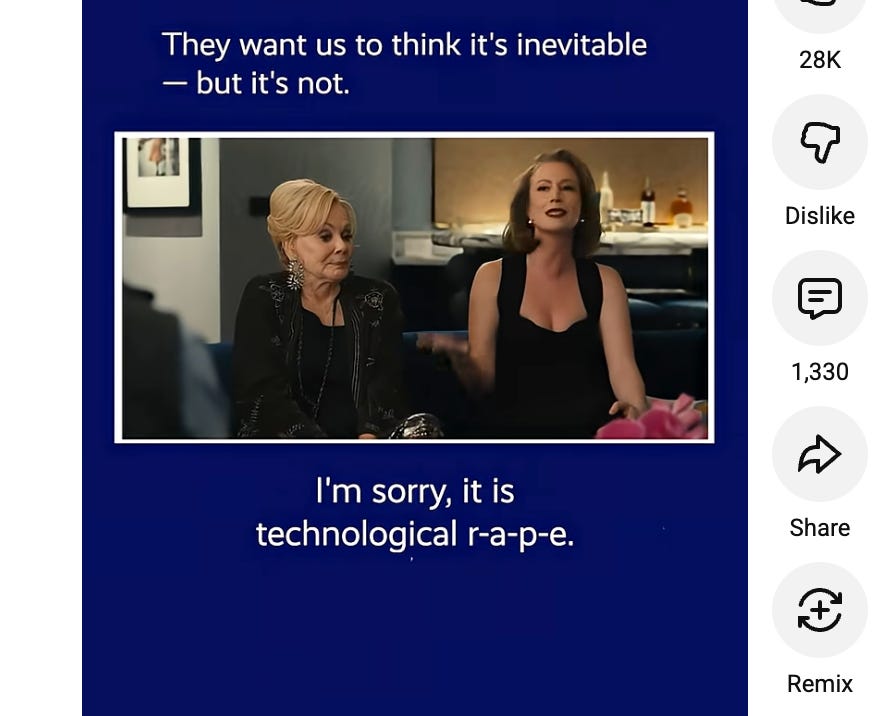
So, thanks to Ms. Einbinder for letting me take her name in vain these past couple months. As a goodbye I’ll give her the last word, with this anti-AI rant from her Hacks’ character:
And that’s what’s converging this week! See you next time.