


Welcome to CONVERGER, a (mostly) biweekly newsletter mapping the content singularity where AI and the internet collapse all media into one—a connective node where emerging technology, policy, culture, futures thinking and storytelling intersect.
<<Achievement Unlocked: CONVERGER was cited in the New York Times!>>
Some issues may be heavier on media commentary, others on AI policy, others on personal passions like sci-fi’s influence on technology (both for good and bad) or the evolving medium and business of comic books in the digital age. You never know what threads might come together in convergence-space!
I’m Kevin Bankston, your host. You can watch me develop newsletter content in real-time on LinkedIn and the social network formerly known as Twitter, and less often on Bluesky and Instagram.
IN THIS WEEK’S EDITION, we depart from our usual format of multiple features and shorter fragments in order to focus on a single feature, nearly 10,000 words on a topic I’ve never seen any other media critics tackle.
The subject: the politics of comic books, a medium and industry that I’m both personally and professionally fascinated by, and also have been learning to write for as described in CONVERGER #3 — “How I ‘Engineered Wonder’ by Making Comic Books”.
So, no AI or internet angles today; instead, we’re focusing on how the particular features of the comic book industry have resulted in some distinct political themes emerging simultaneously across the biggest titles published by the “Big Two” publishers, Marvel Comics and DC Comics.
Put simply, today’s comic book heroes are unapologetically woke AF. But they may not be allowed to remain so for much longer…
When Villains Rule: How Marvel and DC Comics Became the Unexpected Anti-Trump Art Form
The biggest current superhero events from Disney’s Marvel Comics and Warner Bros.’ DC Comics share one premise: the villain has already taken over, and the heroes are the resistance. This is the superhero genre reacting to its political moment, which it has done since 1938 and can do faster and cheaper than film or TV. But will this anti-authoritarian streak at the big corporate comic publishers survive DC’s potential takeover by the Ellison-owned Paramount Skydance and Marvel’s move from New York to Hollywood?
TABLE OF CONTENTS
I. Marvel’s Ultimate Universe: Insurgent Avengers Fighting for Global Revolution
II. In Another Marvel Universe: The Doom Reich and the New American World Order
III. DC’s Absolute Universe: Underdog Heroes Combatting Oligarchy in a Rigged Game
— Absolute Batman: Beating Down Billionaires and White Supremacists
— Absolute Superman: An Absolute Immigrant Fighting Corporate Exploitation
— Absolute Green Arrow: The Luigi Mangione of Superheroes
IV. Elsewhere in the DC Multiverse: Batman Fights Bad Cops, Wonder Woman Fights ICE, Peacemaker Fights Nazis, and Superman Fights…Israel?
V. How Did Comics Become the Anti-Trump Art Form?
— The Personal Politics of the Comic Book Creators
— The Historic Cycle of Political Superheroics
— Comics as a Fast-Adapting Barometer of the Culture
— The Increasing Diversity of Comic Book Fandom
— Politics in Comics Have Flown Under the Corporate Radar…So Far
VI. Will Comics’ Anti-Authoritarian, Anti-Oligarch Streak Be Allowed to Continue?
The villains have won.
Heroes who in normal times would champion the status quo are now underdog resistance fighters battling a new normal of authoritarians and autocratic billionaires.
This may sound like the world outside your door. But it’s also the core idea at the heart of the past several years of comics publishing from the “Big Two” dominant corporations of the medium, Marvel and DC:
Marvel’s new Ultimate Universe, a multiversal variant of the regular Marvel Universe created through the manipulations of a megalomaniacal supervillain, where the Avengers are revolutionaries fighting to overturn a global authoritarian regime;
Marvel’s mainline universe, where first the devious Doctor Doom finally succeeded in his dream of conquering the world, a world where many welcomed his fascist regime because of its blunt effectiveness, and—now that Doom’s regime has crumbled—where the warmongering Red Hulk is using the power vacuum to try to build “Planet America,” a new world order enforcing his vision of American “freedom” and dominance;
DC’s new Absolute Universe, a pocket universe created by DC’s most powerful cosmic villain, where the tables have been turned such that the heroes are the underdogs and the villains have all the power—for example, where Batman is a working class engineer and the Joker is a monstrous billionaire, and where Superman is much more explicitly an immigrant outsider; and
DC’s mainline universe and its cinematic universe, where Batman is fighting brutal cops in a corrupted police department, the Peacemaker is trapped in an alternate universe where the Nazis won, and Superman is defending an ethnic population against a genocidal invasion.
Noticing some recurring themes here, perhaps?
Today we’ll visit these universes one by one to identify their obvious commonalities, theorize how and why these common themes have emerged, and consider whether such counter-cultural narratives have a future at either publisher. I identify five key contributors to this trend, beyond the rise of Trumpism itself inviting a reaction:
The creators’ own progressive politics, which they are not shy about;
The comic book medium’s long history of using superheroes to comment on politics from a liberal perspective;
The speed and cheapness of comics giving the medium more agility and creative latitude compared to other media when responding to political conditions;
The increasing diversity of a comic book fandom that used to be predominantly male and white; and
The tiny economic size and stakes of the comics industry compared to other media, which has tended to allow its content to fly under its corporate parents radar.
That last factor, however, may soon be changing.
I. Marvel’s Ultimate Universe: Insurgent Avengers Fighting for Global Revolution
Kicking off modern comics’ the anti-authoritarian trend in November 2023, Marvel launched its new Ultimate Universe (Earth-6160) to support a line of reimagined versions of leading heroes like Spider-Man, the Avengers, and the X-Men.
This particular strand of the multiverse is quite different from the traditional Marvel Universe (Earth-616), which is fairly different from the Marvel Cinematic Universe (Earth-199999), which is pretty similar to the original Ultimate Universe of the 2000s (Earth-1610)...but I digress.
In this new Ultimate Universe, an evil version of the Fantastic Four’s Reed Richards called the Maker traveled back in time and rearranged history so that most of the heroes we know and love never became heroes, thus enabling him to take over the world. Only recently have a few heroes begun to emerge and work to counter the Maker’s warping of history, leading to a new set of heroes led by a young Tony Stark, an older Peter Parker who is already married with a kid before becoming Spider-Man, and a brand new set of mutant X-Men.
The overarching story of all of the Ultimate titles—The Ultimates (i.e., the Avengers), Ultimate Wolverine, Ultimate Black Panther, Ultimate Spider-Man, Ultimate X-Men, etc.—is a story of revolution, where these new heroes are explicitly cast as underdog insurgents. They must work to build a resistance network of humans and superhumans to take down the tech-enabled authoritarian Maker and his crew of globe-dominating supervillains, many of whom are twisted versions of characters that were heroes in other universes.
The architect of The Ultimates, hot young comics writer Deniz Camp (also known for politically edgy indie hits 20th Century Men and Assorted Crisis Events) working with artist Juan Frigeri, wears his politics on his sleeve both in real life and in his Avengers stories. He’s the type of unabashedly lefty creator who (IMHO admirably) will use his platform at New York Comic Con to wear a Free Palestine t-shirt on stage and (IMHO sensibly) wear an N95 mask when doing signings. Sadly but unsurprisingly, he’s received death threats as a result of his politics.
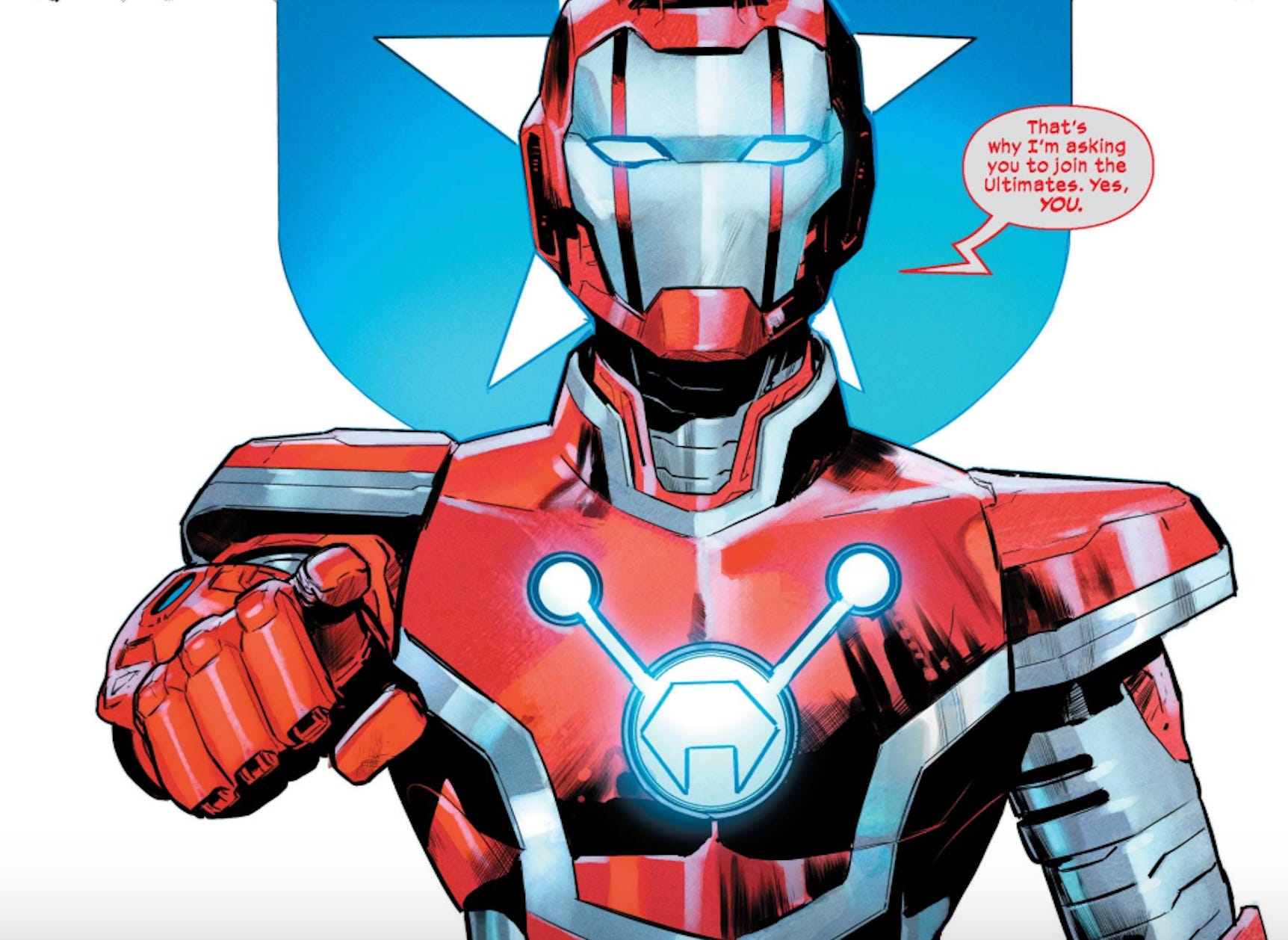
And those politics directly shine through in The Ultimates. Camp has described his superhero team as “a resistance network in occupied territory,” modeled on the partisans of World War II. The team’s leader, the young Tony Stark a.k.a. Iron Lad, builds a decentralized, encrypted-app-enabled movement of ordinary people in addition to his super-team.
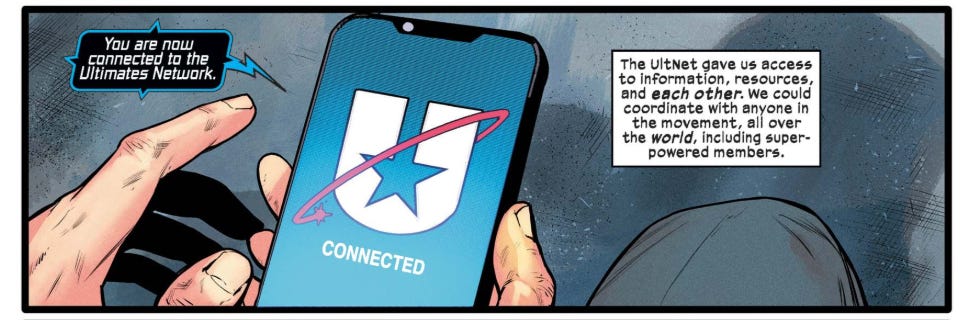
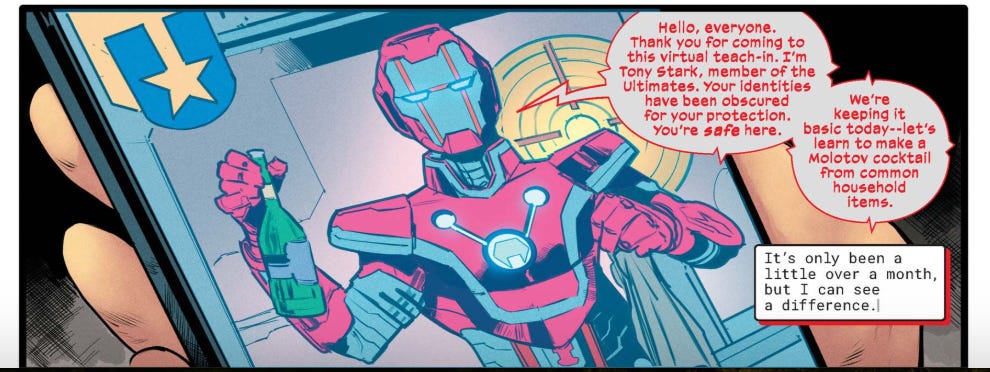
Camp, a son of Turkish and Filipina immigrants, has said he rejects the “great man” theory of history: his hero is the movement, not the lone superheroes. “The team itself is the hero,” according to Camp:
[W]hen I look around [at] the people that are now considered heroes they don’t come out of nowhere, they emerge from movements: in the past Martin Luther King or Rosa Parks were not individuals acting on their own, these were people born out of a movement. The Ultimates reflects how real-world change happens: through collective effort, not individual genius.
In the comics, the “Ultimates Network” that Iron Lad helps enable ends up growing to include a vast coalition of civilians. Leading up to the finale, this global collective rises up en masse when Stark hijacks the global airwaves to call for revolution in a sequence that one reviewer read as directly addressing the deployment of federal troops in U.S. cities. And really, how could you not, with imagery like this?
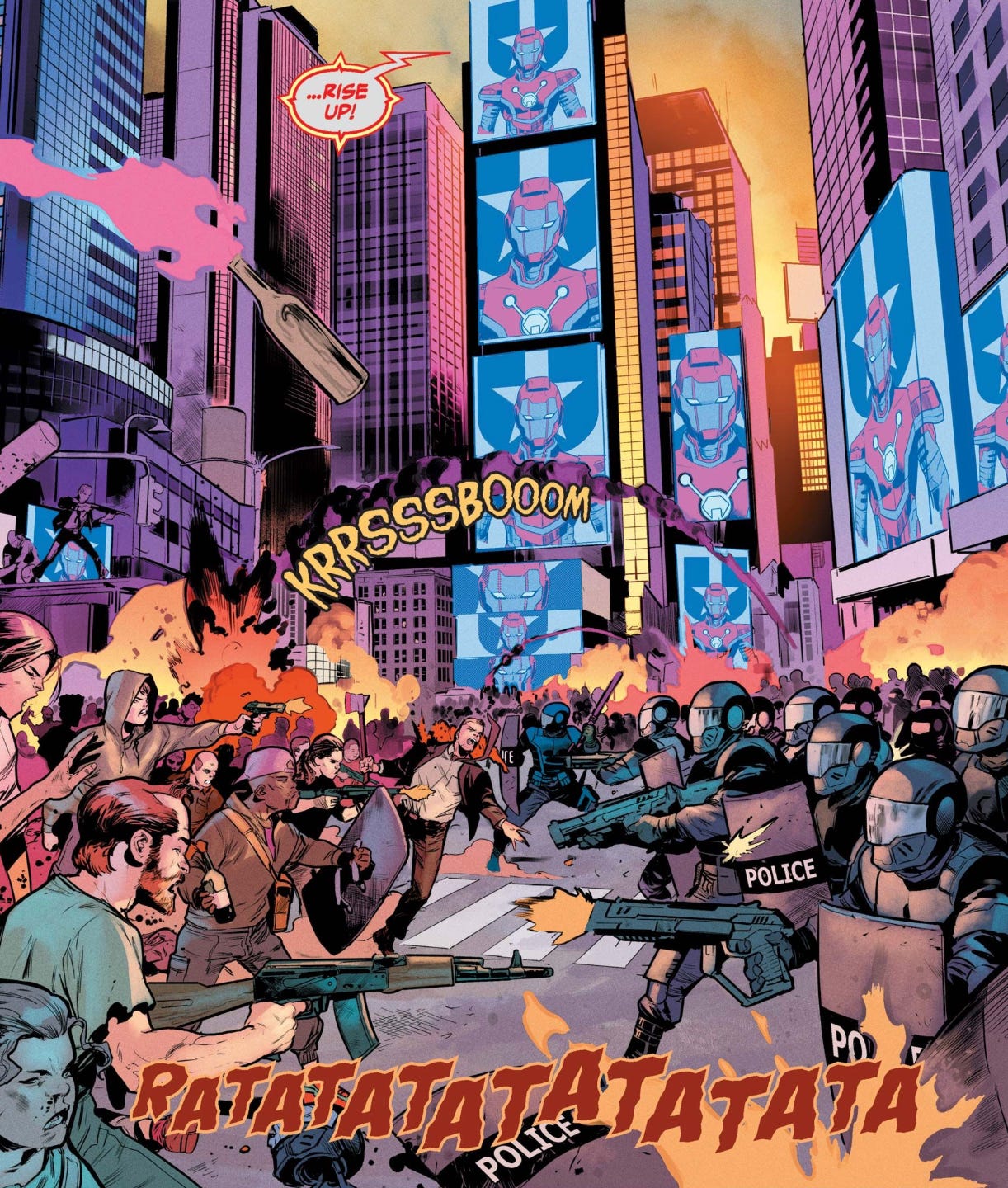
These left-wing revolutionary politics are threaded through many of the other Ultimates characters and their often overtly anti-colonialist storylines.
For example…
Ultimate Hawkeye is Charli Ramsey, a they/them-pronouns Two-Spirit Oglala Lakota character whose community is exploited by the oil corporation Roxxon; Camp modeled Charli on the Standing Rock water protectors, and their arc focuses on sabotaging Roxxon’s refineries and pipelines;
Ultimate She-Hulk is Lejori Zakaria, a Pacific Islander whose home was used as a gamma-bomb test site and whose sickened and mutated community was written off as disposable, a story of nuclear colonialism rooted in America’s real history in the region;
Ultimate America Chavez is an immigrant from another dimension who, after the Ultimates free her from imprisonment and exploitation by a corrupt White House under the Maker regime, defends an independence rally in Guatemala;
Ultimate Luke Cage leads revolts inside the prison system that enslaved him, transforming it into a network of prisoner-run “autonomous self-governing collectives;” and
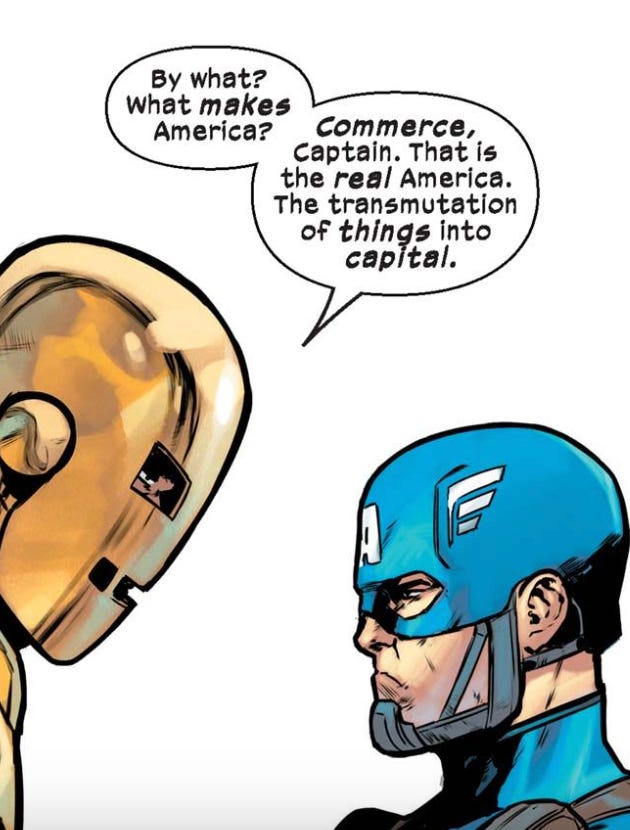
A disillusioned Ultimate Captain America is forced to face the possibility that the American promise he fought for was never freedom but profit, though he still has his priorities straight: he always has time to fight neo-Nazis. “Nazis are always a priority,” he says when Iron Lad tries to focus him on other threats.
Ultimately (pun intended), after two years of preparation by these dedicated “terrorist” super-revolutionaries, the uprising against the Maker within the Ultimate Marvel Universe is successful. His global authoritarian regime was finally overthrown, and the story of the Ultimate Marvel Universe ended (for now) in the giant-sized Ultimate Universe Finale in June.
However, the spread of authoritarian power doesn’t end at the border of Marvel’s alternate universe; it’s also taken up a years-long residence in the regular Marvel Universe. Back in the old 616 Universe that is home to the traditional Marvel heroes we know and love, villainous fascist regimes have become the rule there as well.
II. In the Other Marvel Universe: The Doom Reich and the New American World Order
In the traditional Marvel Universe, the entire world spent last year in the grip of planet Earth’s most powerful villain, Doctor Doom.
A master of magical dark arts encased in a powerful suit of tech-armor, merciless dictator of the fictional Eastern European country of Latveria, Victor von Doom is the oldest foe of the Fantastic Four and the most consistent thorn in the Marvel heroes’ sides. And in 2025, over the span of a nine-month cross-series event called One World Under Doom, he took over the world overnight with a little help from his new status as the world’s Sorcerer Supreme, a role he usurped from hero Doctor Strange the previous year.
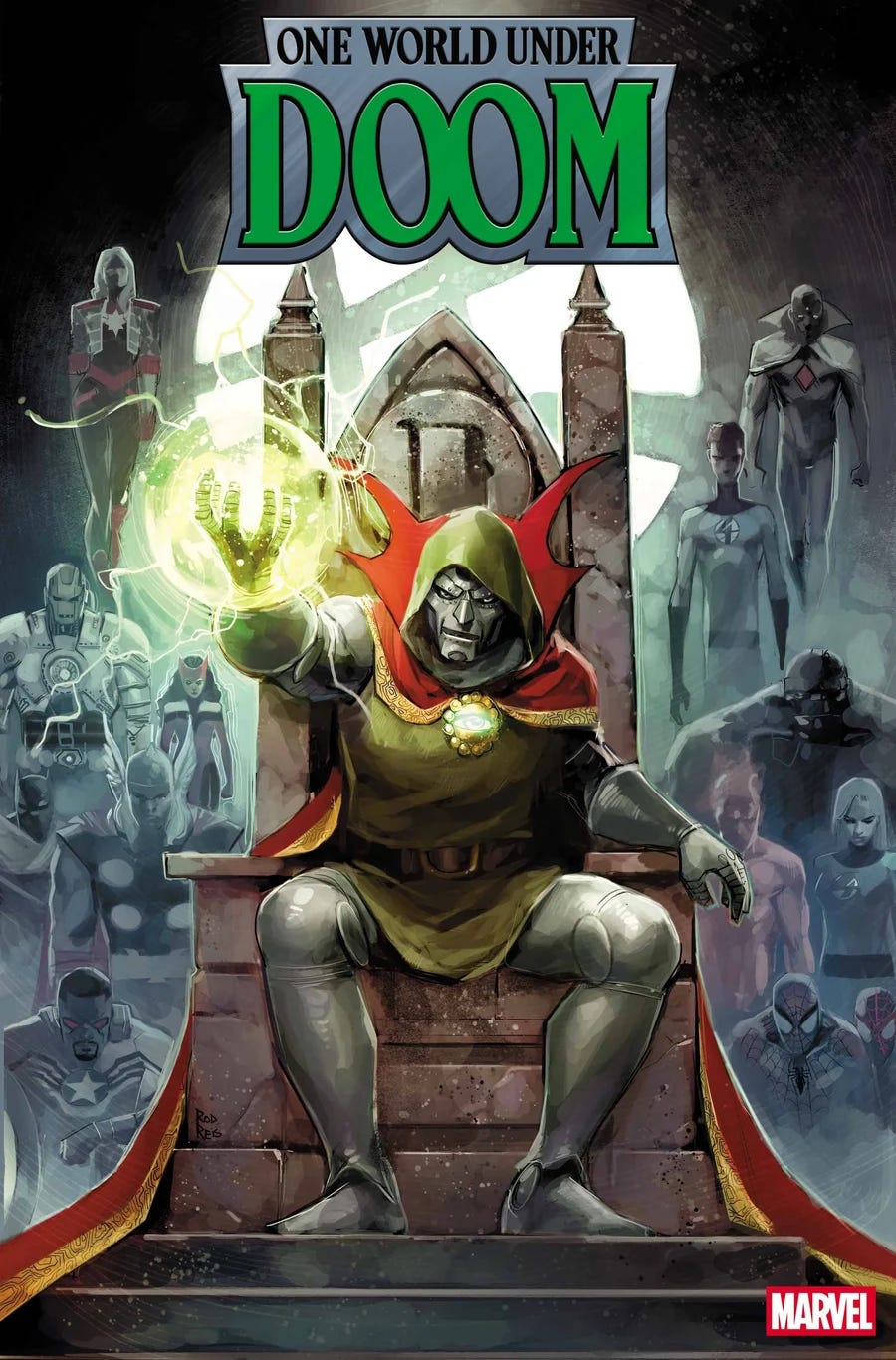
But Doom didn’t (directly) use magic to take over. As he first addressed the United Nations in issue one of the main event series, it seemed that the globe’s leaders of the world submitted to his power voluntarily, convinced that he was the only one who could save the world.
As Doom explained when taking on the mantle of world ruler, echoing Trump’s repeated claims that “I am the only one who can save this nation”:
Nothing can save you, save for the enlightened rule of a single person who can make the hard choices. One who is above being bribed, being corrupted, who does not care about petty comforts that confound other men. Doom is above money. Doom is above desire. Doom is above all. And in his magnanimity, in his pity, in his greatness...Doom will save you.
Doom proceeds to rule as an apparently benevolent strongman: he outlaws war, ends existing conflicts, and mandates free universal healthcare, free public education, and open borders. Like the Italian fascists, he makes the trains run on time—and the people love him for it. The Marvel heroes assume Doom must be exerting mind control to take power but leaders and then the public follow him willingly, approving of his rule because the world was broken enough that a competent tyrant feels like a relief. Doom, convincingly, argues that the superheroes now complaining of his rule have been selfishly squandering their powers by failing to shape human society for the better.
One World Under Doom’s writer, Ryan North, has been clear that his story (with art by R.B. Silva) is about fascism:
That’s a fantasy, right? That’s a fantasy of What if there was one perfect person who could come down and fix everything for us? And that’s a dangerous fantasy, that’s an anti-democratic fantasy. So in one sense, [One World Under Doom] is a story of a fascist leader trying to take things over, and succeeding in doing that. When you look at fascism as a political system, you have to see that it’s sold on that seductive fantasy of Here’s a guy who can fix everything. This man alone can do it. Doom sees himself in that way. He’s the kind of guy who’s like, “Yes, OK, yes, that is fascism. But when I’m doing it, it’s not fascism, it’s the actual best guy doing it, so it’s fine.”
Other storylines in the Marvel Universe took on similar politically-tinged themes during Doom’s rule. For example, Spencer Ackerman—a Pulitzer-winning national-security reporter and critic of the national security state, author of the Forever Wars newsletter and the book Reign of Terror: How the 9/11 Era Destabilized America and Produced Trump—took over writing Marvel’s Iron Man in 2024 working with artist Julius Ohta. After having Tony covertly plot an oil pipeline bombing against Roxxon in his first storyline, he then sent Tony Stark underground to help rebel cells combat the Doom regime in his second storyline, pointedly entitled “The Insurgent Iron Man,” where Tony returns to his arms dealer roots to supply the revolution.
Of course, Marvel’s champions of the status quo eventually do defeat the Doom regime, disrupting his cult of personality by exposing his true nature. Fantastic Four’s Reed Richards reveals in a televised debate what his fellow heroes have discovered upon infiltrating Doom’s sanctum in Latveria: that he has been magically feeding off of the souls of a million imprisoned Latverians, including children, to maintain his power. Superheroes fight and beat Doom, yada yada yada, world leaders shamefully pretend they were under his mind control the whole time, and things go back to normal, right?
But then they don’t: enter another authoritarian threat in the form of General Thaddeus “Thunderbolt” Ross, the military officer who over the decades pursued Bruce Banner’s The Hulk until he himself was transformed by gamma radiation into a hulk himself—the Red Hulk.
The Red Hulk had been a prisoner of Doom’s in Latveria during much of the One World Under Doom crossover, but at the end of that story when Doom has been defeated, Ross plants an American flag on top of Latveria’s Mount Doom and takes control of the nation, calling it “New America.” He then immediately invades the neighboring country of Symkaria to impose his version of “democracy.” One must wonder whether he might attack Greenland, Venezuela, or Iran next.
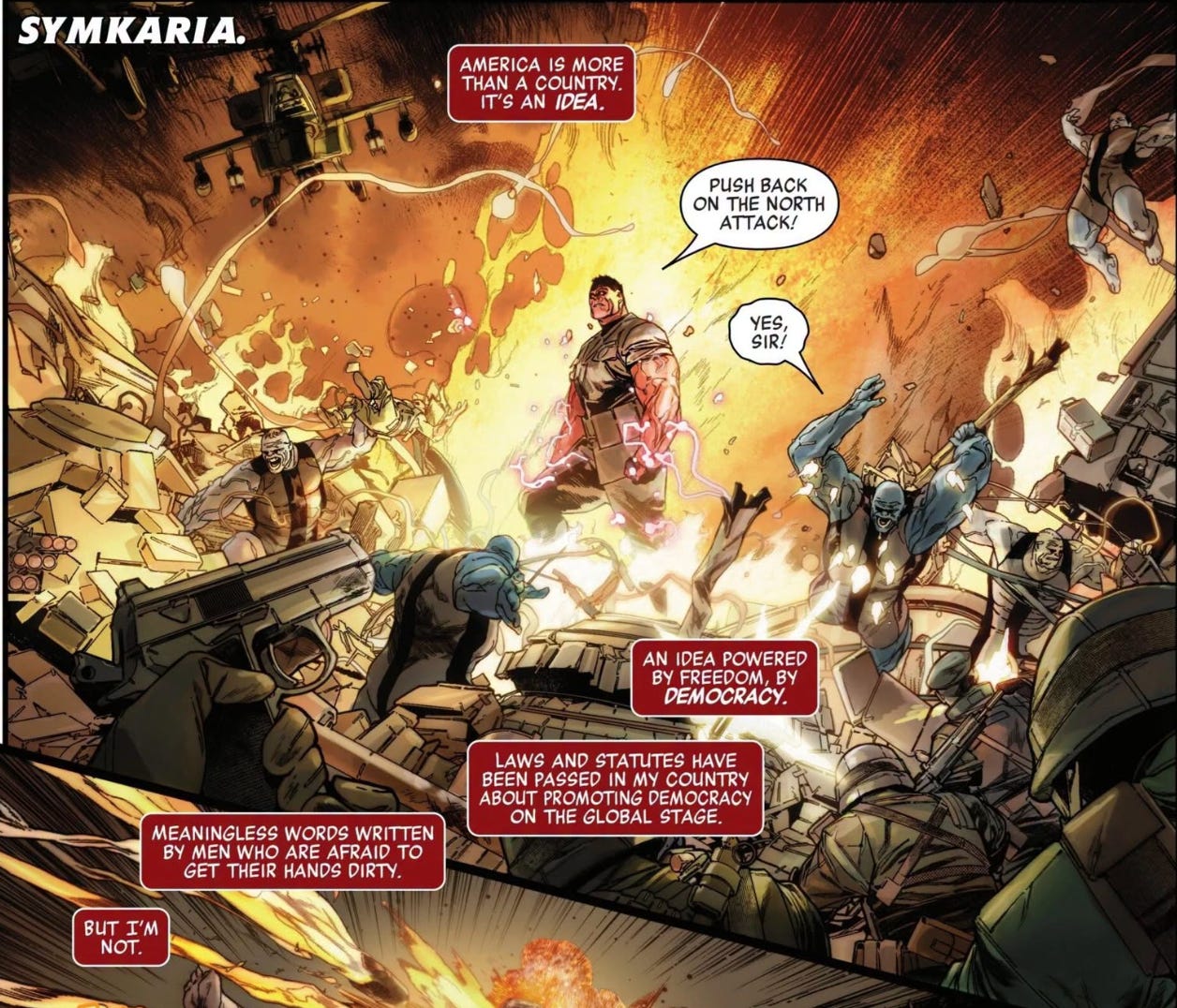
It turns out that while in Latveria, the Red Hulk has seen a vision of the future using Doom’s infernal prediction machines used to compute likely future timelines: a vision where he as global President has successfully imposed his version of American virtues upon the world.
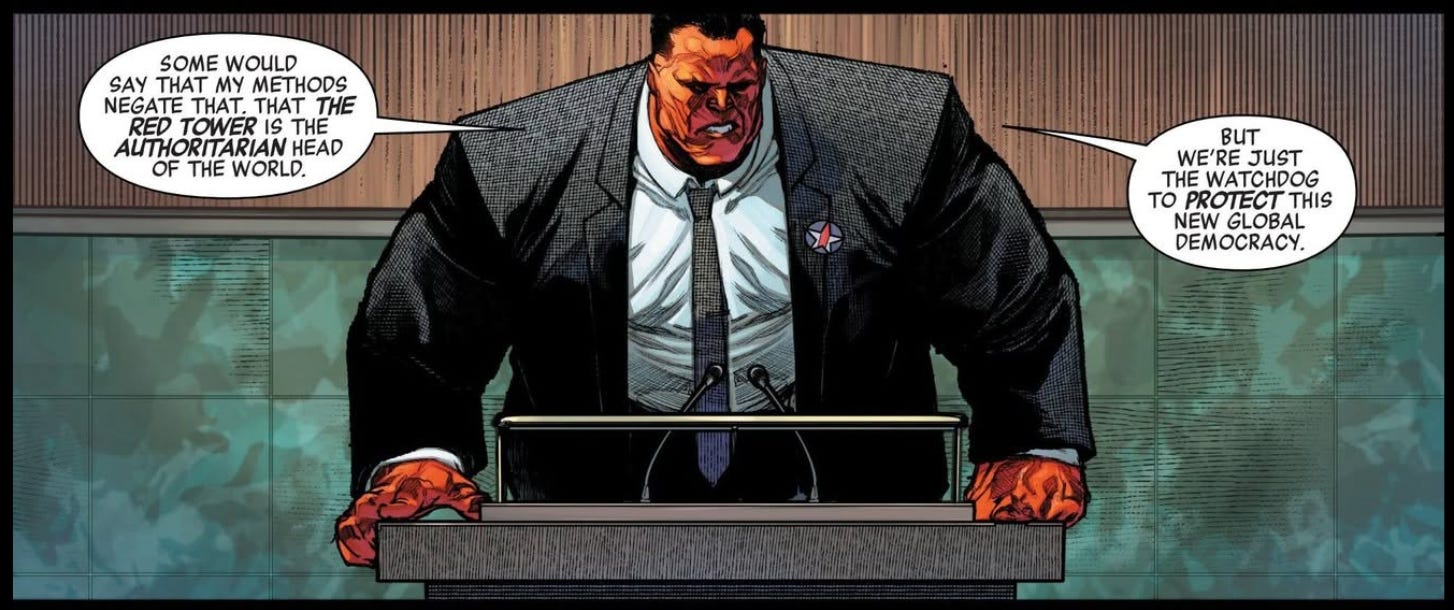
And now, with a growing army of Hulk soldiers and more-than-a-little-Nazi-ish uniform tailoring, he is going to pursue his plan for a “Planet America.”
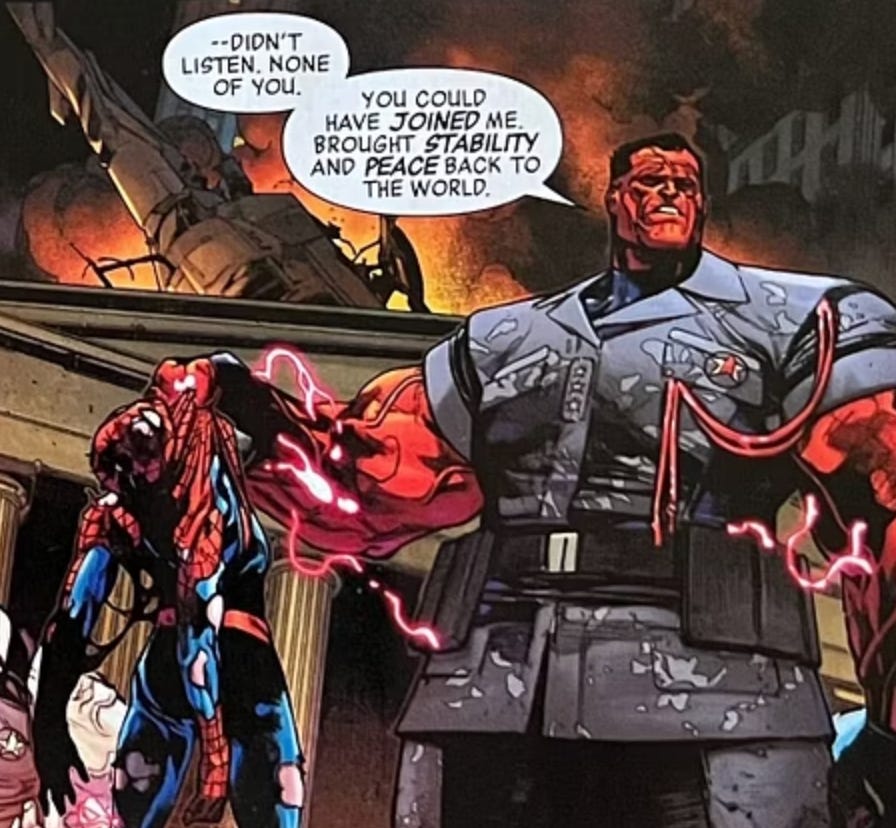
This new Red Hulk storyline—under the title of Avengers: Armageddon, written by Canadian Chip Zdarsky with art by Delio Diaz—only launched in June, so our Marvel heroes are still very much in the midst of fighting this latest Trump-echoing American imperialist villain. One wonders what the next authoritarian threat for our heroes will be after this one is inevitably defeated.
Nor are those threats unique to the Marvel Universe. At the very same time that Doom and Red Hulk have been playing fascist, over at DC—Marvel’s “Distinguished Competition,” as Stan Lee used to put it—legendary heroes like Superman, Batman and Wonder Woman are also fighting a globally dominating evil that is more subtle, a bit less overtly political, but even more pervasive.
They are fighting the odds in a darker, harder world that was literally created by the villain.
III. DC’s Absolute Universe: Underdog Heroes Combatting Oligarchy in a Rigged Game
Launched in October 2024 to help revitalize DC’s creative and economic foundations, much like the Marvel Ultimate universes before it, DC’s Absolute line takes place in a separate universe from the regular DC timeline with fresh new versions of its heroes designed to appeal to a new modern audience.
And, much like with Marvel’s Ultimate Universe, the conditions of the Absolute Universe were essentially defined by a villain who altered the world to stack the deck against its heroes. The architect of the Absolute world is Darkseid—the most powerful cosmic villain in the DC Universe and the authoritarian ruler of the hell-planet Apokolips. The Absolute Universe is all a part of a plot to enhance his power, which relies on something called Omega energy—basically, evil entropic energy, the opposite of the energy of creation, Alpha.
In the DC All-In Special that kicked off the Absolute run in October 2024, Darkseid strategically engineered his own “death” to unbind himself from the traditional DC Universe so that he could gain control of another reality in the multiverse, a primordial “alpha world” that he could shape as he wished. His wish was for a darker, harder universe where villains win, a world driven by “challenge” and “turmoil” rather than the “life” and “hope” that drives the regular DCU. Darkseid’s goal: a world that would generate Omega energy rather than Alpha energy, enabling him to grow even more powerful as he lurks in the background.
Turns out, comics readers were as eager for this dark turn as Darkseid. Although intended as an experiment, the Absolute Universe has quickly become the most successful part of DC’s comics business, blowing past sales records as new and old readers have been sucked into this parallel universe architected by Scott Snyder, a writer previously best known for working on the mainline Batman titles and creating a range of indie horror comics. And no title has been more successful than Snyder’s own Absolute Batman, which has become the most consistently best-selling comic in the industry right now.
Absolute Batman: Beating Down Billionaires and White Supremacists
The clearest key to Absolute Batman’s appeal is simply its art by now-superstar artist Nick Dragotta. His dense, expressive, very manga-influenced style, and his ridiculously, cartoonishly swole design for Batman—a pin-head on top of an absurdly muscle-bound body—is just plain fun, and the first cover depicting this new Batman absolutely (no pun intended) leapt off the shelves.
The comic also portrays a darker, less naive, more modern vision of superheroics, where Batman is much more of a hot-tempered take-no-prisoners bone-crusher than the cooler, calmer Bruce Wayne we’ve known before. The comic takes Batman to ludicrous (and ludicrously entertaining) extremes: the humongous bat symbol on his chest turns into a massive bat-shaped battle axe with which to lop off bad guys’ extremities; his costume can exude huge spikes on which to impale his enemies when they attack; and in one now-notorious issue he drop kicks an evil child into Gotham River. This guy is, as Snyder frames it, “Batman AF.”
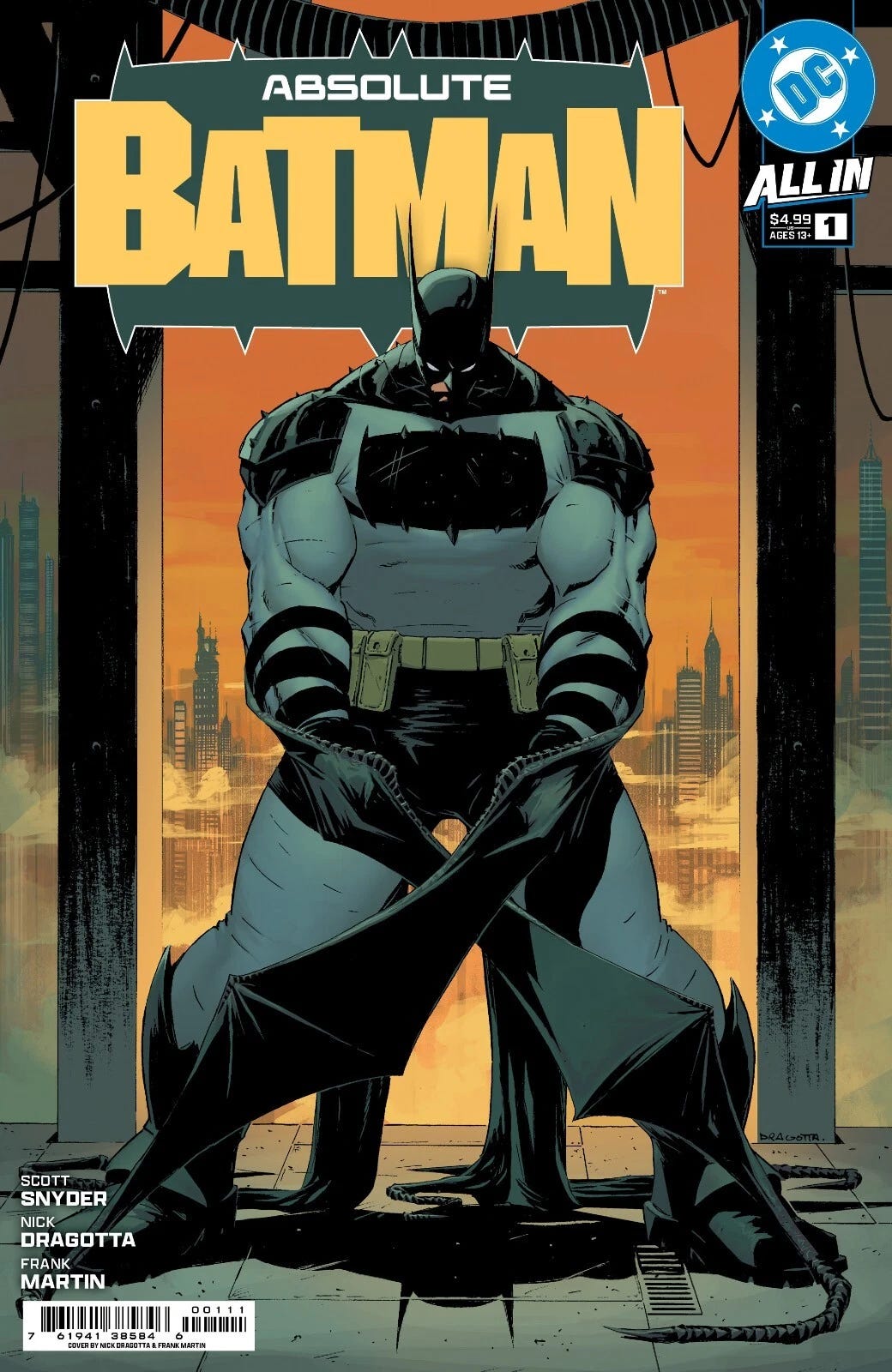
But another key to Absolute Batman’s popularity is also the key to its politics: this younger Bruce Wayne who has just started his journey as Batman is an underdog in a world where the villains have all the power. Bruce is a working-class civil engineer who works construction. He has no generational wealth to back up his one-man war against crime. He has no Wayne Manor, no Batcave, no Wayne Industries, no Alfred (well, there is an Alfred, but instead of Bruce’s butler he’s a black ops spook who becomes one of Bruce’s allies).
Instead, in the Absolute Universe, the villains are the ones with all the resources and all the power. In particular, the Absolute Joker—Batman’s nemesis—is now a scheming billionaire with a global reach who drives most of the conflicts and bankrolls or breeds in a lab most of the villains that Bruce must face. In a very direct way, and as Snyder tells it in response to the politics of the current moment, Batman’s nemesis represents entrenched generational wealth:
With Batman, a story I’ve always wanted to do is, what if Batman, instead of being a part of the system and having the resources that Bruce Wayne does, came from a working-class background? What if he comes up in a world like today, where wealth is even more stratified? Where the generational billionaires are often the people that seem to be antagonistic to the rest of us. This is the way I pitched the Absolute universe.
He’s even more direct in another interview, making an apparent reference to Elon Musk’s support for Donald Trump in the 2024 election: “The Joker in our story is a longtime Davos-attending, multi-company-owning, entrenched evil figure. But I pitched that before we had billionaires openly manipulating democracy. The world caught up.”
And although the Absolute Batman starts out a loner, Snyder’s goal is to illustrate the same core lesson as Camp’s The Ultimates. From a podcast interview:
What makes a comic good to me is when you have something to say and you know that you are saying it like every issue. For me, like Absolute Batman has a really simple message. It’s how do you change the world when you’re just one person and everyone in power has resources beyond your wildest dreams. You need more people and Batman needs to become a collective. And that’s the secret of the entire story. And it’s Bruce learning these things over time.
Further echoing our current political moment, when the Absolute Batman isn’t building a revolutionary collective to face monstrous villains backed by the billionaire Joker, he is often fighting Nazis, cops, or Nazi cops. Most notably, in Absolute Batman Annual #1 (October 2025), written and drawn by Daniel Warren Johnson instead of Snyder and Dragotta, an early-career Absolute Batman finds white nationalists harassing an immigrant woman and her son near a migrant encampment. He tracks them—including some masked white supremacist police officers—back to their headquarters where they are planning to firebomb the camp, and then proceeds to viciously (in some cases probably lethally) beat them all and burn the place to the ground.
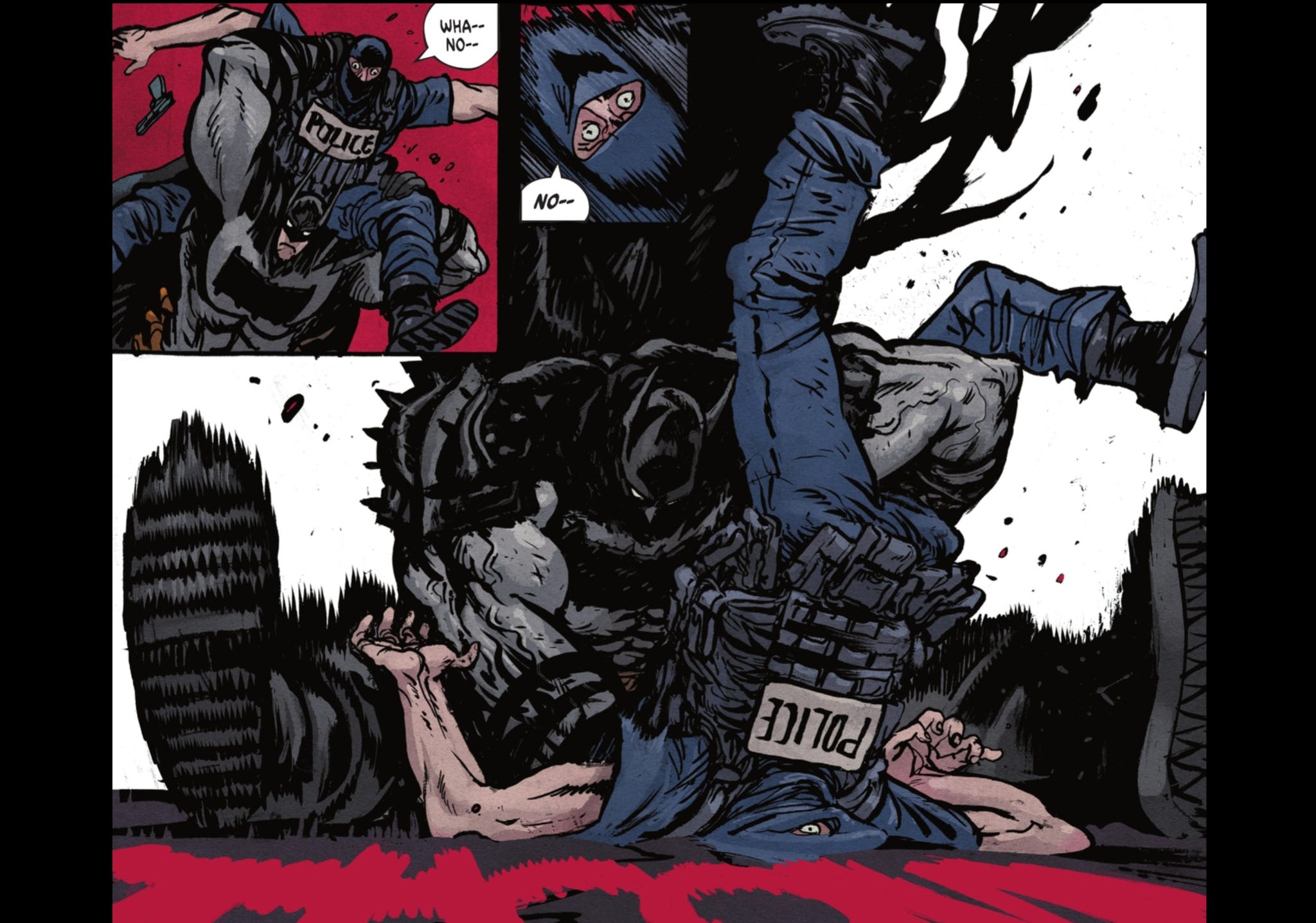
Johnson was blunt about his intent: “I don’t know, man, it’s just Batman beating up white nationalists,” and “I’m not exactly a subtle storyteller... But I’m angry and it’s coming out in these next 30 pages.” He elsewhere noted that the central image, which unsurprisingly went viral online—a two-page spread of Batman breaking a Nazi’s arm mid-salute—came to him after watching Trump’s second inauguration. Johnson predictably received both widespread praise and angry threats as a result, with the issue becoming one of DC’s top sellers for the year.
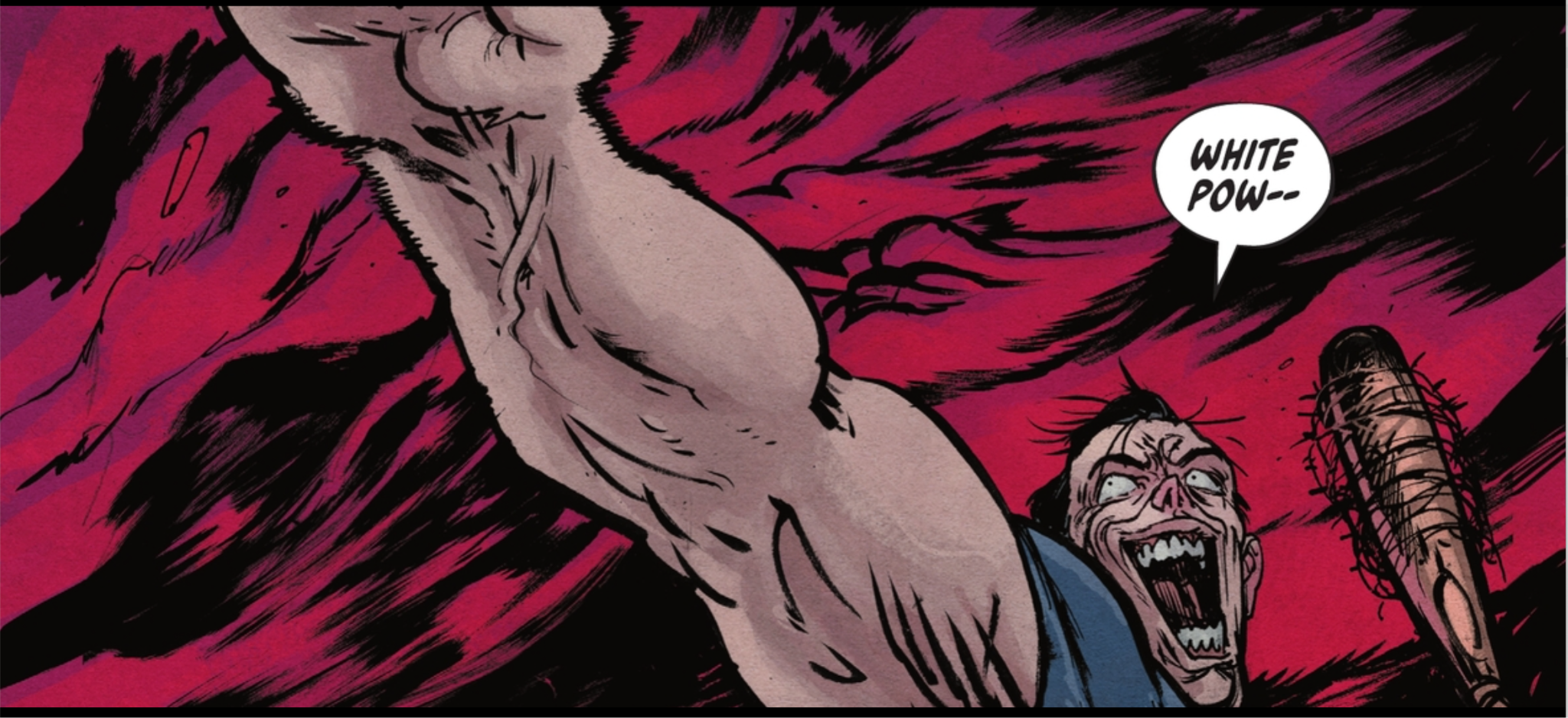
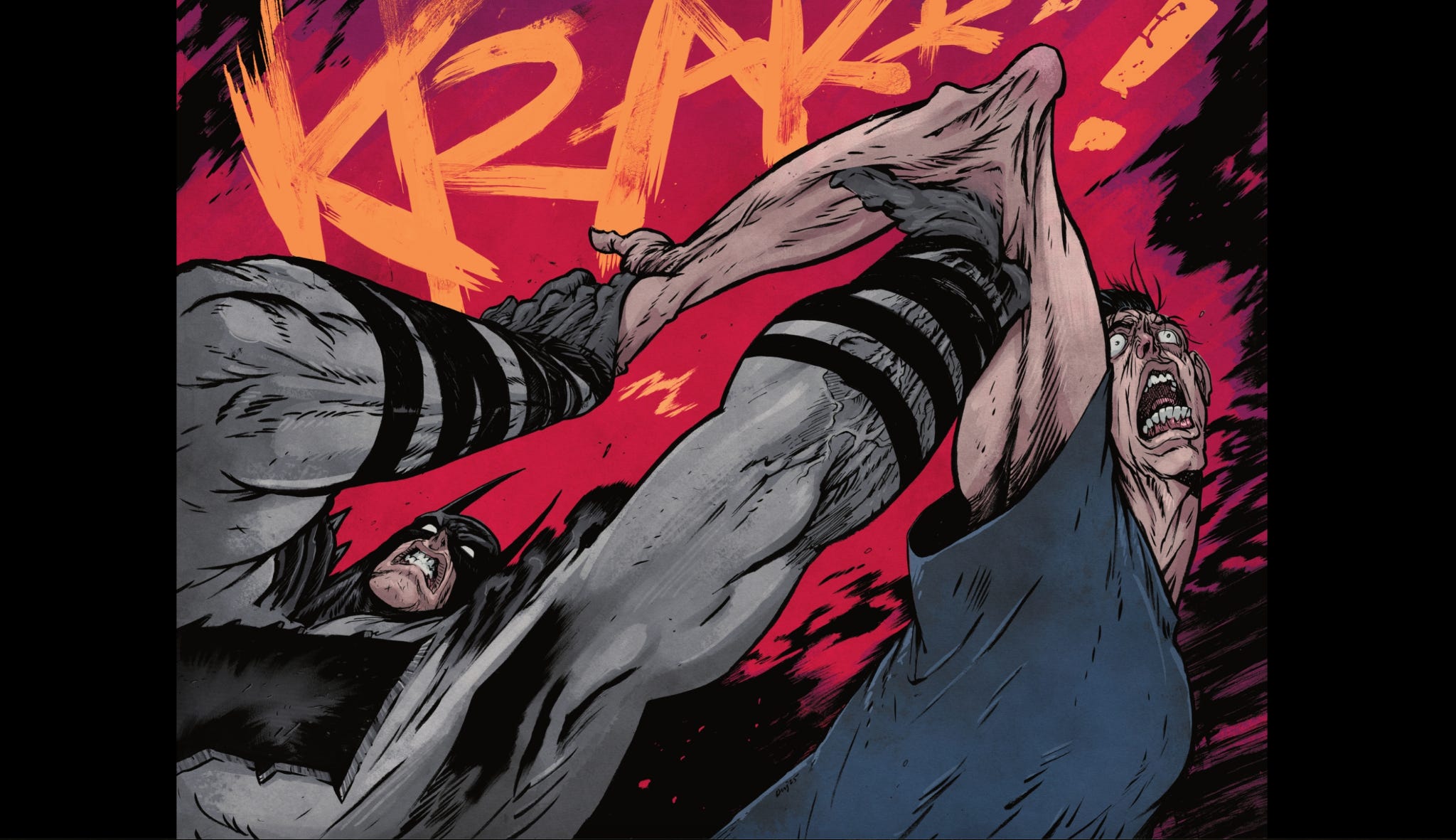
One reviewer aptly described the Absolute Batman Annual as “a garish mirror held up to the headlines,” viewing it in part as a response to ICE’s vicious campaign against immigrants. Some criticized this hyperviolent response as mere violent wish-fulfillment, “Punisher for liberals,” though it’s worth noting the comic raises the same objection itself: a priest in the story advises Bruce that the violence he is contemplating will do more harm than good. And though Batman wins the physical fight, he is at the end left emotionally devastated by shame as he remembers the lessons of his dead father, a teacher and pacifist civil rights advocate who would have been horrified by his son’s actions.
Absolute Superman: an Absolute Immigrant Fighting Corporate Exploitation
An overriding concern for immigrants and other marginalized communities, and fear of entrenched capital and its exploitation of people and the environment, is also central to the Absolute revision of DC’s flagship hero Superman. In Absolute Superman from writer Jason Aaron and artist Rafa Sandoval, Kal-El of Krypton is truly an alien—he reaches earth not as a baby to be raised by the kindly Kent family on a Kansas farm, but as a fully-formed and angry teenager raised within Krypton’s lowest labor caste of miners and farmers rather than by its scientific royalty. As Aaron explains it,
More than anything else, Kal-El is an immigrant. He’s the ultimate immigrant story. He has much more of a fully-formed immigrant identity. He’s like 13-14 years old when Krypton blows up. He grew up basically in the Kryptonian version of Smallville, so he’s got that small-town upbringing, but it happened there. So when that all is taken away from him, and he comes here, and travels a very different kind of immigrant path, he’s an immigrant in 2025, which can be a darker, more dangerous journey.
In the Absolute Universe, an old Batman villain—the century-old evil mastermind Ra’s al Ghul—has become Superman’s nemesis. Like the Joker, he’s another CEO billionaire, head of the massive and massively evil Lazarus Corporation. In Absolute Superman, Lazarus is basically an amalgam of every exploitative multinational oil or mining or agriculture corporation, systemically exploiting laborers and the planet for immense riches.
After first coming into conflict with Lazarus when the Kents refuse to sell their farm to the company, and then being reported to Lazarus’ private armed mercenaries the Peacemakers as an undocumented immigrant, Kal spends years on the run and on a most-wanted list, protecting migrant miners and factory workers in Brazil, Mexico, Vietnam, and on South Dakota’s Pine Ridge Reservation. Aaron agreed when an interviewer characterized the comic as “made for this time in America, given the extreme pressure people are under and the looming threat of deportation,” and he emphasized that Superman has “got to be a beacon. It’s not just about the cool people he can punch in the face.”
As for Wonder Woman, the third in DC’s trinity of top heroes, her Absolute version is also an underdog—rather than being an Amazon warrior raised in the supportive matriarchal environment of Paradise Island, she’s now a warrior witch who was raised in Hell—though her story doesn’t carry as much of an overt political valence as her counterparts. But the anti-authoritarian, anti-capitalist streak evident in Absolute Batman and Absolute Superman runs even harder through the recent Absolute Green Arrow series by writer Pornsak Pichetshote and artist Rafael Albuquerque.
Absolute Green Arrow: the Luigi Mangione of Superheroes
In this darker Absolute Universe, the original Green Arrow, billionaire archer Oliver Queen, was killed off by the Joker-aligned cabal of evil oligarchs in an earlier one-shot called Absolute Evil. As with Absolute Batman, the creators concluded that having yet another billionaire crime-fighting hero was not in line with the times. Instead, in the new Absolute Green Arrow series, he has been replaced by an anonymous serial killer who hunts and murders corrupt billionaires, leaving green arrows in their bodies.
To be clear, this new Green Arrow is treated as a villain—the protagonist is the superhero who is hunting him, the original Green Arrow’s old flame Black Canary. But the story doesn’t shy away from obvious real-world parallels. For example, just like Luigi Mangione after the murder of UnitedHealthcare CEO Brian Thompson, this new Green Arrow killer becomes a folk hero to many.
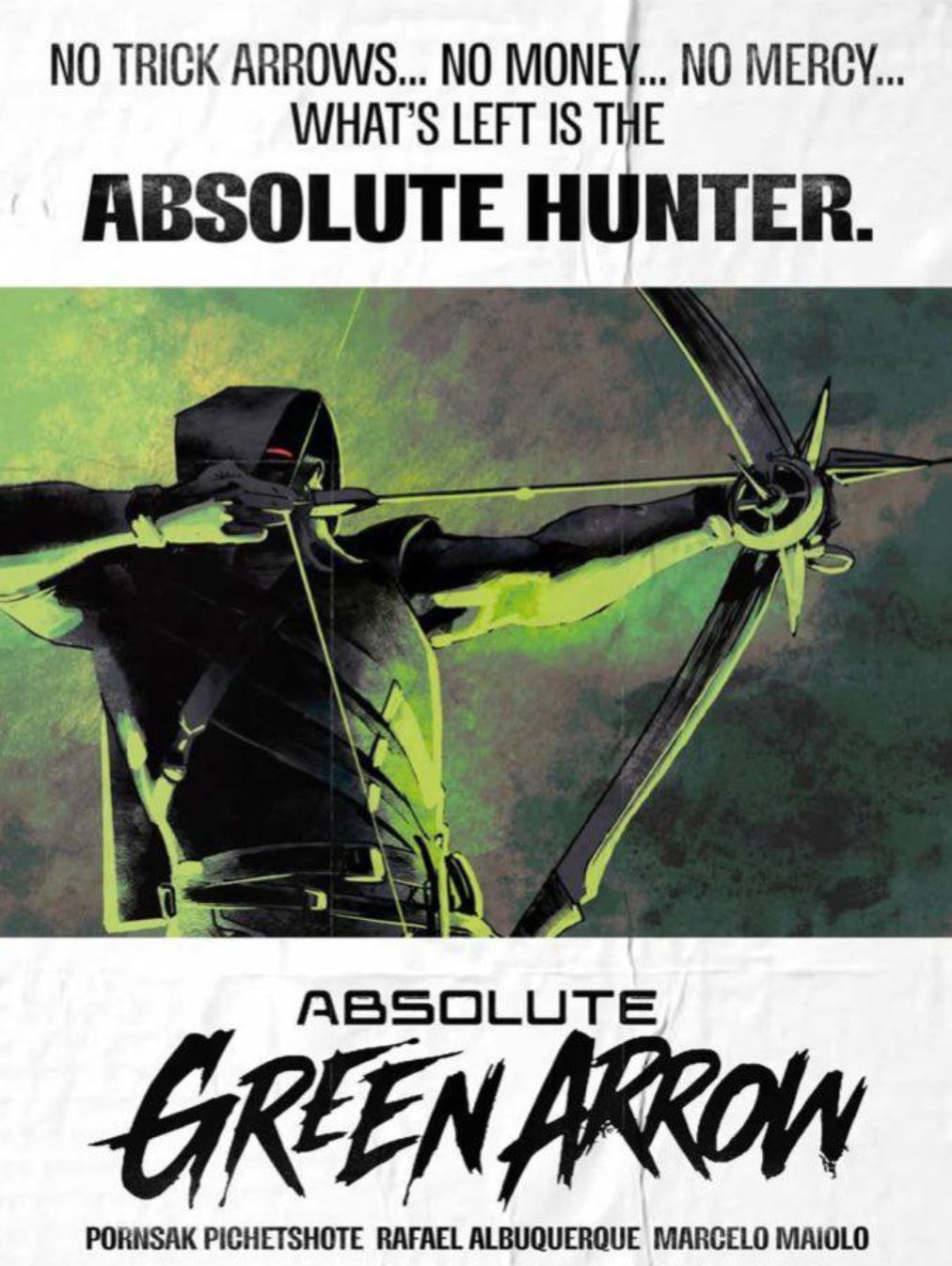
Pichetshote himself has not been shy about how he’s processing his anger and confusion about the state of the world in this comic:
Absolute Green Arrow is an angry book. It’s a reflection of the world outside our window today, and it should get you thinking about life beyond the pages you’re holding. The extremity pursued in this book, and other Absolute titles, is about more than looking badass. It’s a way to capture an emotional truth we’re all experiencing in 2026.
Going further into the origins of the book, Pichetshote explains:
There was an idea to do an Absolute villains book, but then, as the world became what the world is, I realized I didn’t want to be writing a book about bad guys who get away with doing stuff. It felt like there was enough of that in the world. I actually wanted to write about the exact opposite of that.
As one critic puts it, the Absolute Green Arrow narrative functions as an outlet for the “anger and helplessness we all feel when we read the news and see unspeakable crimes going unpunished,” providing a cathartic, fictional landscape where predatory institutions face terrifying consequences. Pichetshote uses this narrative to illustrate the same question that The Ultimates and Absolute Batman are also explicitly dramatizing: whether and how an individual can effect change in an unjust world. Pichetshote explains:
Just like the Green Arrow of the mainline universe, this Green Arrow is trying to affect change. The problem is, again, the world is different. The world is one where the institutions seem to be pushing against change. The question then becomes: What do you have to do to make change happen? How far do you have to go? How far is too far? You can make the argument that this Green Arrow might be going a little too far.
It may seem a bit risky for DC to turn one of its biggest heroes into a billionaire-murdering villain. But Absolute Universe architect Scott Snyder has made clear that these timely and controversial themes are very deliberate:
[P]eople really want riskier comics. They want comics that feel like they’re made for this moment. And I think there’s, you know, there really is a counter-narrative that happens sometimes where in rough times, occasionally publishers and other kinds of media empires sort of want to play it safe because they think that’s what people want. They want comfort food. But I’ve always believed the opposite. You know, in tough times, you want stuff that feels urgent and feels your own.
At DC, the riskier superhero stories are definitely concentrated in the Absolute Universe, but similar risks are being taken by creators elsewhere in the DC multiverse…
IV. Elsewhere in the DC Multiverse: Batman Fights Bad Cops, Wonder Woman Fights ICE, Peacemaker Fights Nazis, and Superman Fights…Israel?
While anti-authoritarian politics are more explicit in DC’s Absolute Universe, they are also present right now in other parts of the DC slate.
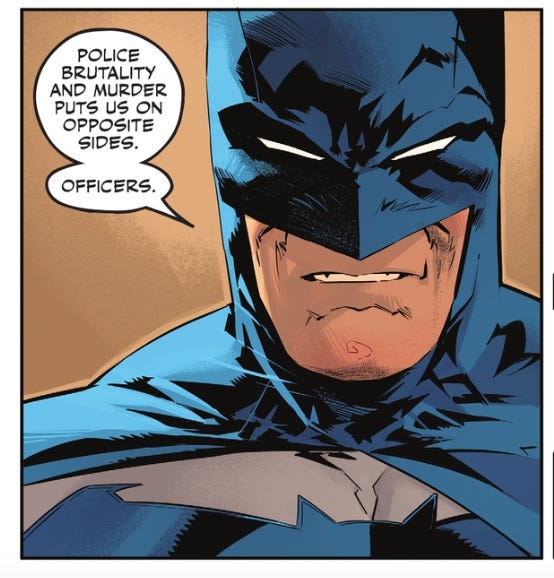
For example, back in the regular DC comics universe, writer Matt Fraction’s Batman is pitted against the newly corrupt and brutal Gotham City Police Department, now run by his old supervillain foe Vandal Savage with the backing of the supervillain Mayor, Poison Ivy. Again, villains rule.
In the second issue of Fraction’s new Batman series with art by Jorge Jiménez, the cops shoot a wounded Robin and throw him in a rough-riding transport van, a scene that evokes the death of Freddie Gray. Echoing the oft-fabricated justifications of violent ICE agents, Savage then invents a story that Batman shot a cop to justify a crackdown. In a confrontation with police, Batman’s line is blunt: “Police brutality and murder puts us on opposite sides. Officers.”
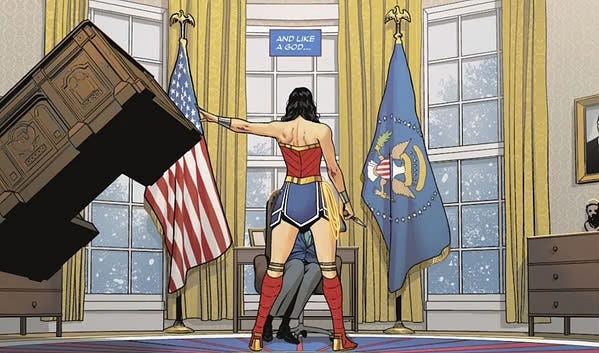
The Wonder Woman of the main DC Universe has also recently found herself as an outlaw on the wrong side of corrupt law enforcement, in a prophetic storyline that started in the fall of 2023 and unfolded through election year. At the same time Donald Trump was campaigning on the promise of "the largest deportation operation in American history," writer Tom King and artist Daniel Sampere had Wonder Woman facing off against a corrupt U.S. government run by “the secret King of America,” the Sovereign, protecting her fellow Amazons from the masked agents of ICE stand-in AXE—the Amazon Extradition Entity—tasked with removing the warrior women by any means necessary. Wonder Woman’s year-and-a-half war with the Sovereign culminates with her storming the White House, where she forces the villain to carve the word “LIAR” into his own chest before taking him to be imprisoned on Paradise Island.
Hardcore, that Diana of the Amazons.
Just as Wonder Woman was defending her own immigrant community, creators of DC’s cinematic universe were having Superman lean into his immigrant side (much like with his Absolute counterpart) as well as his pacifist politics (very unlike his Absolute counterpart). As director and DC Studios head James Gunn highlighted before the opening of the new Superman movie last summer, his movie “is the story of America. An immigrant that came from other places... but for me it is mostly a story that says basic human kindness is a value and is something we have lost.”
Those comments provoked right wing anger that grew once people actually saw the movie, wherein Superman intervenes to protect a vaguely ethnic civilian population from invasion and genocide at the hands of an aggressive neighbor, which could be (and was) read as a stand-in for Russia invading Ukraine and/or Israel invading Palestine. Gunn says the script was written before the current Middle East conflict, so a one-for-one reading may not be warranted, but there’s no arguing that the movie’s pro-kindness, pro-peace stance was a reaction to real post-Trump political trends.
The same can be said of another Gunn-helmed DC project, season two of The Peacemaker on HBO, where (spoiler alert) a mid-season twist strands the lead hero in an alternate reality where the Nazis won World War II.
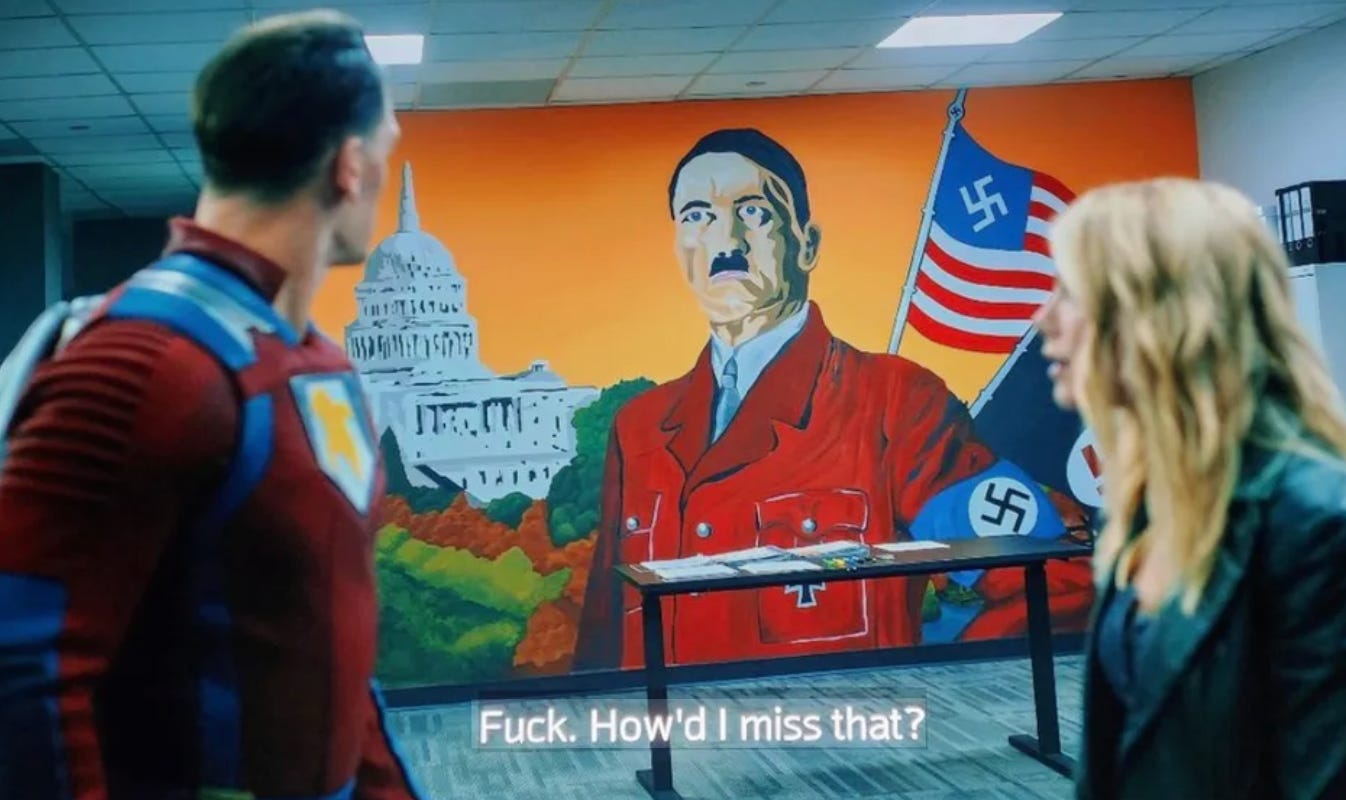
Gunn again mostly demurred when pressed to link this creative choice to the real-world political environment. Asked where the idea came from, Gunn credited Philip K. Dick’s The Man in the High Castle, not current events. Pressed on whether the political moment inspired it, he said he “can’t say for sure,” allowing that rising neo-Nazi visibility “probably has some sort of effect upon me,” but then saying, “I don’t think of it like that.”
In light of all of the above indications of a broader anti-authoritarian trend in comics media, however, it’s hard not to think of it like that. The question then becomes, why and how have these apparently anti-Trumpist thematics come to dominate American corporate superhero narratives? And will they be allowed to continue?
IV. How Did Comics Become the Anti-Trump Art Form?
Like many of my articles here at CONVERGER, this one started with an observation I made on Twitter:
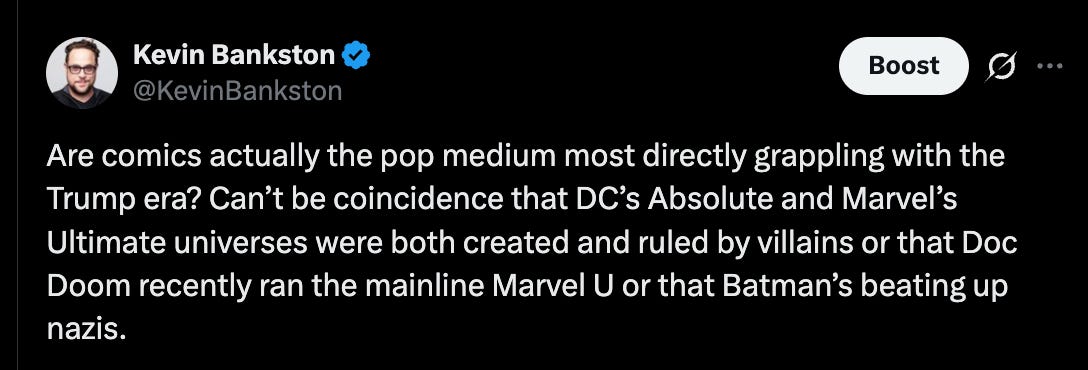
The answer, to my mind, was an obvious “yes;” the bigger question was “why?” In the same thread I offered three reasons for the trend:
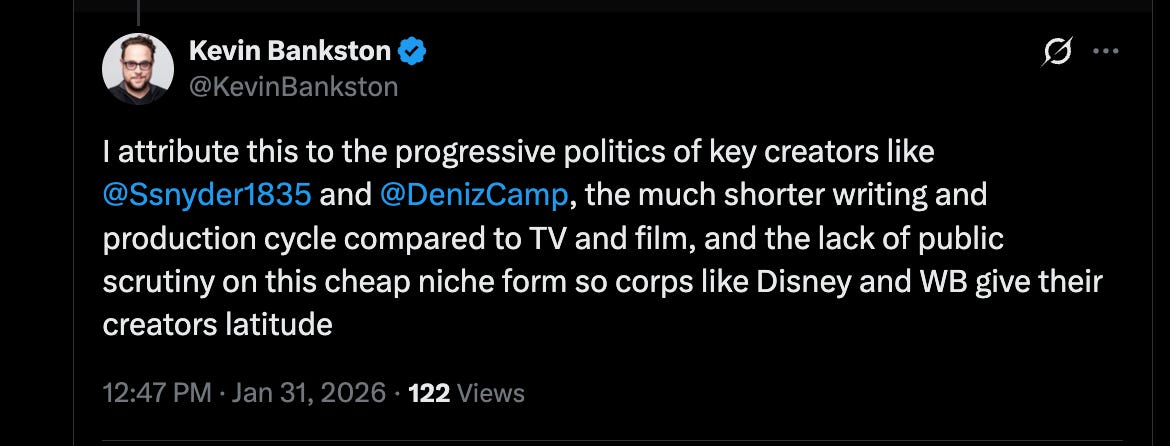
That prompted a “like” directly from The Ultimates writer Deniz Camp, which convinced me I was on to something and prompted me to do this deep dive on the issue. After that research I still think my basic thesis is correct. Let’s walk through all the pieces.
The Personal Politics of the Comic Book Creators
First, this trend can be attributed simply to the politics of the creators involved. For example, Daniel Warren Johnson was happy to make clear that his supremacist-bashing Absolute Batman was a direct response to Trumpist politics.
As previously mentioned, The Ultimates’ Deniz Camp is also explicitly anti-Trump and not shy about it, including getting some community blowback for a tweet saying “missed again :-(“ after a gunman’s failed attack on the 2026 White House correspondents dinner (he later tweeted to suggest that his post was really about darts).
Absolute Batman writer and Absolute Universe architect Scott Snyder, has similarly long been vocal on Twitter about his objections to the Trump administration, including ICE’s treatment of immigrants, and will gladly post an Instagram reel of himself attending a No Kings rally holding a sign: “Here because we ❤️ America but hate dictators!”
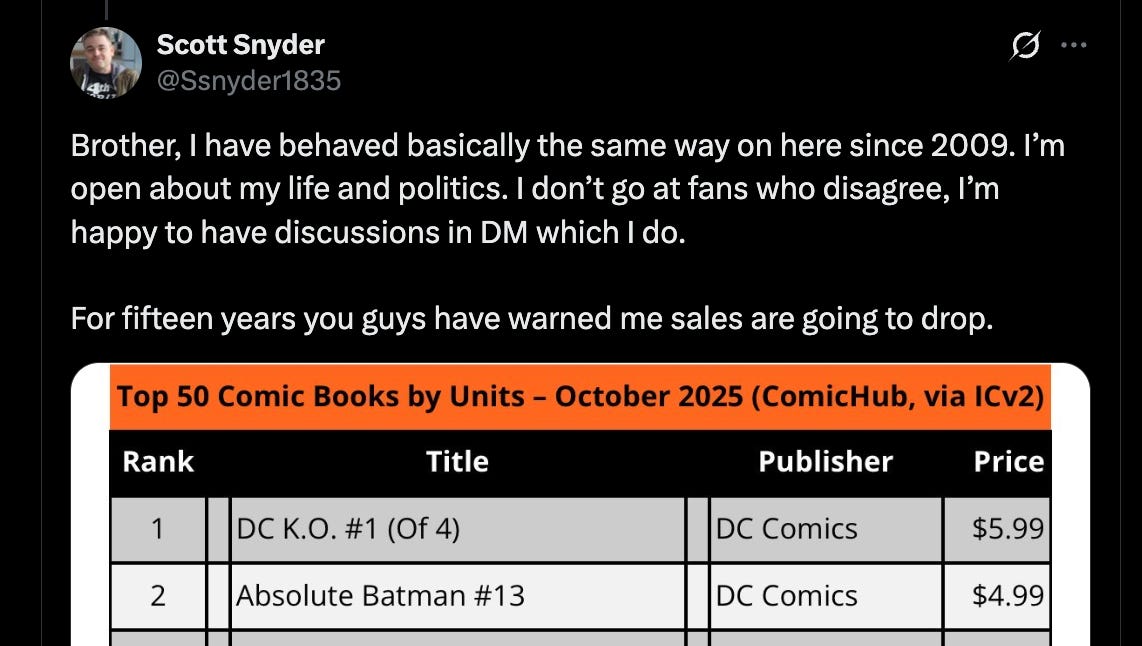
Widely renowned as one of the nicest people in the industry and revered for his enthusiastic representation of the comics field in good times and in bad, Snyder is not confrontational about his politics and consistently welcomes civil political dialogue with those that disagree with him. But Snyder’s also not averse to taking a victory lap in the face of his critics. Responding to one angry commentator who pushed him to stop posting about his politics by arguing that it was seeping into his comics and was going to hurt the industry by putting off Republicans, Snyder responded with a sales chart where the only comic that sold better than his Absolute Batman was another title that he wrote, DC K.O.
Of course, comments from some of these creators also contain equivocations or disclaimers or a focus on historical rather than contemporary analogies: Camp talking about WWII partisans, Gunn citing The Man in the High Castle, Snyder saying “I don’t ever want it to feel like a direct corollary to reality” and elaborating that he doesn’t want to “dilute” Absolute Batman’s “universal message about standing up for people” by including bald-faced commentary on current politics. Spencer Ackerman too has made clear that he wants his comic books to appeal to all readers regardless of their politics: “I hope I’ve done this in such a way that you don’t have to share my politics to like this book…. I want a story that provokes thought. I don’t want a story that tells you what to think.”
Ryan North similarly backed away from direct political analogy in discussing One World Under Doom. When an interviewer suggested that the comic’s interrogation of cults of personality spoke to America’s current situation, North protested:
That’s not [just] an American thing! …[One World Under Doom] is talking about world politics not in the sense of actual What’s Going on Today politics, but the idea of fascism versus more democratic approaches. You see a lot of that in history—not so much in the present, where we thankfully do have a lot of democracies—but going back a couple hundred years, where you have nations represented by kings and queens and individuals, and world politics was the relationships between these individuals and what they wanted to do.
Frankly, this vibes to me like plausible deniability, or a concession to corporate parents who might be nervous about direct political commentary. I can’t believe that Ryan North was primarily inspired by the past “couple hundred years” of authoritarian history rather than the authoritarian standing right in front of him in his own country right now. Rather, it’s clear from their shared focus on super-powered strongmen, white supremacy, and billionaire oligarchy that all of these writers are intentionally commenting, directly or indirectly, on American politics today.
The Historic Cycle of Political Superheroics
This is far from a new trend. Superhero comics are often criticized and rightly so as inherently conservative stories of might-makes-right where conflict is resolved and the status quo is preserved through righteous violence. But there is also a clear historic cycle of comic book heroes being used as progressive commentary on the politics of the day, starting with the very first superhero.
Superman debuted in Action Comics #1 in 1938, created by Jerry Siegel and Joe Shuster, sons of Jewish immigrants in Cleveland. Born at the historic pivot point between the Great Depression and World War II, the original Superman did not fight supervillains. Instead he fought slumlords, corrupt politicians, war profiteers, and abusive husbands. His first issue has him saving a wrongly convicted woman from execution, stopping a wife-beater, and confronting a crooked arms lobbyist. His tagline was “champion of the oppressed.” He was a populist hero for ordinary people against concentrated power, or as one comics historian bluntly put it: “He’s essentially a violent socialist.”
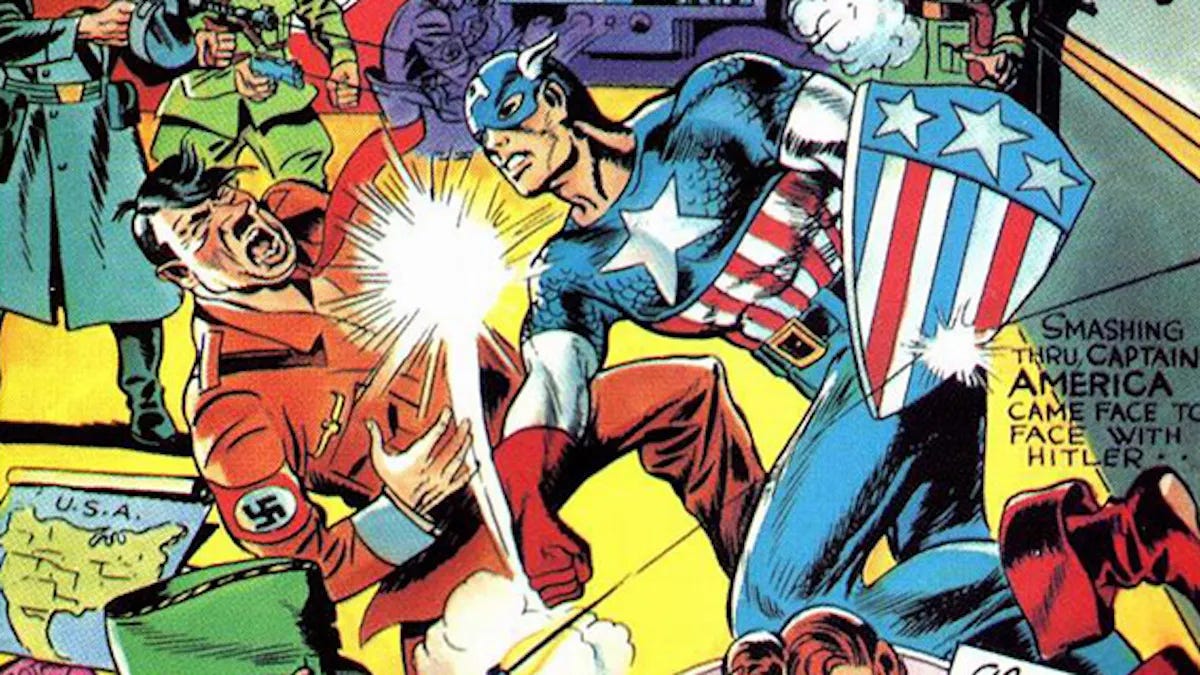
Comics were also anti-fascist before the U.S. was. Captain America Comics #1, by Joe Simon and Jack Kirby and published by Marvel predecessor Timely Comics, was published a full year before the United States entered World War II. Famously, the cover showed Captain America punching Hitler at a time when many Americans were still isolationist, or actively sympathetic to the Nazi cause.
The next generation of superheroes—the “Silver Age” Marvel heroes born of the early 60s—were not godlike paragons of virtue like DC’s Superman, Batman and Wonder Woman, but were instead monstrous radioactive freaks and geeks facing human-scale problems as well as super-powered threats. They were mutated outsiders who lived in “the world outside your window,” in particular a recognizable New York City, rather than DC’s fictional Gotham and Metropolis:
The Hulk was basically a nuclear-powered Jekyll and Hyde, a misunderstood brute in constant conflict with the U.S. military.
The Fantastic Four’s origin story reads as body horror when their bodies unpredictably (and especially in the case of the rock-bodied Thing, tragically) transform after being bombarded by cosmic rays.
Peter Parker is an outcast teenage nerd who is driven by guilt to become Spider-Man after failure to use his powers against a criminal results in the death of his Uncle Ben. “With great power,” taught Uncle Ben, “comes great responsibility.”
The X-Men were created as an explicit civil rights allegory, where a team of super-powered mutants led by MLK-analog mutant integrationist Professor Xavier is “sworn to protect a world that hates and fears them,” often in combat with the more militant mutant separatist Magneto and his Brotherhood of Evil Mutants (a ham-handed and admittedly offensive analog to more militant Black voices like Malcolm X and the Black Panthers, who unlike Magneto obviously were not genocidal mass murderers).
These bizarre new misfit heroes, often hounded by the establishment, became touchstones for the 60s counterculture, which rejected the comparably square and by that point campy DC heroes. The young left admired the Marvel heroes so much that in 1965, The Incredible Hulk and Spider-Man were both on a list of college campus heroes published by Esquire, “28 People Who Count,” along with names like JFK, Bob Dylan, and the Viet Cong.
DC caught up politically in 1970 with less campy, more socially-conscious stories like Denny O’Neil and Neal Adams’ series pairing the conservative “space cop” Green Lantern with the more street-level populist crusader Green Arrow. This superhero political odd couple embarked on a cross-country journey to see “real America,” where in DC’s own words, they “discover[ed] there are some evils that can’t be cured with a power ring or trick arrow, such as racism, poverty and drug abuse.”
Indeed, in their very first story together, Green Lantern #76, the two emerald heroes must face the scorn of an elderly Black man from the tenements who upbraids them for ignoring the plight of his community:
I been readin’ about you. How you work for the blue skins… and how on a planet someplace you helped out the orange skins… and you done considerable for the purple skins! Only there’s skins you never bothered with — the black skins! I want to know… how come? Answer me that, Mr. Green Lantern!
In response, Green Lantern only hangs his head in shame: “I… can’t…” Nor could Green Lantern or Green Arrow protect their junior superhero colleague Speedy, another super-archer like Green Arrow, from becoming addicted to heroin in a now infamous storyline that sought to humanize the country’s drug problem.
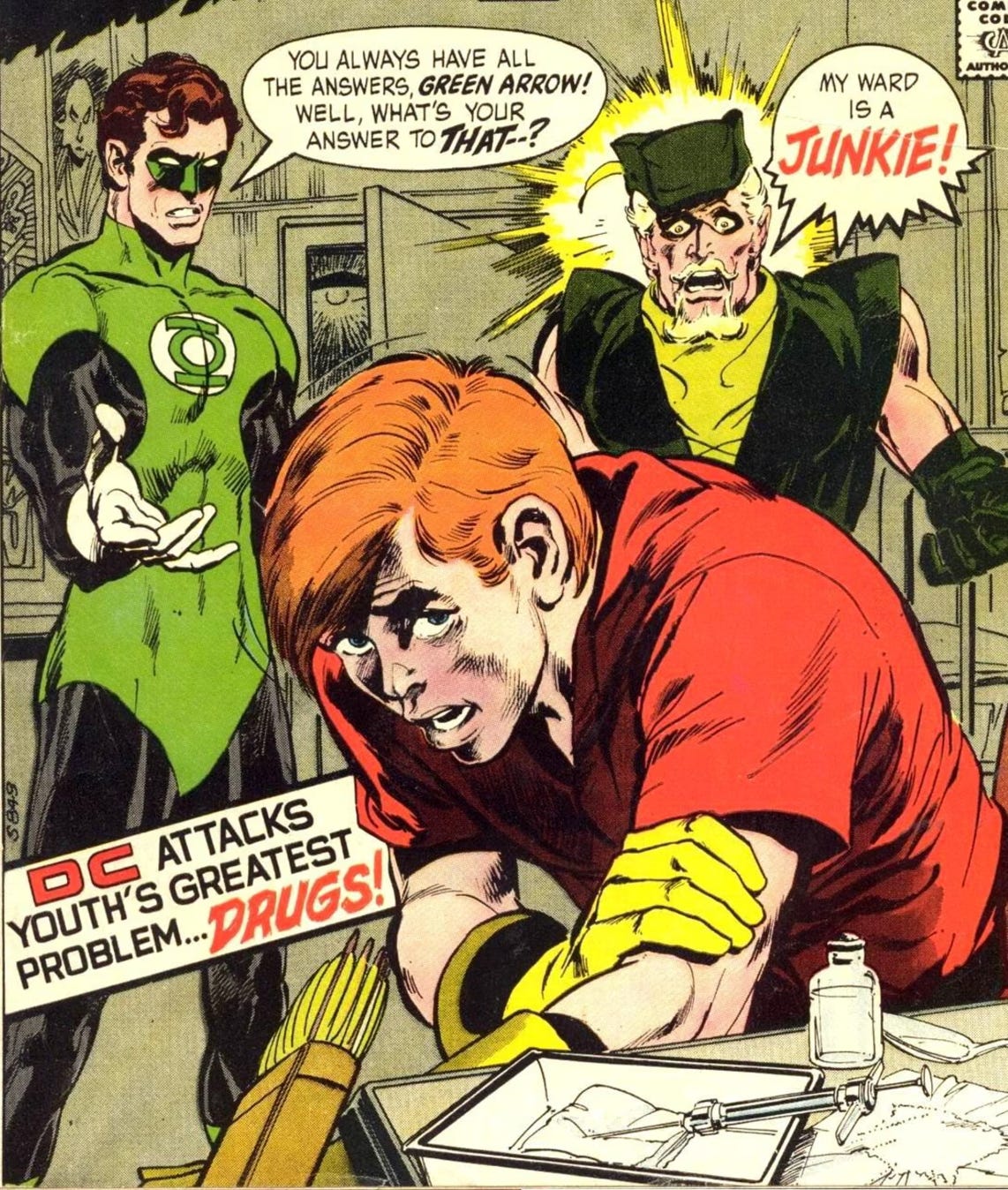
O’Neil and Adams closed out their “Hard Traveling Heroes” cross-country arc with the introduction of DC’s first Black flagship hero–a righteously angry, college-educated African-American architect named John Stewart who took on the mantle of Green Lantern–belatedly following in the footsteps of Marvel’s Black Panther who debuted in 1966.
Back at Marvel, into the 80s and beyond, the discrimination metaphor of the X-Men began to extend to LGBTQ people and other marginalized communities. The graphic novel God Loves, Man Kills (1982) set the X-Men against a genocidal televangelist, recurring plots around potential “mutant cures” read as analogues to conversion therapy, and a parent’s question to her mutant son in the 2003 film X2, “Have you tried not being a mutant?”, echoed a familiar familial refrain for a generation of gay people.
Suffice to say, comics have long had a progressive streak, one that recurs cyclically as the outside culture prompts it, and this cycle has continued into the 2000s. Most notably, Marvel’s Civil War miniseries by Mark Millar and Steve McNiven responded to the post-9/11 security state: after a superhero-caused disaster kills hundreds, the government passes a Superhuman Registration Act requiring heroes to register with the state or else be thrown into an other-dimensional black site prison without trial. The analogies—to the 9/11 attacks, the USA Patriot Act, and Guantánamo—were obvious. Yet the two-sided story also allowed Millar to take well-deserved aim at the entire idea of masked vigilantism as a solution to societal problems, also an inherently leftist critique.
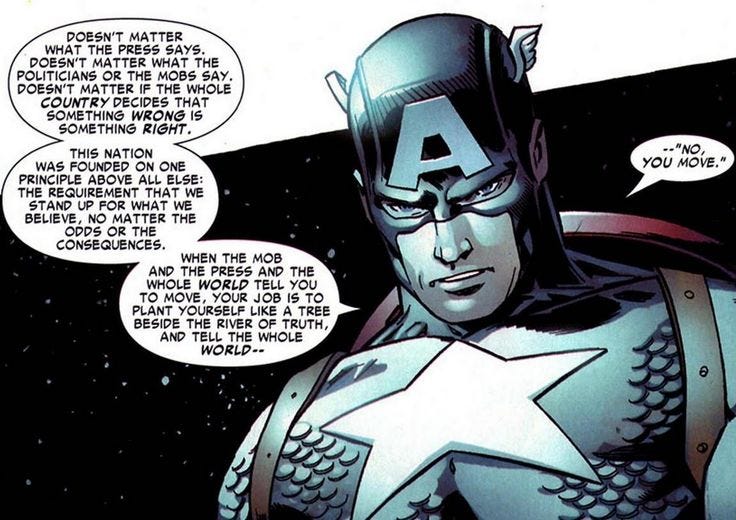
Millar has called Civil War “accidentally political”: “Obviously, there’s a certain amount of political allegory in a story where a guy wrapped in the American flag is in chains as the people swap freedom for security.” But the politics don’t seem accidental, any more than the modern Green Arrow taking on issues around race and police violence in the wake of the Ferguson uprising, or the Marvel vigilante anti-hero the Punisher responding to his skull logo being taken up by “warrior cop” police, “Blue Lives Matter” activists, and military operators as a celebration of lethal force.
The Punisher’s co-creator Gerry Conway took issue when his character was symbolically used to uphold state violence, calling cops who wore it a “disgrace,” arguing that “police should not be embracing a criminal as their symbol,” and likening Punisher skull stickers on cop cars to “a Confederate flag on a government building.” In a 2019 issue, the Punisher himself commented on the cops’ cooptation of his symbol: when admiring cops try to take a selfie with him, Frank give them a beatdown and tears up the Punisher skull decals on their car:
I’ll say this only once. We’re not the same. You took an oath to uphold the law. You help people. I gave all that up a long time ago. You don’t do what I do. Nobody does. You boys need a role model? His name is Captain America, and he’d be happy to have you.
The Punisher then reiterates that if the cops don’t follow the law, “I’ll come for you next.”
Clearly, the current anti-Trump trend in comics is really just the culmination of long-standing progressive strands of thought running through the nearly century-long tapestry of comics history. The online right may want liberal politics out of today’s comics, but those politics have always been there.
Comics as a Fast-Adapting Political Barometer
There’s a particular reason why comic books have often been more responsive to the immediate political environment than other mass media, and that’s because they are made so quickly. As described by star comic writer Grant Morrison, known for his contemporary takes on the X-Men, Batman, Superman, and the Justice League among many others: “the frequency of comics is so fast. There’s a turnover every month, so lots of stories are being told, and the comics are able to keep pace with culture and fashion in a way that movies and TV are too slow to do.”
Morrison and other comics writers have often highlighted how superheroes are a reliable barometer of the culture by virtue of comics’ production economics: a comic book goes from writer’s word processor to the reader within a matter of a few months, is made by many fewer people on an exponentially smaller budget requiring fewer layers of financing and approval, on a schedule that makes the pace of TV and film look glacial. As Morrison puts it in the introduction to their 2013 book Supergods:
The low production costs (pen and ink can conjure scenes that would cost millions of dollars of computer time to re-create onscreen) and rapid publication frequency mean that in comic books, almost anything goes. No idea is too bizarre, no twist too fanciful, no storytelling technique too experimental.
The speed of comics is what allowed Morrison contemporaries like Alan Moore and David Lloyd in the 1980s to respond with ongoing month-by-month disgust to the accelerating right-wing excesses of Thatcherism in V for Vendetta, their tale of revolution in the face of a future fascist regime, or Moore and artist Dave Gibbons to comment in real time on the growing cold war nuclear militarism of the Reagan administration in their classic miniseries Watchmen (although in that work, parodically, the President is a fifth-term Nixon). The same velocity and creative latitude gave Frank Miller the ability to viciously parody an increasingly senile Ronald Reagan’s nuclear posturing in his classic Batman tale for adults, The Dark Knight Returns, a caricature that Miller defends to this day as “a cartoon imitation of the absurdity of some of his excesses and, of course, his personality... sorry, he ran for that Office.” Asked if DC objected at all to his satiric portrayal of Reagan in the book, Miller replied succinctly: “No.”
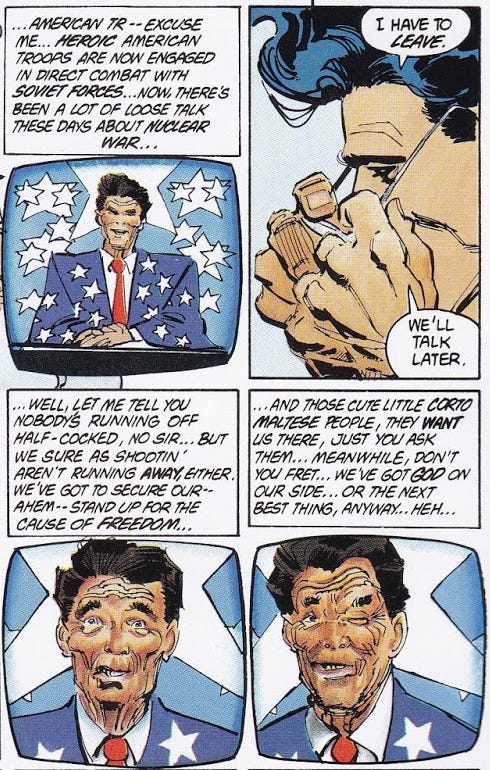
To sum up, the cheap and fast-turnaround cycle of comics publishing has meant that comic books are often more agile in reflecting changes in the culture, and in the composition and politics of its fan community, than other media. And over time, that community has grown increasingly diverse and therefore even more receptive to progressive politics in their comics.
The Increasing Diversity of Comic Book Fandom
A comics readership that in the 1990s was overwhelmingly white and male is now close to an even split by gender and much more racially varied, a shift that academic Michael Goodrum ties directly to the industry’s move toward more diverse characters and creators. As in other areas of media like games and science fiction, this has turned the comics field into culturally “contested terrain” as demonstrated by the “Comicsgate” harassment campaign that arose in the late 2010s to target women, creators of color, and LGBTQ creators.
However, as anyone who has attended a modern comics convention can see, these reactionary factions have mostly failed to lessen that community’s distinctly welcoming approach to comics fans of all kinds. Although some elements of comics fandom are still insular, hardcore comic nerds are if anything a population that’s well-acquainted with being culturally excluded, and therefore they’ve worked hard at creating inclusive spaces regardless of race, gender, or ability (or whether you are a Marvel fan or a DC fan or an anime fan, for that matter). For lack of a better term, comics fandom these days is pretty damn woke.
This demographic and political shift is evident not least from the simple fact that all the comics I’ve discussed in the current wave of anti-Trumpist, anti-billionaire, anti-supremacist superheroes have been hits, ranging from modest to massive. The comics audience is buying what these progressive creators are selling—which helps explain why these creators are being given the creative and political latitude that they are.
So, the fact that today’s politically-tinged comics are making money is certainly one reason they’re getting made. But the fact that they don’t make money—at least compared to other mass media—is also a likely reason.
Why Comics Have Flown Under the Corporate Radar…So Far
In comparison to other mass media, the size of the market for monthly comic books—in terms of audience and in terms of dollars—is tiny. So is it that surprising that the corporate overlords of these comics businesses aren’t paying much attention, especially when the comics publishers are making a modest profit while also serving as a cheap IP feedlot for film and TV screens?
Data is hard to come by—industry rankings of sales like those published by ICv2 don’t give unit numbers—but combined with occasional PR from the companies when bragging about orders on particular titles, it’s not hard to reverse engineer the basic scale of sales. And that scale is quite small.
Putting aside the Absolute titles which are now breaking records, a very successful Marvel or DC title (which usually retails for $3.99 - $5.99) maybe sells around 100,000 copies per month, and the vast majority of titles sell far less. For example, Ben 10, the seventh biggest selling title in ICv2’s May 2026 numbers, initially moved only 82,000 copies. Marvel releases no sales figures at all, but estimating based on its chart positions (e.g. 16th in ICv2’s store-level chart for March 2025), The Ultimates likely sells roughly 40,000—60,000 copies an issue. The average weekly single-issue print run of comics titles was a mere 12,000 to 22,000 copies in 2024.
Even the biggest hits still only sell six figures worth of comics monthly: Absolute Batman #1, the best-selling comic of 2024, sold just under 400,000 copies across all printings, while in June 2026, Absolute Batman #20 passed 500,000 copies, matching the best-selling Batman single issue ever. But these are outlier numbers that are so big as to be contributing to a recent boom in foot traffic into comics stores—along with the next generation’s hunger for Japanese manga and young adult graphic novels. This all translates, at best, to a few hundred thousand people in the US who are regularly buying weekly comic books.
The network of comics stores that sells almost all of these monthly periodical comics (or “floppies”)—otherwise known as the comics direct market—is commensurately small. Again, hard numbers are hard to come by, and because of the recent boom the number is growing, but conventional wisdom is that there are over 3,000 of these shops globally, with roughly 2600-2800 of those in the US as of 2025 (down from 3,100 to 3,300 in 2021). By comparison, there were over 10,000 traditional bookstores in the US in 2020 based on census numbers. A very small proportion of monthly comics are sometimes stocked on the newsstands in those regular bookstores, but the days of ubiquitous comic spinner rack at drug stores and groceries ended decades ago. The comics direct market is a small niche market catering to a small niche audience.
Looking at the numbers, floppies generated $460 million in North America in 2024, which ICv2 called “a 15-year high.” ICv2 later reported that 2025’s sales boomed by 30% year over year, implying a total around $600 million. That is the entire format: every Marvel, DC, Image, and indie single issue combined. Japanese manga sales alone in the same geographic market rival that entire number.
For comparison with other media, let’s put that in terms of unit sales: at ~$5 average cover price, $460M translates to something like 90 million floppies sold in a year total, across every title and publisher. Meanwhile, U.S. bookstores sold around 750—800 million print books and movie theaters sold about 800 million tickets. In other words, the American periodical comics industry moves about as many units (and at much lower prices) in a year as the regular book trade or box office does in six weeks.
Comparisons to TV especially show just how miniscule this market is in relation to the markets that Marvel and DC owners Disney and WB really care about. The entire floppy market will make in a year about what the streaming industry, which had about $113.3 billion of revenue in 2025, will make in a day or two. The highest selling single comic of the year with 500,000 readers—a freakishly huge outlier—has an order of magnitude smaller audience than a single episode of the 112th highest rated TV show on broadcast, cable, and streaming, which in 2024-2025 had an audience of about five million people. That same audience of that one middling-rated show on one night is also an order of magnitude bigger than the entirety of the comics direct market audience that regularly buys periodical comic books.
So: small potatoes. Very small potatoes. All of which means the corporate mothership probably isn’t paying all that much attention to the specific content getting published in these few monthly pamphlets serving a relatively tiny nerd audience. That translates practically into a great deal more creative latitude compared to all those other forms of media, which both cost and make infinitely more money. Presumably, the big bosses just haven’t been paying that much attention, except when it comes time to adapt those comics into the TV shows and movies that make the real money.
But that may be changing now.
VI. Will Comics’ Anti-Authoritarian Streak Be Allowed to Continue?
As outlined above, the comic book publishers have likely been given a lot of latitude—or, more accurately, been benignly neglected—by their corporate parents such that no one has really noticed or cared much about the obvious political bent of today’s biggest comic books. But there’s reason to think that may soon be changing.
First, there is the Ellison family’s attempt to merge Paramount Skydance with Warner Bros. Discovery, which owns DC. We’ve already seen how the Ellisons’ obvious Trumpist allegiances have impacted CBS: Stephen Colbert’s Late Show was cancelled less than 48 hours after the comedian called Paramount’s $16 million settlement of a baseless lawsuit by Trump “a big fat bribe,” while 60 Minutes’ sterling journalistic reputation has been trashed by new CBS News editor-in-chief Bari Weiss’ transparent political biases that have led to stories embarrassing to Trump being blackholed along with the reporters behind them. At the very least it would seem that if the merger goes through, James Gunn’s influence over the politics of DC’s screen adaptations is not long for this world. But considering the continued importance of DC Comics to fueling those adaptations, it would not be surprising if an Ellison regime would lead to distinct changes in political perspective there as well, with corresponding changes in content. We won’t know until the state attorneys general’s lawsuit to stop the merger plays out; trial has been scheduled for March 2027.
In the meantime, big changes are also happening at Marvel Comics. It was just announced in July that a seismic shift is coming: the editorial offices of Marvel that have been based in New York City since the founding of the company are being moved to Los Angeles, to be closer to the Disney corporate headquarters and to Marvel Studios which is also now in charge of the Marvel publishing arm. That move is anticipated to be completed within one year, by July 2027. How will that move change how Marvel Comics is governed and how closely its content is monitored? We’ll have to wait and see, but it seems reasonable to expect more direct control from the corporate parents when they’re literally in the office next door.
I’ll admit that I’ve had mixed feelings about even publishing this article at all, for fear it would just bring more scrutiny on these relatively small publishing companies and their progressive creators from these naturally (and in the Ellisons’ case, unnaturally) much more conservative corporate behemoths. But security through obscurity is usually a losing battle, whether we’re talking about maintaining cybersecurity or creative freedom, and if we aren’t clear about what’s happening, we also can’t help defend it when push comes to shove. And from where I’m sitting, the creative freedom of the comics industry is absolutely worth vocally defending. Indeed, it may be the one mass medium still left, as marginal as it is, that can freely speak truth to power in an increasingly authoritarian era. When cowardly corporate leadership comes to try and shut these comics creators up, the fan community whose dollars those companies rely on to keep their comics IP generators alive will need to be ready to defend them.
The villains already won. That’s why we all need to be heroes, now. Who’s ready to step up?
amazing work here, Kevin. Enjoyed this one.